 Home Library Audio-Visual Consultant Life Coach Links Website all my own work. It has some 500,000 words and many links to check. If you find mistakes I would be pleased to know. |
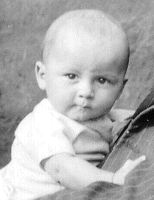
Hypnosis for BeginnersDylan MorganEildon Press THIS ALSO AVAILABLE IN PAPERBACK for those who prefer a traditional book that they can read anywhere. You can find it via your bookseller or Booksort.com or myself. This is an enlarged version of the well-received first edition, nearly twice the length (73,000 words). Perhaps the most sought-after new material is a chapter on self-hypnosis. The first edition is still available here. NOTE: The contents of each chapter are summarised in the Chapter Headings.INTRODUCTIONTHIS BOOK, as the title suggests, is aimed at beginners and people who do not believe in things without good evidence. (I am one myself.) The best evidence is something that you can check yourself. This book gives a large number of things that you can do, starting from scratch, and also helps you to make sense of what you will find. It is perhaps ideally suited to students on a course in hypnotherapy who have an active interest in using hypnosis later in helping people. It will be of great interest to students of psychology as it will teach them a lot about the way that people's minds and bodies work from a slightly more practical angle than is common in textbooks. It should interest anyone who is motivated to have a more-than-average understanding of people - themselves and others - and of the ways they can be affected. It will also interest those who wish to use some of that knowledge to help themselves through self-hypnosis. It might also be of value to those who are already using hypnosis because it has a fresh approach to the whole subject. There are many hundreds of books that will tell you what to do. This book is pretty much alone in giving an understanding of what you are doing It is quite practical, with many suggestions for things that you can do. (Though any particular reader is likely only to attempt a proportion of them.) But there are a number of things that you will not find in the book. It is not a history of hypnosis or hypnotism: the best source for that is probably Alan Gauld's book The History of Hypnotism. It does not teach hypnotherapy (clinical hypnosis) - though it is a very useful grounding in basic techniques. If it is at all possible, you should attend a proper school, of which there are many these days (in the UK at least), to learn hypnotherapy. But for a deep understanding of hypnotherapy I have written the more theoretical Principles of Hypnotherapy (Eildon Press 1996). It is not a primer in stage hypnosis. I am uneasy about the use of hypnosis on stage, where it seems to me that it is used to make people behave in a less-than-human way. It is not simply a rehash of earlier books on hypnosis. It is a fresh approach which offers insights that you will not get elsewhere. The book is based on a few simple principles. One is that hypnosis does not exist in some little isolated world of its own, somehow detached from all other human behaviour and experience. Stage hypnotists have a vested interest in making it appear so, for it then makes their performances more wonderful. But an unfortunate side-effect is that it cuts hypnosis off from millions of normal people. I hope to reach others who, like myself, have a healthy scepticism of things that stand far away from their normal experience and which do not have a clear explanation. You will therefore find that at very many points in the book I link hypnotic phenomena to our daily experience of related things. I would hope that the reader who starts this book with an openly sceptical attitude to the whole subject will end it thinking, "Well, I can now see what it is all about. It is not that different from things I have met in life. I can now see that it is just a matter of taking some of those things and working with them skillfully. Wish I had the time to learn the skills." My next principle is that I do not want you to take anything I or anyone else says on trust. I want you, as far as possible, to check things out for yourself. To my mind the fact that this is possible makes hypnosis a wonderful field of interest. If I am learning almost any other subject I have to accept the facts and opinions given me by other people 99.9% of the time. In this field you do not need any expensive equipment to check things out for yourself. You do not need to spend hours in the library mugging up on what all the authorities have said down the centuries. All you need are some people - friends or family or colleagues or fellow-students - who will give you some of their time and you can find things out for yourself. Since other people are nearly always the most interesting other objects in the universe, as well as being pretty common, you will find yourself doing the most fascinating of things. Because of this emphasis on finding things out for yourself this book is filled with ideas of things to try, each taking between a few minutes and perhaps half an hour. Some of them you can do by yourself - your brain is just as good as anyone else's for this purpose - others, of their nature, need a second person. In some cases you can, with a little ingenuity, be both people by using a tape recorder. You can at one time record in your own voice the part of one person and later play it back to yourself in the part of the second person. But on the whole most of the book will be more interesting if shared with at least one other person. Those readers who are using this book as part of course on hypnosis will have the advantage of large numbers of interested fellow-students to work with. They will very easily be able to verify conclusions of mine regarding the wide variation in responses from different people. The third principle around which the book is constructed is the only element that I am taking from established science. It is that the brain and nervous system are organised into complex subsystems. One system deals with movement, one with vision, one with sexual activity and so on. Each system commonly has subsystems. Thus the part of the brain that deals with sensations from the body has separate areas to deal with sensations from the tongue, sensations from the hands, and so on. I regard this general principle as non-controversial, though I have not, of course, been able myself to check all the century or so of research which has gone into arriving at this conclusion. But I find that if I start with this simple idea then it makes it possible to structure all that I find in hypnosis in a very natural and satisfactory way. You will find out if it also does this for you. It might seem natural to start this book with a definition of hypnosis, but I think it is better to leave it until the final chapter. By then the reader should have acquired a good idea of what the definition means. Chapter 1. Simple Connections.Summary: We explore some basic facts about the way in which the brain and body work. Specifically the reader is encouraged to discover by actual experience how words and images can activate other systems in the brain which relate to feelings, muscles, senses, sense of balance, etc.. These are compared with "tests of hypnotisability" and "hypnotic inductions". They are also linked to our common experience of learning a variety of other things. ENTERTAINMENT hypnotists love to make hypnosis look dark and mysterious and complicated. They love to pretend that they have special powers that no-one else possesses. I love to make things bright and clear and open, and I do not claim any special powers. Throughout the book, starting a few paragraphs ahead, I am going to ask you to try out various things and to think about them. These things are simple and everyday, and will turn out to be not at all mysterious, and yet they are a foundation on which much of hypnosis is built. We understand new things best by relating them to familiar things. We understand complicated things by relating them to simpler things. This chapter contains simple and relatively familiar things. In later chapters the understanding of this chapter will lead on to a deeper understanding of hypnosis. We also learn best by doing. So this book is full of things to do. If some of them seem to you to be rather elementary things, it is worth remembering that on most courses that teach worthwhile things you have to start with some very elementary things.A mathematics course may start with simple addition. A dressmaking class may start with just a series of simple stitches. A football course may start with some simple fitness exercises and so on. But if you master these elementary skills then you are in a position to do very much more complex and worthwhile things. Words can trigger pictures in your mind.This must seem a pretty obvious fact. You need only think of reading a novel, and remember the pictures that come to mind as you do so, to confirm it to yourself. But it is still worth doing a little exercise on it, as follows. First just think to yourself, "I am on holiday." STOP NOW. Did you see a picture of it in your mind? People vary, but it is unlikely, in the very short time I allowed you, that you saw anything very clearly. Now allow yourself more TIME. Think, "I am on holiday." Pause for quite a few seconds to give the thought time to flower. "It is my favourite kind of place." (Pause.) "The weather is just how I like it." (Pause.) "I am wearing my favourite clothes." (Pause.) "I am doing my very favourite thing." (Pause.) "I am on holiday!" In each case, and throughout the book, the word "Pause" is used to indicate a period of some two to five seconds. In all probability that extra time was repaid by a very much more vivid picture or pictures in the mind. But it is best, especially if you are a student of hypnosis, to get someone else to do the same thing, perhaps with you saying the words: "Picture yourself on holiday." (Pause.) "It is your favourite kind of weather." (Pause.) etc.. Afterwards ask them about what they saw. In this way you will discover for yourself the fact that people can have quite different degrees of clarity of picture, and the pictures themselves can be quite different. I, for example, usually manage only very washed out images, at best, but you will probably find that I am the exception rather than the rule. The conclusions I would expect you to be able to agree with, after some experience, are the following simple ones. 1) Words can lead to pictures in the mind. The next exercise explores the extent to which words can directly affect muscles without going via the usual volitional process of willing an action. Hold your arms straight ahead of you with the palms facing each other and a couple of centimeters apart. Look at the gap and say "Close... Close... Close..." repeatedly at a comfortable speed. A typical result is that over a period of a minute or so the hands do move together until they touch. They will do this without any sense in you that you have willed it. There is no effort at all. To check this, try it on other people (for students it is essential that you do). In that case you can speak the words as you both watch the hands. In this way you will discover that there is again a range of responses. An average closure time is a couple of minutes. In some people it will happen in seconds. In others nothing seems to happen before you run out of patience, or their arms get exhausted. Occasionally someone will resist and there will develop a trembling in the arms as one set of muscles acts to pull the hands together and another acts to separate them. Another, much rarer, response is for the hands to move apart! (Which I usually interpret as a deep-seated compulsion to resist any external influence.) But in each case you or your friends should find a strange feeling of things happening which are not willed. The conclusions I would expect you to be able to agree with are the following simple ones. As a third example you might see how words can lead to activation of the sense of touch. In particular they can make an itch arise. All you do is to repeat to yourself, "There is something itchy on my nose." (Pause.) "There is something itchy on my nose." (Pause.) Repeat this for up to a couple of minutes. It is valuable to try the same thing with other people, with either the other person or you saying the words. The most likely result is for an itch to be reported and perhaps scratched within that time, but again you should find considerable variation. The time taken will vary from seconds to longer than the time allowed. Some people will find an irresistible urge to scratch because the feeling is so intense. For others it will be quite mild. Oddly enough in some people the itch may arise somewhere other than the nose. But as a result of these experiences I expect that you will be able to agree with the simple observations: 1) Words can lead directly to a sensory impression. In the above three examples we have started with words. Now we move on to see the effect of mental pictures. Here is a way of seeing if a picture can lead directly to a muscular action. Let your hand rest freely and comfortably on a surface such as table, chair-arm or your leg. Imagine a ribbon tied to the end of your index finger. Picture the other end of the ribbon being held by someone you like, whose hand is about a metre above yours. They are trying gently to lift your finger without you feeling the ribbon at all. Keep the picture in your mind for a few minutes, closing your eyes if it helps you to picture things. A typical response is for nothing to happen for a while, and then the finger starts to twitch slightly and then slowly to lift up into the air. (This type of response is sometimes called "finger levitation" in books on hypnosis.) Students especially should try this out on other people in various ways. You can ask them to go through the exercise as I have suggested that you have done. Or you can be the "friend" lifting the finger by means of an imaginary ribbon which you are holding. In that case they place less of a strain on their imagination. They will be able to see you, and your hand lifted as if you are holding the ribbon. It is only the ribbon that they will need to imagine. You can expect to find that the time taken varies, and the nature of the movement can also vary from very jerky to very smooth. In some cases there may be a sideways movement rather than a vertical one. At the end of a series of such trials you can decide if you agree that: 1) Mental pictures can lead directly to muscular activity. Now how about seeing if pictures can give rise to feelings? When you consider the billions of dollars made by a film industry whose main purpose is to create images that will arouse emotions of a variety of kinds, it should not be very surprising to you that this can happen. But it is as well to try something on the following lines to explore the ways in which internally generated mental images can do the same thing. The simple approach is to picture a person or situation that normally arouse strong feelings in you. The person could perhaps be someone that you hate or love or fear. The situation could perhaps be one that you find erotic or embarrassing or exciting or frightening. In any case after you have decided on ONE (do not jump about) keep the picture or pictures of your chosen topic in front of your mind for a minute or two. As usual, students should also get a number of other people to do the same exercise. The normal reaction is for a quickening of the breath and an increase in heart rate and adrenaline production. These are part of the body's normal response to any moderate to strong emotion. In addition there will be the particular sensations associated with the particular emotion that you have chosen. These are harder to describe but are usually unmistakable. For example fear and excitement produce pretty much the same physical responses - heart, breathing, adrenaline - but one is accompanied by a strong feeling of unpleasantness while the other is very pleasant. You are likely to find that different people respond in a range of different ways. In some there is only a very slight effect. In others it can be quite dramatic and rapid. The scenes chosen will of course also be very different. At the end of this you should have been able to confirm for yourself what I will call the Standard Finding in future since the pattern should by now be clear: 1) The effect does happen. Now we might try the effect of a picture on a sense: perhaps asking if a mental image can affect the sense of balance. The following is one possible way. Think of a situation in which you are rocking or swinging, such as in a small boat, a hammock, a swing, a rocking chair, a rocking horse or so on. Sit comfortably upright with closed eyes and picture the chosen situation for a few minutes. Notice any sensations of movement. You can try a similar thing on others. You should not be surprised by now to find people responding differently. Some will not only feel themselves moving but you will also see their bodies move. At the other extreme some will report nothing. Again check to see if your experiences confirm the pattern of the Standard Finding: 1) Mental pictures can stimulate activity in the sense of balance. At this stage the pattern revealed by all these experiments should be quite clear. It amounts simply to this. Activity in one part of the brain (verbal or visual in the examples we have done) can lead to activity in other parts (in the above examples: visual, emotional, nerves connected to muscles, nerves connected to the senses). The speed and nature of the connection varies from person to person. As a final explicit example here I would like you to explore the following connection. It leads from the kinaesthetic sense (a sense of position and movement - of arm in this case) to the involuntary activation of some arm muscles. Simply get your friend to close his or her eyes. (So that they cannot see what is happening, and so vision is not directly involved.) Then without saying anything (so that words are not involved), simply lift up one arm slowly and lightly by the wrist until it is being held in one position in space. You then gently move it up and down very slightly and lightly around that position, so that the arm is given quite strong sense that it somehow "should" be in that position. You should find that over a minute or so the arm starts to feel lighter and lighter as its own muscles take over the job of keeping it floating in the air. Eventually you should be able to leave it there and it should remain there with no effort or complaint from your friend for some considerable time. Check for yourself, as always, the usual Standard Finding: that the effect happens, takes time and varies from person to person. I hope that you do try these things out with other people. We nearly all make the unquestioned assumption that since we are all human beings our inner, invisible workings are basically identical. You should find, as I have, that there is in fact a great deal of variety, more of which should be revealed as you progress through the book. If you would like to experiment with other connections then you will find other suggestions at the end of the chapter. What has all this to do with hypnosis?My first reason for looking at such things is that these phenomena, and many other like them, are presented in many other books on hypnosis as examples of fundamental "hypnotic phenomena". Take for example the involuntary rising of a finger. This is often presented as something that is happening as a result of a "hypnotised subject" obeying the suggestions of the "hypnotist". The other examples I have given can also be presented in that light. This chapter should show that these simple phenomena do not, in fact, require anything very much out of the ordinary. They can be achieved in many people with no special powers or skills, no "hypnotic induction", no special techniques. The main requirement is patience! My reason for looking at the phenomena in the simple way above, with no "inductions" or any of the other trappings of hypnosis, is to be able to base the whole science on simple and observable phenomena. I believe that this makes for clarity of thought. (My initial training was in the physical and not the psychological sciences.) I have said that these phenomena and things like them appear in older books on hypnosis. They do so in one of two main guises. These are as parts of an "Induction Procedure" or as "Tests of Hypnotisability". I will discuss these different ways of looking at them and then compare them with the way I tend to look at them. You may then come to your own conclusions. It can be helpful to know that in the past there were two schools of thought about hypnotic phenomena which were labeled "State Theory" and "Trait Theory". Those who belonged to the State school maintained that hypnosis was a "state" that people could be "put into". I suppose that they thought of it as being like a "state of sleep" or a "state of fear" or a "state of being in love" or a "state of subservience". This approach naturally encourages you to think of what the hypnotist has to do in order to put someone into that state. And each hypnotist or hypnotherapist had his (or, very rarely, her) own procedure, which consisted of stringing together a number of steps, each of which was an item of the kind mentioned above, or of a slightly different class that we will meet in the next chapter. A hypnotist might start by using words to act directly on the muscles of clasped hands to make them lock together. He might follow this up by getting someone to stand vertically and then act on the sense of balance to make them feel that they were falling, while simultaneously using words to activate all the muscles of the body to make it rigid. He would then catch them and lower them, rigid, to the floor. Further steps were taken of a similar kind. The cumulative effect would be to create and enhance the idea in the mind of the "subject" that they would do whatever he said. This then made it possible for the hypnotist to suggest increasingly amusing responses. (It is perhaps worth noticing that he would never, however, have the power that the army Sergeant achieves with months of training: HE can use one word to get a man to walk forward into a hail of death-dealing bullets!) You will find more on Induction Procedures later in the book, especially in Chapter 5. Opposed to the State theorists were the Trait theorists who said that far from it being the case that power lay in the hypnotist, all that was happening was that a natural capacity or trait in the subject was involved. On this view, hypnotisability is something like introversion, or IQ, or musical ability: it is something innate in the individual, and can be measured by various tests. As far as I know the first of these tests were developed at Stanford University from around 1960. What did they consist of? Well, very much the same sort of thing that we have seen above, together with items that will appear in later chapters. A typical Test would consist of a short sequence of items of this kind, and a scoring method such as: "Score +1 if the hands move significantly together within 2 minutes. Score +1 if the subject scratches face within 1 minute. Score +1 if there is significant arm catalepsy (rigidity) as assessed by the difficulty experimenter has in bending it." People who collected a high score on such a test were regarded as being very hypnotisable. Those with a low score were regarded as being poorly hypnotisable. If you are interested in more detail you can find an example of such a test given in some of the more academic books such as Hilgard & Hilgard Hypnosis in the Relief of Pain, Kaufmann, (1975) However, those tests were made to look more like hypnosis because there was a standard introductory "induction" before they were made. When, later in the book, I have discussed inductions, I will be encouraging you to compare the results of suggestions before and after an induction. If you come to the conclusion that nothing that you say to or do with your "subject" in the preliminary stages makes any difference to their response to the little experiments then you will probably tend to agree with the Trait Theorists: you are dealing with an innate property of their minds and bodies. If, on the other hand, you find that your initial induction or preparation of the subject makes quite dramatic differences to their later responses then you will be more inclined to side with the State Theorists. Entertainment hypnotists, a band not renowned for their interest in theory, act as if they came from both camps. In the earlier steps of their acts they typically use one item - usually one of forcing hands to stay clasped - to select from the audience those with whom they could expect the best results. Implicitly this is saying, "I can do little without a good subject." (Which is essentially true, but not something they would want to broadcast.) Then, in the latter part of the performance, they proceed as if, "This is all my doing. I am putting you into a state of hypnosis through my power." (And it is true that they are using certain skills to get the subject to do things that would not normally be in their repertoire.) What this shows, it seems to me, is simply the Standard Finding as applied to the suggestions of the Stage Hypnotist: He does achieve the effects, but it takes him time to build up to the more dramatic ones, and they can only be achieved easily in some people. If you watch carefully, you will also see that some of his subjects will do well on one of the tricks but not on another. In recent decades the State vs. Trait argument seems to have died down, with neither side having won a victory. Most practising hypnotherapists would accept that there is some truth on both sides and get on with their main job of helping people. The way I look at things is as follows. I start with the scientific fact that human brain, like human society, is very complex. (There are some twenty times as many neurons in the human brain as there are people on earth.) Furthermore it is divided into a variety of subsystems. Some cells in the brain are organised into a system that deals with vision, for example. Other cells are organised into a system that handles speech. Others, again, handle movements. Now these subsystems are not totally independent of each other. They are interconnected. They can affect each other. I then view the above experiments as simple examples of the general and non-controversial truth that one subsystem of the brain can affect others. For example activity in the verbal part can lead to activity in the visual part - words can activate pictures. They also show that people have their mental systems somewhat differently connected. And they show that the speed and the nature of the connections varies from person to person. You do not have to see things in that way, but while reading this book you should know that this is how I view things. I find that all of the steps of Induction Procedures create or use such connections between systems of the brain. I find that all of the Tests of Hypnotisability involve exploring how easily the connections between various systems can be created or utilised in a given person. If you want to say that that it is a trait of a given person that a particular pair of subsystems interact in a particular way, then I would largely agree. I would, however, argue that since it is possible to learn to alter the nature of the connections, the trait cannot be regarded as fixed. If, on the other hand, you want to call what happens when a particular collection of subsystems is active and interacting, with others inactive, "an hypnotic state" then I would not object. However, I would simply note that it has proved impossible to find ONE such collection, so that you have simply found one of many possible "hypnotic states". (For example, there are hypnotic "states" which involve a great deal of visual content, even to hallucinations; others that centre only on muscular responses in which there can be no pictures in the mind at all; and there are countless other possibilities.) In practice I avoid the use of the word "state" myself because of this vagueness, preferring to be more precise and instead to describe what is happening in a particular person at a particular time by giving as detailed a list as possible of what systems are active and inactive, and how they are interconnected. There IS, nevertheless, a family resemblance in what is going on in the minds of people who are regarded as being "hypnotised", characterised by the following facts. Most of the mental systems that deal with the outside world, other than listening to the hypnotist, are inactive. There is a greatly increased focus and attention to the words of the hypnotist. It commonly involves an increased activity in certain internal systems such as the visual imagination. There is a great reduction in mental resistance to suggestions made by the hypnotist. There is an increased rapport - an inclination or desire to cooperate with the hypnotist. All of these aspects will be dealt with in more detail in later chapters. If you do not quite understand them at this point, do not worry. However, I regard that as a broad generalisation, not a precise definition. Within this broad generalisation you can have people with very different kinds of mental activity. Some may be aware of intense internal pictures, perhaps of the past, or of a part of their body (one client of mine saw himself walking through his soot-caked lungs), or of certain sensations, or of feelings, or of the absence of sensations, or of floating, or of nothing except my voice, or of scents, or of a dead relative, and so on. The brain waves of such people will be significantly different; their experiences will be quite different; their internal chemistry will be quite different. There is too little that they have in common to make it very useful to use just the one word "hypnotised" to describe them. Nevertheless, the generalisation that they all tend to have a very focussed or limited awareness or attention compared with normal, outward oriented functioning makes a useful step towards the matter of the next chapter. You may have already noticed, if you have performed the above experiments, something that a later chapter will deal with in more detail: that the phenomena arise most effectively if the mind is focussed; if there are no distracting thoughts; if there is nothing else distracting happening. In other words it is best if there is no other mental activity: if other mental and physical activity is switched down or off. In the next chapter we will be exploring, in the same practical way, examples of this "switching down" to complete our survey of the elementary building blocks of the practice of hypnosis: the fact that changes in the activity in one subsystem can lead not only to an increase in the activity of another, but also to a decrease. I also find that this way of thinking in terms of the connections between systems is invaluable when it comes to analysing and solving the human problems that fall in the domain of hypnotherapy. A phobia, for example, can be understood as the existence, in a particular person, of a connection between the picture or idea of something feared and the emotional system of fear. If the idea becomes active in the mind then it activates the fear. Notice that, as in the above examples, we would not expect the link to be the same for everyone: people vary tremendously. If we want to change this state of affairs it is best to start with a clear idea of what two parts of the mind are involved. Hypnotic techniques will then be used not, as we have been doing so far, to forge a link between those two systems, but to weaken or remove it. At other times the hypnotherapist does forge new links between systems. For example, think of the way in which in some people it is possible using hypnotic techniques to help them to overcome an unwanted habit of smoking by connecting the thought or smell or taste of tobacco smoke with the activation of the nausea response. "The very sight or smell of a cigarette will make you sick." This can be made so clear and strong in some people that it is more than enough to ensure that they do stop smoking. It should be clear that the creation of such a connection is very similar in principle to the sort of thing that you have already explored in this chapter. In line with the experiments described earlier you might perhaps say to a friend who smokes something like the following. "Experience as clearly as possible the most significant aspect of smoking to you." (For some it would be a picture, for others a taste or a smell, or the sense of holding one in fingers or mouth, or of the feeling in the throat, or lungs or body.) "Then just notice if this leads to a sensation of nausea." You then need only say enough to keep their minds on the possible association for a minute or two, rather like the itch. Then, as in the other little things we have done, you will find some smokers experiencing a strong feeling of nausea, others a mild one and others none at all in the time. With the first class of people the experience can be strong enough to significantly reduce their desire to smoke even if they do not stop. Although we will later find ways of intensifying this sort of thing, you should by now see something of the value of starting with the simple approach of this chapter. Of course in real life you would not even need to suggest an imaginary cigarette. You could just talk quietly to your friend as he or she is actually smoking. "What is it doing to you?" "You once said that the first one you ever smoked made you feel sick." (Pause.) "Do you remember?" (Pause and wait for some assent.) "Does this one make you feel like that at all?" (Pause.) "After all it is healthy to feel sick if you have swallowed poison." (Pause.) And so on... I would predict that if you tried this without the assent of the friends they would get rather angry with you and shut you up! People naturally tend to defend their minds against changes - a matter we will be dealing more with in Chapter 8. With their assent, however, you should discover again the Standard Finding: given enough time, quite a good percentage of people would find some degree of nausea developing in response to smoking. This matter of using hypnotic techniques to make healthy or therapeutic changes in people will not be covered in much detail in this book . That is covered in The Principles of Hypnotherapy. Speed of response and learning.There is a very natural question that may well have arisen in your mind as a result of the experiments at the start of the chapter. Why is there usually such a slow response compared with the almost instantaneous reaction of my hand to the idea of moving it in the normal, conscious way? The answer to this might help to throw light on the whole business of the interaction between different subsystems of the mind. The answer, I believe, is quite simple. Nearly every new piece of learning is slow. When I was first learning, as a baby, to direct my hand, I do not suppose that hand action followed my intention at all quickly. It was certainly with less accuracy. I doubt if anyone can remember that piece of learning, but perhaps you can remember learning to type. The thought of the letter 't' would not then produce an almost instantaneous movement of the index finger of the left hand to the middle of the top line of the letters on the qwertyboard. There would first be a message from the verbal part of the mind to the visual part, directing it to look for the letter 't'. That in turn would activate the eye muscles to track along the keyboard. When the eye had found the letter 't' the eye would stop and the next stage was started. A connection was activated in the brain from the visual system to what is called the motor strip - a collection of cells on the right hand side of the brain - which controls the left side of the body. These would start the left hand moving towards the letter. When the finger tip touched the key a message would be sent to another part of the brain, next to the motor strip, that responds to sensations of touch. This would then activate the motor strip in a new way. The linkage between the muscles of the index finger and the nerves that register pressure would cooperate to press it with a suitable sort of force. When resistance was felt, so that they key was known to be fully depressed, then the finger would be lifted. The first time anyone does that, it that takes quite a long time. I have seen people hunting for a key for up to a minute! The pressure on the key may easily be far too hard or soft. I do not suppose that anyone is surprised by this initial slowness of inaccuracy. Neither are we surprised at the remarkable power of the brain to simplify, with practice, this long chain of cause and effect in the nervous system. It happens in the acquisition of all skills. With time we get faster as the brain builds in more and more direct and rapid connections between an original stimulus and the required response. An expert typist need only hear a word and his or her fingers will type the word out without any need to look at the keys at all. Pianists, snooker players, racing drivers, chess players - in fact I think any person with a skill in ANY department, will have spent many, many hours, slowly improving the connections between different subsystems of the brain in order to produce the most direct, accurate and rapid reactions. What do we call this process? Learning! If I ask someone to learn something new, whether it is the Russian vocabulary, or how to tie a particular knot, or how to dance a particular step, or how to recognise a certain scent, or cook a particular meal I would expect the following to be true: 1) They can learn to do it. Do these three principles seem familiar? I think so. But then I would expect it. Hypnotic phenomena have to do with our nervous systems. They must therefore happen in accord with the principles which regulate the nervous system. And the above three rules seem pretty fundamental, whether we are aiming to produce the kind of learning that is taught in schools or by sports coaches or the kind of learning beloved of Stage Hypnotists and Sergeant Majors which is, "Your body must act on my words without question," or the kind of learning which is the province of hypnotherapy, which is learning to stop fearing something, or to change a habit, or to sleep again at night, or to stop blushing or to control bladder function and so on. If you would like to test my answer by experiment, it is in principle quite simple. Take any of the exercises from the earlier part of this chapter. Repeat them every day or so for a few weeks - just as if you were teaching someone any other skill. If I am right then you should find that the responses in a willing "pupil" will get faster and more precise with repetition. (You will have as much problem with a reluctant "pupil" as any teacher.) Take the hand closure experiment we started with. The connection in that case is between a response of the auditory system to a sound (your voice) and the muscular reaction. You should have found that the first time you try it, it will take an average of a minute of two for the closure to happen. But if you were to repeat it over and over again with a willing friend, then I expect you to find that the response will become faster and faster. In time you may both find that when you say "close" your friend's hands will close automatically, and quickly and without his or her conscious involvement. Stage hypnotists like to get their "subjects" into a totally relaxed condition that looks rather like sleep in response to them saying, "sleep". If you watch carefully, you will find that they run the prospective subject through the process of being told "sleep" (often with a finger click as well) followed by an eye closure and a muscular limpness many times. Each time it tends to become faster and more pronounced. However, a piano teacher will find the same broad result in trying to teach a pupil to press a certain key when she sounds a certain note on a tuning fork. Most pupils are a bit slow and uncertain to start with. With repetition they all get better and faster. Some pupils will need only one or two repetitions and then the connection is permanent. Others may need hundreds of repetitions, and even then be a bit hit and miss. Piano playing is trait-like in that some learn more easily than others. Playing the piano is state-like in that the player is functioning in a rather special, particular way. The conclusion I have drawn from my years of work in hypnotherapy is that it is not a case apart. It involves the same principles that arise in other areas of learning. The reason it has been treated as a thing apart is, I believe, because the kind of connections between systems hypnosis deals with are off the beaten path, and so are often unexpected. In stage hypnosis the unexpected is used to entertain the audience, and the seemingly "magical" nature of what is happening is exaggerated to impress. (But this is not a book about stage hypnosis.) In hypnotherapy the unexpected enables many problems to be solved which are often thought to be insoluble. (I have written another book on the application of hypnosis to such problems.) Other simple experiments.Finally in this chapter, if you want to try further experiments on the lines of those few examples at the start, here are some ideas. I start with the observation that for some people the following are easy connections. You can expect therefore to be able to reproduce examples of them in most people, though with more or less ease. A musical sound can activate a picture. Many listeners to classical instrumental music can find that it naturally arouses images in their minds. So you should find that if you play some music and say, "When I play this music you will picture a place / a face / etc.." then it will happen with the usual Standard Finding. A taste can activate a picture. For example a chance taste of a madelaine cake famously released a flood of pictorial memories for the writer Proust. So you could say, "When you slowly eat this biscuit some memory will return," and expect it to happen more or less vividly and quickly. The name or picture of a food can give rise to a taste or smell. For example my daughter, when young, found that the sight of a food on TV enabled her to taste it. So you might say, "Now, I am going to talk about curries. After a while you will find that the hot taste on your tongue. You may even sweat!" A number can link to a colour. Some people think of '3' as being green and so on. So you might say, "I am going to count. With your eyes closed I want you to see yourself chalking the numbers on a blackboard as I do so. But you have multicoloured chalks, so you can choose a different colour for each digit." After you have counted to ten you can ask what colours they chose. A colour can activate a feeling. For example certain shades of yellow can make some people feel nauseous. So you might say, "With eyes closed I would like you to think of the most unpleasant yellow that you can think of, a sickening yellow. Just keep your mind on that horrible yellow." Again there is a fair chance that you will, in some people, be able to induce a physical reaction. A feeling (e.g. of disgust) can activate the stomach muscles and lead to a feeling of nausea. So you might just say, "I want you to call to mind the feeling of disgust. All sort of things might have given you that sickening feeling. Call it to mind... etc.." Then in a few minutes ask if there has been an actual physical response. A touch (as of an animals fur) can arouse an emotion of pleasure or of fear (in different people). So you might say, "Just imagine being in a dark room. All alone. Your hands are hanging down near the floor. Suddenly you feel something furry brushing past." Then ask if there was any emotional reaction. If there is no initial response you can continue to keep their minds on it for several minutes and see if it then evokes an emotion. The total list is very long, depending on how finely we discriminate between the different mental systems. For example, vision can be subdivided broadly into perception of shape, of colour and of movement. Some people (painters?) will find it easier to trigger off a perception of colour than of speed while for others (racing drivers?) it will be the reverse. But each of these divisions could be subdivided. For example the part of the visual system that deals with shapes can be subdivided into groups of cells that will respond to the shape of a dog, others that will respond to the shape of a cat, and so on and so on. There are people for whom that subsystem that responds to a dog will be linked to the system of fear while that system or division that responds to a cat will be linked to love. There is therefore an enormous number of possible combinations of systems that you can experiment with: limited mainly by your imagination. Chapter 2. Switching Systems Off.Summary: We explore various ways in which muscular relaxation can be induced. The main systems used to do this include the verbal, visual, emotional, musical and humorous. We end with a sample compound induction script. In the previous chapter we looked at ways in which activity or connections in various parts of the brain could be switched on. In this chapter we will be exploring this area of how to switch off a system. In particular we will look at reducing the activity of the muscular system and its related nervous system. There is one very important fact about muscle tissue that is worth bearing in mind in this context. It has no direct Off switch! ANY electrical message, whether delivered via the nerves or via wires switches a muscle On: it makes it contract. There is no electrical signal that can direct a muscle to expand. That is the reason why, throughout the body, muscles occur in pairs. You have one muscle to curl a finger and another to straighten it. You have one muscle to bend the knee and another to straighten it. When you are walking your body runs through a sequence of first tensing one muscle of a pair and then the other. The one that is NOT being tensed gets stretched by the action of the other. Then the action is reversed. Incidentally much chronic or long lasting muscular pain is a result of a pair of muscles being simultaneously active or tense. They are each pulling against the other, but nothing is moving. This can often be seen in "stressed" people, in which there are two mental systems also fighting against each other. If you have clearly in mind this basic physiological fact that ALL electrical activity reaching the muscles causes them to contract then it will make clearer the basic notion that you cannot ORDER a system to switch off, but that if you stop it being activated then it will slowly subside into a resting or nearly inactive condition. The first exercise in this chapter is something that might be familiar to you. It is a relaxation technique that is sometimes called "progressive relaxation". Something similar can be met in ante-natal clinics; stress-relief courses and so on. But it is also a common starting point for much hypnosis. The simple idea is that you pay very gentle attention to a particular muscle or muscle group and think "relax", NOT in a spirit of "For heaven sake, RELAX! I tell you RELAX!!" but rather of, "I am asking nothing of you now and so you can stop doing anything, you can relax." You are paying attention in the way a loving mother pays attention to her baby drowsing in the cot. Alternatively you can think of the word "sleep" rather than "relax". But if so, remember that it is not that YOU who is going to sleep but a group of muscles that is going to sleep. (A very common misconception about hypnosis is that it feels like going totally asleep. Some people are disappointed if they do not feel that they have lost consciousness. I suspect that this idea comes basically from watching stage hypnosis in which at a click of the hypnotist's finger, perhaps even accompanied by the word "sleep", the subject instantly relaxes all muscles and therefore looks asleep. But if the subject is asked about the experience later, it is usually clear that they have not been asleep in any normal sense of the word. You will find an example later.) You can proceed like this. Sit or lie comfortably. Let your mind rest on your right hand. Think "sleep" or "rest" or "relax" or some other word that you find particularly appropriate - in a slow calm way. Then repeat it with pauses, just as we have done for other things in Chapter 1. If you are working on yourself you will of course be continuously aware of progress. If you are working on another person it is helpful to ask gently every so often, "How is it going?" so that you know what progress is being made. You might murmur something encouraging if relaxation is increasing and something reassuring if there is little change yet. Continue for a few minutes. At the end of that time you should find that your hand does indeed feel very relaxed, and far more relaxed than when you started. Again it is essential for students and useful for others to try the same thing with friends, both with them saying their chosen word and with you doing it for them. I expect that you will again discover our Standard Finding: there IS relaxation, it takes time and it varies from person to person. And also that with repetition it gets more rapid and direct. There is no magic in this. It is simple and natural. It can be an illuminating exercise to do something similar but with an urgent, commanding approach and tone. Use phrases like, "You must relax. Come on! Relax! Get a move on! Are you stupid or something! Relax!" I think that you will find that for most people the tension increases. Few people would ever take this line with someone else, of course. But it is surprising how many people take this attitude with themselves at times. Most insomniacs play a version of that game, "Come on! I must get to sleep. This is desperately important! Is there something wrong with me, or what! Sleep!!!" Note that although we have focussed attention on the hand, what has primarily stopped happening in the former experiment is the activity in the nerves leading towards the muscles of the hand. And this has resulted in a drop in the activity of the muscles themselves because they have stopped receiving "contract" messages. Once you have demonstrated for yourself the ability to switch off all right-hand related activity you can proceed to some other group of muscles such as those in the left hand and repeat the process, with yourself and with others. And you will not be surprised by the Standard Finding: that these muscles too will slowly get less and less tense. The nerves leading to them - technically called efferent nerves - become less and less active. You may also notice the now familiar variations between people. In some, for example, the process is accompanied by a series of small twitches. In others there may be feelings of heaviness or of lightness or of warmth or cold or of tingling and so on which accompany the process. Beyond that you can continue to pay attention successively to all other major muscle groups, relaxing each in turn in the same way. As far as I know there is no magic about what order you do this in. Some people like to move in a broadly upwards direction: start with the feet, then calves, then thighs, then lower body, then back, then chest, then shoulders, then upper arms, then lower arms, then hands, then neck, then face and then scalp. Others will reverse it. But I have often jumped about with just the same effect. In some cases I will ask how things are progressing and if any particular group of muscles feels tense. That group will then get more attention, and I will come back to it repeatedly in between relaxing other, easier groups. Neither does there seem to be some magical pattern of words which are automatically better than any other for a given person. But if you have experienced hypnotherapy or progressive relaxation you will generally have found that far more complex patterns of words are used than I have presented above. We might find something like, "And as you relax, every nerve, every muscle, every organ is entering a state of bliss, of total peace." Or they might be like, "You are sinking deeper and deeper, deeper and deeper into a state of total relaxation, total peace. And as you relax you will feel SO secure, SO safe, SO contented, that you will feel able to relax deeper and deeper." What is the function of such sentences? I would like you to observe that what is really happening here is that words are being used to arouse certain feelings: feelings of peace, safely, contentment and so on. This is a perfectly good procedure. We have seen in Chapter 1 that words can activate feelings. IF the feelings activated have the effect of reducing activity in the nerves leading to the muscles then this will naturally speed the relaxation up. For students particularly it is very useful to be aware of what you are trying to do with a particular person. By all means use emotional, poetic language, but do so knowing that you are using it for a specific purpose. Another kind of approach that you will find mixed in with some relaxation procedures is something like this. "Picture yourself lying on golden sands." (Pause.) "The sun is shining warmly and you feel totally relaxed." (Pause.) "You are on holiday and all tension is going from your body." And so on. It should be fairly clear that what is happening here is an attempt to activate certain pictures in the mind: pictures of being on holiday, in this case. IF it is the case that those pictures are associated with being relaxed then this can be worth doing. We are then activating pictures to inactivate the muscles, in a way similar (but opposite) to what has been done in Chapter 1. However, students, in particular, should note exactly what they are trying to do. In particular you should be asking yourself, "Do I KNOW that these pictures lead to relaxation?" This can actually be very important! There are some people who HATE lying on the beach in the sun. A suggested picture of this situation will then activate a great desire to move away. Muscular tension will result because one part of the mind will be saying in effect "Get up and out of here" and starts to contract the muscles that will get the body up, while another is saying, "No, you are supposed to stay here," and will be starting to tense opposing muscles to keep the body in place. A set of such opposing muscular tensions is a classic symptom of stress, as observed above. So for some people you may find that a process that you will find in many standard text books is producing entirely the wrong results. I hope that you can now understand why. (One of the biggest problems and frustrations of my early career was the way in which standard procedures, recommended by the books, would often not work. Why not? The books were no help. The only advice I could get anywhere was, "Try another approach." It was no use asking, "Why did it not work?" There was no theory or framework to give an answer. The simple expedient of asking the clients what was going on in their heads was not current. I hope that you will find the approach in this book enormously more helpful. It should give you a much firmer grounding of understanding of how things work.) You could explore the three avenues I have mentioned so far - using direct words, feelings or pictures - for yourself. I will suppose that you have first tried the direct path from words to muscular system as described above. Ideally you should try the two other approaches on other days. If you were to run them one after another then you will start the second on a person who is already uncommonly relaxed from the first, and so you will not be comparing like with like. On the second day you might try to use words purely to arouse certain pictures which are associated with relaxation. The broad pattern is the same whether you are trying things on yourself or on others. First of all we need to know a situation that you or they find relaxing. This might be anything. Common scenes include the beach, a cozy fireside, a woodland dell, a garden, a childhood bedroom, sitting with a pet, lolling in a bath and lying in bed, but it could be anything. I had one client whose idea of total relaxation was disco dancing! Then you arouse these pictures in your mind or the other's mind, perhaps by gently repeating certain key words. But since we are interested in how much effect the pictures alone are having on the relaxation, try to avoid words such as "relaxed", "calm", "sleep" and so on that might have a direct effect. You might, for example, proceed almost totally by questions. You. "And what is your cat's name?" You see the pattern: every question is getting the mind focussed on the picture of the relaxing setting. You are using no words yourself that suggest relaxation. Your aim is to get your friend's mind firmly fixed on the pictures of a relaxing scene and then to discover how much effect they have in relaxing the actual muscles. An intermediate method is to use some questions like the above and some statements which use something of what you have learned. Such statements might be the following. "Just see how Samantha moves her head as you stroke her." "Look around at the room." "See your hand moving across Samantha's fur." Continue for about the same length of time that you used for the direct relaxation by means of simple words and directed attention. Feel free, if you are working with another person, to ask for progress reports - "How are you feeling?" - so that you know how things are going. Finally, at the end, ask for some measure of how relaxed the person feels. Most people can give a pretty reliable answer to, "How relaxed are you on a scale of 1 to 10? 10 is totally relaxed." Then see if any clear pattern emerges for a given individual. You may discover that one of the approaches tends to give the better result for one person and the other for another. For, as always, people vary, and we have no way of knowing without trying. Here is another example of the visual approach using more statements and fewer questions. Y. "You have told me that you find the idea of a fireside relaxing. So just close your eyes and start to picture it. See the flames. Is the fire wood or coal?" Y. "See the wood crackling. See the glowing of the wood. And perhaps you can now also see the fireplace." (Pause.) "And any ornaments on it." (Pause.) "Tell me about what you see." F. "It is an old-fashioned fireplace. There is a clock. And candlesticks. And some brass things. The mantle is wood." Y. "That sounds very nice. I wonder if there are candles in the candlesticks, and what is the lighting like in the room? Look around and see." Y. "Look at the chair. Is it old or new?" F. "It is old and very soft. There is a cat on it with me." The client may continue to enjoy the scene for a long time - I have known one to remain so for up to an hour, and then be reluctant to stop! The purpose of the above is very clear. It is designed to arouse in the mind a very clear picture of being in a certain place. In the context of this chapter the place is chosen because it is associated with relaxation for the given person. But in this case we have avoided any words which directly suggest emotions, or sensations, or muscular tone in an attempt to explore the effect of images alone, as far as that is possible. At the end you can ask, "And how relaxed are your muscles now?" to find the extent to which the images reduced muscular activity. In the context of hypnosis the word SCRIPT is used for something like the above. However it is worth emphasising that in what I have presented, the scene is precisely tailored to the tastes of the client by means of the question and answer format. This tends to make it far more effective than if the client is merely placed in a setting that the hypnotist finds relaxing, for obvious reasons. As a simple example the hypnotist might like cats and introduce one into the script but the subject have a phobia about them. One person might like small cosy rooms and another find them claustrophobic and so on. On another day you might try an approach in which you attempt purely to activate appropriate emotions and see how effective they are in reducing muscle tone. The approach, at it simplest, is to sit or lie with eyes closed, and with an intention not to dwell on any pictures that come to mind. (Since the effect of pictures has been established on the previous day.) You will be repeating to yourself, "I feel wonderful." (Pause.) "I feel calm." (Pause.) "I feel happy." "My happiest feelings are coming back to me," and repeat ad lib. The idea is to see if you can work solely on arousing the feelings and then see how effective they are for you in switching off muscle tone. And of course students should attempt the same on a number of other people. As a model to start with you might try something on these lines. Y. "Now just close your eyes and tell me how you feel - and by this I mean things like stressed or contented, anxious or calm and so on. This time we will not be bothering about physical sensations. Just focus on any feeling that would stop you from being relaxed. So how would you describe your present feelings in that light?" This type of process, which will be slightly different for each person (because they may choose different words), can obviously be continued until we find that in response to questions about feelings the answer is in all ways conducive to relaxation. You will then be able to form an idea of the extent, with a give person, this simple procedure leads first of all to feelings which commonly accompany relaxation and secondly how well they act to induce relaxation. As a result of the three different approaches you will then have an idea of the relative value and consequences of three basic approaches: direct on the muscular system, via the imaginative system or via the emotional system. If you are doing this work on yourself then you will thereby have developed some potentially very useful self-knowledge. If you are a student of hypnotherapy you will have already have learned something of great importance: some of the reasons WHY certain things appear in inductions, and therefore a far greater ability to create inductions for yourself which will be far more tailor-made to a given client. The other valuable habit that should arise out of this groundwork is that of asking the clients what they are thinking / feeling. This is something that I will return to many times. For reasons which probably stem from the old authoritarian - "you will do what I say" - ideas of hypnosis, older books tend to assume that the hypnotist is doing all the talking and the client should NOT be encouraged to say anything. There are times when, for particular reasons, this might be true, but for a far greater part of the time the value of knowing what is happening is enormously more important. In the above exercises, in which we are making no pretence that anyone is "hypnotised" and so it is fine to comment freely on what is happening, the habit of questioning and listening should develop more easily. Once your mind starts to move in this way, of looking at the systems that you are deliberately activating to get the required switched-off response in the muscular system, you should feel motivated to explore other avenues. Here are some suggestions. We have used the verbal system, but what about the musical subsystem of the auditory system of the brain? For many people the activation of this system by a particular kind of music leads to a relaxing effect. Note that the music might well not be a gentle flute. There are people who find a heavy drumbeat relaxing. And what about the olfactory system - smell? For some people the activation of this system by certain smells can lead to relaxation: a fact used in aromatherapy. And what about the sensory system? The touch of a human hand can in some people lead to relaxation. Aromatherapy again seems to make use of this connection, as do some other physical therapies. But why not generalise this? Just holding a hand can, at times, produce this effect. Are there some particular alternative touches - such as pet fur, or the touch of a furry toy - which would, in a particular person, lead to a relaxation of the muscular system? And what about that somewhat higher system of mirth? I have sometimes had the most wonderful relaxing effect on people by activating a very strong sense of amusement leading to laughter. And what about the sensation of rocking? Or of being in water? And ... see if anything else comes to mind. "BUT" you might be saying, "I cannot provide all those things!" Do you expect me to provide a hundred kinds of music; to train in aromatherapy and fill my room with its scents, to have a rocking chair, furry toys and so on all to hand?" And the answer is, "You can always conjure them up! IF they are significant triggers of relaxation in a person then there is a very good chance indeed that you can activate the appropriate system by the techniques we learned in Chapter 1. If someone responds to the touch of a pet, for example, then there is every chance that you can evoke the response via words or pictures, and you should have seen that rocking can be evoked with no expense other than a few minutes of time. Many people can hear a favourite piece of music in their minds, and so on." That is the wonderful economy of hypnotic techniques. They need no High Tech or expensive equipment, and yet are wonderfully precise: we can pinpoint very particular parts of a person's mind and body and affect them in a way that NO surgeon, NO drugs can begin to match. The techniques of hypnotherapy are natural, powerful, precise, gentle and capable of being developed far further than they have to date once their true nature is understood. Here are some more sample scripts which focus on activating one particular subsystem of the brain with a view to using it as a means of relaxing everything else. Y. "I would like you to think about a piece of music that you have found very peaceful and relaxing." After a few minutes you can interrupt." Y. "Very good. How clear was the music? And how do you feel? Has the music helped you to relax?" On the other hand you might find that, in a particular person, one or other or both of the music and relaxation was weak. Here is another fragment of script, working on the sense of humour. Y. "I would like you, with closed eyes, to start to remember amusing things. For example, do you have a favourite comedian? " In cases where this works you then simply wait until one or two scenes are recalled, usually with smiles or laughter. You need only give a little verbal encouragement. Then after a few minutes you can ask about relaxation. "There is nothing like laughter to relieve tensions, is there? How relaxed do you feel now?" You might try the two approaches above on a few people to gain some experience of how they work, and should find the usual Standard Finding. If you have the time and inclination, you might then work out for yourself how you might try out other approaches outlined above: scents, sensations of rocking in a swing? or boat?, touch - of fur? water? hand? and so on. At this stage you may be thinking that this is all far too complicated. Why is there not some one simple way of doing hypnosis? There are two ways of answering this. The first is to say that you can try to use one simple approach on everyone to relax them. Some hypnotists and hypnotherapists do just that. They have their fixed scripts and they fit people to their scripts. At times this works beautifully. But at other times it fails totally. It is a bit like going to buy clothes in a shop with a limited range of sizes and styles. Some people will be lucky in both. But others may find nothing that either fits or suits them at all. The second way of replying is that when you are faced with a particular person, you will not be using everything that you have learned, only a part, which simplifies things. Some quite simple questions will serve to give you a very good idea of what approaches are likely to be most effective and you can then improvise a script based on what you have heard. For example, suppose someone loves boats and music, hates animals and has no sense of smell or humour then you can at once eliminate any references to scents or smells from your relaxation script but might go a long way with activating a sense of the rocking of a boat and some favourite music. Likewise if someone is mad about flowers, but has little imagination or interest in much else then you would naturally start a script on the lines of thinking simply of sitting in a summer's garden after spending happy hours working there, drinking in their colour and scent and sinking into a bee-drowsy dream. This will tend to produce the desired response in the subject. So, in short, the approach that you are learning here gives you flexibility; it enables you to personalise your approach and it helps you to understand what you are doing when you use a given script. The scripts that we have used above can be called simple scripts because they focus tightly on using one specific system to produce a required change. By contrast most scripts that you will find in other books are compound or complex scripts, which is to say that they aim to produce a specific change by using a variety of different systems. As a final exercise I would like you to read the following compound script which is designed to relax. Being compound it is more like those you will find elsewhere. Each paragraph is based primarily on one particular system, but I will in each case introduce three words or phrases that could activate other systems. You should not find it too hard to identify, for each paragraph, the dominant system being worked on, and also the three exceptions. The answers, as I see them, can be found at the end of the chapter. 1. Primary mode: simple verbal suggestion of relaxation. Now you are going to discover that you can relax. (Pause.) All you need to do is to listen to me and you will relax. (Pause.) Listen to my voice, it is relaxing. (Pause.) My voice will gradually make you more and more relaxed and peaceful. (Pause.) Your muscles will respond without you having to do anything. (Pause.) Just listen to my relaxing voice. (Pause.) You will feel quite happy. (Pause.) More and more relaxed and calm. (Pause.) It will be better than being on holiday in the most luxurious resort. (Pause.) Because you will be totally relaxed and at peace. (Pause.) All tension will go. (Pause.) Your muscles will relax and be at rest. (Pause.) And your skin will relax until it is as smooth as silk. (Pause.) Relaxed, restful and at peace. 2. Primary mode: activation of visual system with imagery of relaxing scene. Next I would like you to imagine yourself lying in a boat which is drifting peacefully on a river. (Pause.) You are lying on soft cushions. (Pause.) The sky is blue with perhaps a few small white clouds. (Pause.) Someone else is taking care of the steering. (Pause.) On either side you can see green fields with a few bushes (Pause.) And perhaps a few cows or sheep. (Pause.) You are able to relax completely as you drift along. (Pause.) There are some rushes waving gently beside the water's edge. (Pause.) And you will feel the boat is rocking gently with them. (Pause.) A little ahead there are a few ducks drifting along as well. (Pause.) And you might just see a few lazy trout deep in the river. 3. Primary mode: senses of touch. You can trail your hand in the cool water. (Pause.) The water caresses your skin. (Pause.) It slides like silk giving a wonderful cool, clean feeling. (Pause.) You can see the little ripples your hand makes as it trails alongside. (Pause.) And the touch of the water is matched by a gentle caress of a breeze on your brow. (Pause.) The whole day is so relaxing. (Pause.) The very sunshine warms you deeply. (Pause.) You can feel the warmth sinking into your whole body. (Pause.) And the rocking of the boat lulls you into a deeper and deeper peace. (Pause.) You can hear the gentle lapping of the waves on the side of the boat. (Pause.) And feel their gentle touch on your hand (Pause.) 4. Primary mode: activate emotions associated with peace and relaxation. The boat is now drifting under the branches of overhanging trees. (Pause.) And they are giving you a deep sense of inner peace. (Pause.) The trees and river together make you feel safe and cared for. (Pause.) Feelings of love of nature are growing deep within you. (Pause.) There is a growing peace. A growing happiness. (Pause.) The trees are murmuring of peace. (Pause.) You can feel the water washing away all stains, all pains. (Pause.) You can feel an inner peace, and inner joy. (Pause.) With every minute feelings of greater and greater inner goodness, peace, love and joy are filling you. (Pause.) You are reaching the Deep Centre of all Good Feelings. My father-in-law, Stanley Yates, who was a hypnotherapist before me, used a script rather like the above for nearly all his clients. He also had the advantage of one of those deep, warm, brown and velvet voices that enhanced the effect of all he said. And he seemed to get very good results with many clients by using this one approach to start each session. If you are a beginner there is a lot to be said for working with a few compound scripts like this as a foundation. Because we have touched most of the bases - we have used four of the most likely systems to encourage the switching off of the muscular system - we are almost certain to have achieved our end. But as you become more experienced and professional you should acquire more flexibility and the ability to tune your approach more precisely to each client. (There could be the occasional person who has a fear of water, suffers from hay-fever in the country, has a strong dislike of the word "peace" or just feels very uncomfortable with closed eyes in public!) A simple way to speed up relaxation. In the above we have seen various direct ways of producing a relaxed, switched off state. If you are dealing with a very anxious or nervous person then there is a good chance that these ways will not work. It is therefore often an excellent idea to prepare the ground by means of a simple and obvious step first. To see why it works you need only recall that the times when it is most easy to let your muscles relax is when they are demanding it: after exhausting exercise. So you can try out the following on yourself or a friend. Start by sitting comfortably then raise your legs and arms to a horizontal position and hold them there for as long as you can. After a while you should notice that the breathing will increase to cope with the demands the muscles are making, and the heart rate will also rise. The muscles start to feel tired, then more tired, and then perhaps to shake, and finally they are let go and the legs or arms are let fall. The exercise can be continued until both sets of limbs fall. Then, with no further effort or suggestion or action, the limbs will automatically become very relaxed simply from fatigue. If you then use any of the above schemes to enhance relaxation you should find that they will work much more quickly and effectively. Of course there is nothing magical about the exercise I have suggested. Any exercise will have a similar effect. I have chosen it for convenience and because it uses the major muscle groups. A full work out would be even better, but is, of course, harder to arrange. In this chapter we have laid a foundation for useful starting points in hypnosis: how to induce complete muscular relaxation. In a later chapter we will see why this is often important. In brief it is because this change generally leads to the inactivation of another important internal mental system: that of resistance to suggestion. You will have explored the process of inactivating the muscular system via the verbal, visual, emotional, musical, humorous systems, and perhaps some others. Consequently you should be aware of the fact that using the systems approach you will be able to tailor your approach to each particular person. Anyone who has merely read the chapter without exploring the ideas in practice should have begun to see rather clearly the way in which hypnotic procedures are very firmly grounded in simple and even everyday experiences. For a final exercise in this chapter it is worth sitting down and taking a theme of your own and writing down a compound script that you feel comfortable with. Then try it out on a few other people and ask for their comments and responses. Analysis of the compound script above. 1. Primarily this paragraph is verbal. We are using just simple words such as "relaxed", "peace", and "rest". The departures from this are a) the use of the word "happy" which is more clearly designed to activate an emotion b) "holiday in the most luxurious resort" which is likely to conjure up an image or memory and c) "smooth as silk" which could arouse the tactile system. 2. Primarily this paragraph aims at activating strong visual images of the boat journey. The main exceptions are the words a) "lying on soft cushions" which are more likely to arouse a sensation than a picture b) "relax completely" is a verbal rather than visual cue, c) "feel the boat rocking" evokes a sensory rather than a visual response. 3. This primarily aims at activating the sense of touch, loosely including sensations of heat and motion. If you decided (correctly) that sensations of touch, temperature and orientation (rocking) are really different, though similar, systems, then award yourself extra points! The main exceptional phrases are a) "see the ripples" which is likely to arouse the visual system, b) "day is so relaxing" is purely verbal c) "hear the gentle lapping" should arouse the auditory system. 4. This paragraph is aimed at evoking a certain class of feelings. The sentences that stand out are a) the scene of the boat drifting under branches, which is visual, b) the word "murmuring" suggests an auditory stimulus and c) "feel the water washing..." may arouse the sensory system rather than the emotional one directly. Chapter 3. The Visual Imagination.We explore the visual imagination, which is enormously rich and varied. This is a tool much used in hypnosis and so it is valuable to explore its natural processes in many people, including yourself. You may agree that one of the main functions you have when helping another to explore his or her imagination is in helping to maintain focus, primarily by asking questions. The question of what kind of meaning such an exploration gives is left open. There are a wide variety of interpretation schemes which you will find: I simply urge you to keep at least TWO such possibilities in mind so that you are less likely to jump to unjustifiable conclusions. Sometimes the asking of questions will help to resolve a conflict between two interpretations. The material you find is seldom strange by the standard of dreams. This chapter can also be seen as enabling waking dreams. In this chapter I will be asking you to explore another aspect of the way in which the mind works. This aspect is one that is of value and importance in many aspects of hypnotherapy and psychotherapy. It is the amazing richness of the visual imagination in most people. As in the previous chapters we will be exploring what can happen "cold" - without any inductions or anything that looks like "hypnosis". All I will be asking you to do is to work with a number of people on the lines that will be indicated. If anything unusual happens I suggest that it is merely unusual to you: something that you have not explored before. The starting point in all cases is simply, "Sit (or lie) comfortably and close your eyes." There are a number of approaches that can then be taken. To give you an idea of what we are aiming at, I will give an example of the sort of thing that can happen: but each person is different and the example is not one that will be repeated exactly by anyone. Y. "I want you just to imagine that you are walking along some path. It could be anywhere, real or imaginary. All I want you to do is slowly to become aware of your feet and a small amount of path around them. Just let me know when the picture becomes clearish." (There might be a pause for five minutes or so, then your friend opens her eyes and talks freely.) F. "That was fascinating. At first I felt very uncertain in the cave. It was rather dark. But then I had a deep sense of peace. I came to see that the old woman was my grandmother. She died when I was in my early teens. But I used to love going to stay with her. She did not say much to me in the cave - it changed after a bit to being her house and I just had some cakes that she made me. But it felt very good." That is an example, not taken from a particular client, but with broad features which are typical of many. Now I want to see what this might teach us. Question 1. What is YOUR role in that? I suggest that primarily it is to help your friend to keep her mind focussed on the images. If you try to do it yourself you will find that your mind can slip away for a number of reasons. One is that there is little to stop your mind wandering back into everyday preoccupations. Another is boredom: there would not be enough interest in the beach scene in itself to hold your interest. Another is a slight emotional resistance: you might not have liked the initial "alone" feeling, and it would have tempted you away immediately. Another might be sleep: the scenes have a certain dreamlike quality and this in itself, if you are rather tired, can lead you to drop off. Finally you might find the scene very interesting but that can activate a rather analytic or critical part of the mind which can then drown the more fluid part of the mind that is creating the pictures. By being there with your friend you are providing a gentle guidance to prevent their attention wandering off the rather narrow pathway between the above obstacles and pitfalls. If you wish to check my conclusion, then by all means ask your friend to sit in the same chair for the same length of time with her eyes closed, and you will sit in the same place reading a book. My prediction is that under those circumstances her mind will wander into more everyday channels. Will I be right? Question 2. How do you keep her (his) mind on the images? In the above example attention was retained almost entirely by asking questions. On the whole they are non-directive ones. There is little or no attempt to force the friend's mind into certain channels. You might compare this with the authoritative approach that can be associated with some forms of hypnosis - particularly in "entertainment". Directive suggestions will be explored in the next chapter. Question 3. Is there any significance or meaning in what the friend saw? It does not take much imagination to discover certain possibilities about the friend. But with an eye to the use of such things in therapy I would emphasise that there is a big difference between a possibility and a certainty and it will be necessary to check the possibilities out. Here are just a few possibilities that some people might see in the above short account. a1) The opening scene suggests that she feels alone in life. a2) But it could be that she once felt alone in life. a3) It could just be that she has recently read or seen something on these lines. a4) It could be that she is reliving something that happened in a "past life". It is a past-life regression. a5) It could be that she has become telepathically aware of an experience that someone else (dead or alive) is having or has had. a6) The whole thing is meaningless - random "noise" in the electrical machine that is the brain. b1) The presence of the grandmother suggests that she misses a certain kind of love in her life at present. b2) But it could be that she is happy now but an early loss of her grandmother needs healing still. b3) It could be that the grandmother represents some other person in her life. c1) The grandmother may be simply created by memory. c2) She might be created by desire and be little like the real one. c3) It might be that the friend is in actual communication with the spirit of her dead grandmother. c4) The grandmother is a Spirit Guide in the tradition of the Shamans. d1) The cave might be a real one from her past. d2) It might be a symbol representing the womb. d3) It might represent the grave her real grandmother is in. d4) It may symbolise her subconscious mind. You may well feel that some of these explanations are far fetched. But you might as well get used to the fact that there are people in the field who will find all these meanings and others in the visualisations. Some may claim a deep ability to interpret the content on the assumption that many items are symbolic of hidden problems or attitudes. Others may proudly claim special abilities to enable past-life regression, or a shamanic ability to put someone in spirit contact with a dead person. But I would like you to discover that the kind of experience described above can be obtained in many people with no more effort than that outlined above. But as always, it will be in accord with our Standard Finding: it takes time and varies a lot from person to person. It is also likely slowly to get better with practice. I have listed the alternatives above for a special reason. It has to do with an essential of clear thinking if you ever start trying to analyse the results of such explorations. It is to get into the habit of always having in mind at least two different interpretations of everything. This will stop you jumping to conclusions. Jumping to conclusions is one of the besetting weaknesses of the human mind. We all prefer certainty to uncertainly. It is therefore natural to want to seize on the first possible idea and make that True. We then tend to fit our observations to our idea, and not sanely adjust our ideas to the observations. If the visualisations provided by a certain person are open to different interpretations then it can at times be possible to ask questions which will distinguish between them. For example, your friend can later be asked if the beach was one from memory or an invented one. If the former then any interpretations in terms of past lives or entering into someone else's experience can be thrown away. Some of our uncertainties can be resolved simply by asking questions in that normal way. Others can be resolved by asking more detailed questions of the friend while she is visualising. But at times you may find that there remains no way of clearly distinguishing between two possibilities and at other times both can be true. This is not a place to go further into such matters. All I would like you to discover is that the phenomena are quite accessible. They are almost as frequent and far more accessible than dreams. You should find, indeed, that they have a great family similarity with dreams. There is the same lack of reality testing. All sorts of unusual things can happen without causing surprise. There is a mix of usual and unusual, of past and present. Indeed if your friend told someone else about her experience above, with no reference to you or the conditions under which it was obtained, then it would certainly be taken as a dream. It is not surprising if we dream about people who have died. We may commonly dream about landscapes that are partly familiar and partly not. It is quite natural in a dream to find a scene changing from a cave to a house without having to walk from one to the other. So, as yet another way of looking at things, you might like to see what has happened as simply giving your friend an opportunity to have a waking dream: a dream that she is more conscious of than is usual. The dreaming system of her mind is active, but without the experience of sleep. What have been relaxed are conscious control and some reality testing. But there is still conscious awareness of you, and perhaps of other sounds in the room and sensations in the body. Seen in this way the phenomenon is just another example of the way in which hypnotic techniques deal with the switching on and off various subsystems of the mind. This is my preferred way of viewing it. It does not answer questions such as, "What is happening in dreams?" "Is a dream a window on the subconscious?" "Is dreaming no more than mental housekeeping?" All the above interpretations can be applied to sleeping or waking dreams. But it does give a simple way of viewing this kind of "hypnotic" phenomenon in a way consistent with the way I have treated others. It involves a switching off - of conscious control and reality testing - and a switching on or focussing - of the dreaming system. The most useful thing that you can do now is to go away and try out this form of exploration as many times as you can, and with as many people. If you are a student on a course then it can be useful to make a record of what you find. Here are just a few extra pointers of ways to get things going in the first place. (Starting is usually the hardest thing.) Do not expect to get exactly the responses I give - these are only examples drawn from a mixture of clients that I have known over the years. Example 1. Starting from whatever is visible with closed eyes. Y. "With your eyes closed you may see simply a colour. Black, grey or pink. Everyone is different. Just keep your eyes fixed on this and after a while you will see changes. What can you see?" By this stage the process is well under way and you may have a happy half hour or so exploring a house that neither of you has ever seen before. Of course we have no control over the first thing to appear. The main thing is to build on whatever happens. Example 2. Starting with a house. I have found that houses quite often feature and so you might try starting at the point where we left the previous example. Y. "I want you to let your mind roam over houses. They can be old or new. They can be big or small; castles or cottages. Ones you have seen and ones you have never seen. After a while one will seem somehow more interesting than the rest. I want you to tell me once that happens." And then you allow him or her slowly to explore the place room by room. I tend to leave no more than about half a minute between questions to keep myself in the picture and prevent my client's mind from wandering. But that is a guide. I have no reason to suppose that more or less would make things less effective. With a client well into a scene I have at times left things for five minutes or more, as indicated at the end of the first example. Example 3. Starting with a blank TV or film screen. Y "I want you to picture as well as you can a blank screen: TV or video or cinema. Tell me when you can." After allowing them to enter into that programme for a while, you later introduce the following line: Y. "Now how about changing channels? There may be one which features YOU in it." And the exploration can continue from there. Example 4. Starting with an actual memory. Y. "I want you to remember something - anything - from your past." Example 6. Starting with a recent dream. Y. "Did you dream last night?" You may think that that was over-dramatic but in fact I once did have a female client who had had a dream of being a Gestapo Officer in the second world war. She was a man in the dream, of course. As she developed the dream in my office a picture emerged of a man who was simply like a stereotypical Civil Servant. She/he had no empathy for or hatred of the Jews. He/she was simply doing the job. At one point she/he went to a place and met Hitler and some of the other Top Men. But he/she never showed any knowledge of German. And no fact emerged that could be checked against the historical record. The whole point in these exercises is that you never know what is going to happen! You need to be flexible and to be able to improvise. But in each case you work with what you have been told and keep the friend's attention on what is happening with a few questions. You might notice that in most of the above examples the friend's comments tend to become simpler in language and syntax. This seems to be a general rule with a few exceptions. That makes sense in terms of our general picture of what is happening. The dreaming part of the mind is becoming active. Most of the rest is becoming switched down: far less active. The verbal system required to communicate is typically also turned down. If you remember how it feels at times when you have to talk when very, very tired, you will know how it feels when trying to talk with a verbal system at low levels of arousal. Words can be produced, but with effort, and slowly. The words are also arranged in simple ways. And that is just what you will almost certainly find with your friend. (But there are differences. For example people who talk in their sleep are also likely to find it easier to talk when having an assisted dream.) Another thing to look out for is a shift into the first person present tense. At the start your friend may be saying things like, "On the screen I seem to be driving..." later it becomes, "I am driving.." At the start I might be, "I can remember a day when I was playing truant." Later on it would become, "I'm off school." Such changes indicate a more direct involvement with the dream situation. You are getting the information far more directly from the dreaming part of the mind, without it being filtered through higher centres. This is a sign to you that your friend is going "deeper" as hypnotists usually say. In our present picture this amounts to making Dreaming more definitely On and Analysis more definitely Off. There are times when a person is tapping into mental processes which link to memories of childhood, when they will also start to speak in the tones and language of that age. In that case you are entering the sphere of hypnosis which goes under the name of regression - in which you are activating a memory in so vivid and realistic a way that the person's mind starts to behave very much as it did a long time ago: it becomes in effect a child's mind again for a while. Have you ever had a dream in which you have vividly recalled being a child again? Some of us do, some don't. If you have, then you should have a fairly good idea of what is involved in regression: the production of that kind of dream under the kind of guidance I have suggested above. If you do what has been suggested in this chapter you should find out at first hand a little about how flexible the visual imagination is in most people. You will again have found the Standard Finding: there IS a response; it takes time and it varies from person to person. I hope that you will also have heard some accounts that are at least as interesting as most books or films. I have found that people who may seem to be living very quiet, unimaginative lives can produce the most amazing stories and images - as creative as anything I have ever read. I recall, for example, an undertaker whose daily life was inevitably sober, sable and slow. But his secret mind was a riot of activity like a video running in Technicolor fast-forward mode! We pay far too little attention to what is going on in people's heads. Heads that have the magical quality of holding entire worlds in the space of a football. If you are planning to use hypnosis then you will be acting on minds. To do that effectively it is important to understand how they work. The work of this chapter will help you to understand them a lot better. Chapter 4. Directing and Controlling the Imagination.The visual imagination can not only be used for exploration, it can be guided and directed. This chapter provides exercises to develop this ability. The specifics used are to imagine a place, then a strange element in it, then a changed, floating viewpoint, then a floating journey. Next the ability to change images is used to change a small memory; then developed to see if a completely different life can be pictured. This chapter should teach you how much can be done with the imagination in many people without any "induction" or other hypnotic techniques. In the previous chapter we were taking a fairly passive role with respect to the visual imagination. But in this chapter you will be aiming at directing and controlling it. In the previous chapter you were discovering the richness and variety of the images that can arise seemingly spontaneously. In this you will be examining the extent to which you can implant specific pictures. As always, I expect that the results will underline our Standard Finding: that it can be done; that it takes some time and patience to achieve a certain image; that the ease varies considerably from person to person. Why is this important in hypnosis? By now you will be familiar with the idea that hypnosis involves working quite systematically using changes in one system of the brain to induce changes in other systems. You will already have seen how pictures in the mind can lead to various other changes - whether of muscles moving or of emotions or of relaxation. In hypnotherapy the same principle of using appropriate pictures is used to change other, more internal, systems in the mind. The enormous flexibility of the visual imagination is what makes it an invaluable tool in these ways. Your ability to manage the imagination is what enables you to make full use of the tool. I find it helpful to reflect that, in evolutionary terms, sight and the visual cortex of the brain are incredibly ancient systems. I suspect that there are therefore deep connections from the visual cortex to all manner of deep, subconscious systems - as we see in dreaming, for example. By contrast speech is a very recent innovation for the brain. It is therefore likely to have evolved less secure connections with many of the other, older, deeper systems. Furthermore "one picture is worth a thousand words" - pictures are richer in content. For all these reasons we can often expect to produce changes more easily in other parts of the brain by using our words to produce pictures that will generate the required change than to rely on simple words. This chapter is to encourage the student of hypnosis to become familiar with the practice of directing the imagination. In each of the examples below I have written in a specific response from the friend to give you a feeling for how things could go. In practice of course you will get different responses, and need to use your common sense in adapting what you say accordingly. Step 1. Picturing a specified known room. This is an easy task for most people. It is a good way of getting started. Y. "Please just close your eyes and make yourself comfortable." (Pause.) "Now I want you just to think about your bedroom. When you have it clearly in mind let me know." F. (After a while.) "Fine." Although this may seem very easy, it will give you an idea of how vivid your friend's mind is. It may be, for example, that they think so non-visually that they cannot even recall their own bedroom with any clarity. In that case it would be surprising if you managed to get much from that particular friend by working with the visual system! Step 2. Introducing a strange element. Y. "Now, you will be surprised to see that there is a picture / a drawing / a mark on the walls or ceiling that you have never noticed before. Look for it and tell me what you see." (I have given you three possibilities to choose from. You might find others yourself.) Or F. "Someone has drawn a heart on it!" Or F. "There IS a strange mark." Each of these cases demonstrates ways in which your suggestion can be picked up and interpreted. There is, of course, the probability that some of your friends will not see anything on the ceiling or walls. They have not responded to your suggestion. But it might be as well to check out with various other ideas of something strange. Examples might be, "Someone has dropped something on the floor. Can you see it?" or "I wonder if there is something unexpected in a cupboard?" In those examples I allowed the subject a certain freedom in the choice of the unusual thing. That will often make it a bit easier. The alternative is for you to choose the unusual thing. For example: "There is a baby elephant in the middle of the room. Can you see it?" "Look, there is a plate of food stuck to the ceiling. Can you see it?" Step 3. Floating viewpoint. The next thing you could try is to see if you can get your friend to alter their viewpoint so that they seem to be higher than is normal, i.e. is floating or flying. This might proceed as follows. Y. "Now I just want you to be aware of the room again. And your position in it." It is a good idea to allow a few minutes, while repeating from time to time, "Just feel yourself rising" or "Just float gently" or anything on that lines which keeps your friend's mind on the images. By then the majority of people will say something like: F. "I am rising now. And floating over towards the window." Step 4. Imaginary Floating Journey. You might then build on the above and see if you can direct them to fly outside. Y. "Next, at whatever height you feel comfortable, find yourself out of doors. Just let me know when you are there, and exactly where you are." (After a few minutes) Y. "What can you see now?" I have had clients travel right across the Atlantic in this way, landing in New York. You can explore the extent to which you can encourage them to move towards a scene of your choice, rise and fall, go faster or slower as you direct and so on. What you will probably notice is that on the whole you can direct the imaginary scene, but that there are times, and people, for whom it is difficult. (Standard Finding.) Step 5. Altering a memory. Y. "Next I would like you to think of some mildly unpleasant memory. Nothing major. Just something a bit irritating; recent or long ago. Let me know when you have thought of it." WARNING. You should NOT be trying to do anything with very unpleasant memories at this stage. Dealing with traumatic memories is NOT for the inexperienced. You might unleash things that you cannot deal with and which will make things worse. F. (After a while.) "Right." Y. "I don't suppose that was what you would have liked to have happened?" It is then worth waiting a week or so before asking your friend casually about the time he came home from school after scoring a goal, and see what he says about it. In some cases you could find that only the new and better version is remembered. In other cases both versions are recalled but the new feeling about it is the dominant one. Finally there are some people who would report only that they recall you trying to get them to change what happened but it has made no difference: they know what happened and it is still annoying. It may nevertheless be possible that more repetitions would help these to change also. (Standard Finding.) Step 6. An imaginary life. Y. "I now want your mind to wander and to think about all the different lives people have led. Today there are people all over the world in different lives. Some live in deserts, some in cities. Some are rich, others are poor. And in the past things were more different still. You might think of the ancient Egyptians or Druids, or even back to the stone age and before. But I want you to go back to the Stone Age. So far the only direct instructions made are to do with the setting. From that point it progressed as in the previous chapter, as a guided dream. But now you might explore introducing changes more directly. Y. "There is a wild animal approaching. What is it." And so on. If you are creative you might generate a wonderful story for your friend which will have all the drama of a good film but with all the extra senses involved in a personal way. Those individuals who normally get very involved in films are likely, in fact, to respond readily to such direct suggestions. The reason is obvious. You are activating patterns of mental activity that are pretty close to ones that they use quite frequently at the cinema. If you are dealing with someone who takes no interest in fiction in any form then it is likely to be very hard work to activate a mental system that, in them, is very nearly nonexistent or rudimentary. As with everything you will have tried there is no guarantee that you will get a response from everyone, but it is well worth exploring what people can do in this way with minimal preparation. You should find that with patience and enough friends you will find quite a few who respond precisely as directed. Every picture that is seen by your friend has arisen in their visual system: a complex one which extends from the eyes to the visual cortex at the back of the brain. When the eyes are open then this system responds to the messages it gets from the eyes. In these exercises you will have seen that it can also be activated by messages from other parts of the brain. In particular, the words that you use are directly altering the content of the system. One of the beauties of these exercises, I expect you will find, is that the visual system usually responds more readily, in more people, and more richly, than does any other system. (You will have seen in Chapter 1 how muscles will react to suggestion, for example, but they do so on the whole more slowly and the effect is simpler. A rising finger is far less interesting than a flight with the wild geese to Distant Lands.) For this reason, and others indicated above, you will find that the imagination or visual system plays a large part in many of the changes produced by hypnotic techniques. Before moving on to more formal hypnotic procedures it is well worth getting a lot of experience of the ways in which this system works in different people, and realise how much of what happens depends on the way their minds work. You should also get some practice in being flexible, to accommodate these differences. Finally I want you to discover for yourself that much of what is commonly said to be the result of entering some "deep hypnotic state" can be evoked very simply with no preamble, no complex induction and no particular "hypnotic" skill at all! This is not to say that there is NO skill in the practice of hypnosis. The ability to enable a wider range of people to experience phenomena such as the above comes from experience. The value of various preambles and processes such as the deep relaxation of Chapter 2 is that they enable the responses you will have found in this chapter to be evoked more readily, in more people. However all these things are, in the end, merely sharpening and extending things that for some people can happen quite easily and with little or no preparation. It is even more the case that skill is required in the practice of hypnotherapy. For then we move beyond the simple practice of using direct suggestions in order to change the patterns of thoughts in the visual imagination. We are then changing patterns of thoughts which are fundamentally involved in the problem which is being solved. It is akin to the difference between learning to play single notes on a piano and being able to play whole tunes. Much of this book is at the level of learning the notes - the individual components of the hypnotherapist's repertoire. And this chapter is significant because it is through the medium of the imagination that many other parts of the mind can be changed. So learning to direct and control the imagination is fundamental to much that happens in hypnosis and hypnotherapy. Further ideasThere are an enormous number of variations on the above, and people will vary a lot in the extent to which these come naturally. The following is just a possible list of things that might be easily visualised on suggestion. We have covered flying, so why not swimming deep in the sea like a dolphin, running the earth like a dog or horse, entering deep tunnels or caverns like a rabbit. There is a school of thought that views subterranean journeys as being symbolic of going deeper into the subconscious. Or you can play with time. We have covered some simple memories, but you might want to explore further back into childhood. Or you could explore the way in which it is possible to play scenes in slow motion or highly speeded up. And I have heard of people who have been taken "forward" in time and invited to imagine the future! But I have never yet met someone who can be taken "forward" in time in such a way as to be able to predict the result of horse races reliably! For time travel it can sometimes work well to build on the flying experience. Take them high above the clouds and then down to earth again, but with the suggestions that they will land not just in a different place but also in a different time. I recall one client who in that way found himself in the middle of the English Civil War. Or you could ask for pictures of imaginary creatures: unicorns and fairies, wizards and witches, spirits of plant and tree, extra-terrestrials and their space craft, and so on. Or you could play with size, as Swift did in Gulliver's Travels, and direct the imagination to see things from the viewpoint of a giant or a fairy. You should find the Standard Response on all these things: some people will manage them all with surprising ease; and others will manage only a few, with difficulty; and in most cases it will take time and patience for the pictures to emerge. However the nice thing about these last two chapters is that they can provide hours of creative interest for you and your friend. Here, for fun, is a closed "script" that you might use to see how your friend's mind responds. I say "closed" because there are no gaps in it for feedback from your friend. It is therefore more like a book or film where the course of the action is determined entirely by the author. Contrast this with the kind of interactive or "open" stories that can emerge as I have shown above, where a lot of the course of the story is determined by the subject's inclinations and creations. When I started hypnotherapy I used closed scripts quite a lot, but my experience led to the conclusion that they are less useful than open ones. Open scripts naturally fit the contours of the subject's mind better than closed ones. If you read this script out to someone, then do please read it s.l.o.w.l.y.... with pauses.... between sentences... and even phrases. I say that because of the Standard Finding - it takes time for effects to be produced in the brain. Of course it is possible to slow down time by inserting more detail, as a novelist might, but that leaves less scope for the listener's imagination. What is the value of scripts like the one below? You should see that the main effect is the activation of a dreamlike mode of activity in the mind. So a serious purpose could be to enable a particular client to be able to access the dreaming part of the mind. This might then later be used to give access to certain material which the mind deals with more naturally in dreaming and subconscious ways than in analytic and conscious ones. It is possible that the script may remind some readers of drug-induced states. I have never taken any drugs myself, and so have no firsthand experience for comparisons. What I have read suggests that the effects of drugs also are not that dissimilar to certain kinds of dreams. If your friend has partaken in the past, then you could find it interesting to ask him or her to compare the effects of the drug with what they have found in natural dreams and with what can be produced by such a script. "Just sit comfortably and close your eyes. For a few minutes I just want you to remember various dreams that you have had. People have all manner of dreams. There are rather boring dreams about everyday things. There are dreams which are like films. But most dreams are full of unsurprising surprises. People appear in places they have never been, and no-one remarks on it. There are flying dreams, and yet they seem normal. Anything can happen in a dream. Anything can happen in a dream. "You are sitting in a chair. But I just want your mind to relax into imagining that the chair is on a ship. You cannot quite remember where the ship is. But the air is warm. There is only the slightest of rocking sensations. But it is pleasant. Relaxing. There is the murmuring of distant voices. Suddenly there is a splash close at hand. You know that it is the sound of the ship's parrot falling overboard again. "Pieces of Eight," cries the parrot. Another voice says, "It has had one after the Eight. It always goes overboard on chocolates. " "You look over side of the ship to see more clearly, looking for the multicoloured parrot. There is some colour in the water; it becomes brighter and brighter; iridescent rainbow hues; spreading and contracting. There are waves of colour. Swirls of colour. Slowly moving. Slowly interweaving. As bright as baubles on a Christmas tree. You find one special bright bauble attracting your eye. It is so beautiful against the dark foliage. "You feel the magic of a child's Christmas again. The wonder and the expectation of presents. At the foot of the tree there is a very small present, all wrapped up. You pick it up and see your name on it, so you start to unwrap it. Inside the wrapping there is another wrapped present - larger than the first. You start to open the second and see a third - larger still. It is like those sets of seven nested Russian dolls. The fourth present is as high as your knee. The fifth is up to your waist. This is getting really exciting. The sixth is nearly as big as you. The seventh starts to open itself and inside you find the most beautiful dappled grey rocking horse. The saddle and bridle are of a soft red leather, embossed with gold. The mane and tail are as soft as silk to your touch. The stirrups and bit are of brightest gold. "You slide into the saddle and start to rock.. and rock.. and rock.. It is a wonderful feeling of motion, of cantering. You can feel the warm air in your face as you move. Cantering across a great open prairie in bright moonlight. There is a wonderful sense of space. As if you have been indoors all your life, but now are truly out of doors for the first time. The silver-green grass stretches forever. Your horse can ride tirelessly forever. The full moon is larger and larger in the jeweled soft velvet sky. And there is music where the sky meets the earth. A music that keeps pace with your horse's hooves. "The full moon is now very nearly straight ahead, getting larger and larger as it moves down to the horizon ahead of you. You are getting closer to it. It gets larger and larger. Will you reach it before it goes down? It is just sitting on the edge of the world, like a great white disc, when you do reach it and your steed takes a mighty leap right through it.... "You are in a white softness.. a deep feather bed.. softer than softness.. petal-peaceful... supported and enfolded by a loving tenderness. Then some soft-footed black and white butler-coated penguins appear. They carry trays. Trays of all the foods you can imagine - chocolates and ice-creams and cakes and hot and cold meats and pies - they proffer tray after tray for you to choose from. "You select and eat from your favourites. Each mouthful leaves you feeling truly nourished as good food should. And lighter. And lighter. Each new food that you like fills you with lightness until you are floating... floating... floating... You find that there are draperies of watered silk above you. You start to float through them. You move your arms to work your way though them; you are swimming upwards through multicoloured silken layers which are swirling all around, turning bluer as you rise. "You break surface and take a deep breath as you look around at the blue lagoon in which you are swimming. Looking down into the depths you can see corals like jewels. It is bordered by silver sand. You float easily. "Then you find a sense of unease. What is it about? You look around. There is a fin approaching. Shark! At once you feel fear and try to swim towards the shore. The fin comes closer. You try to swim faster, but arms and legs seem to be trapped. A quick look over your shoulder and you see an enormous mouth open with a million teeth. "You hit the Pause button on the Remote Control in your hand. The picture is still. You press Rewind and the shark moves backwards. Its mouth closes. The fin moves away. The fear fades. "It should have been a dolphin. Next time it will be a dolphin. Press Play." "Then, when you have finished, you can reach the silver sands and rest. Then, after a while you will open your eyes and find yourself back on the chair, refreshed after a good sleep. Alert and well. Alert and very well... Just go on swimming for as long as you like. When you have finished just open your eyes...." I wonder what you think of that script? Why did I put the shark in? Ask yourself why in any adventure film the author always puts in the most dangerous exploit just before the end? I suggest that it is so that the contrast of the subsequent triumph is all the greater. The shark will make the dolphin experience a lot happier. What was all that about "Pause, Rewind, Play"? I am assuming that the subject has used a video-recorder and is familiar with those buttons. The mental trick used is one that I would use therapeutically for someone who suffers from nightmares. After some practice - learning! - they can get the dreaming system to learn the knack of stopping nightmares by editing the last few seconds into something a lot happier. There are a number of things in the script that might not suit a particular person very well. If you do not know the listener well enough then it might be as well to check out beforehand, or at least keep a close look at their face while you are reading, to check for any expression which indicates a problem. A very useful catchall question that can be used before any hypnotic procedure which involves the imagination is the following. "Before we start I would like to know if you have any strong phobias or fears?" If you give someone time they will remember things like a fear of swimming or horse-riding or birds which would alert you to the fact that elements in the above script which you thought of as pleasant or interesting would in fact have the opposite effect. A similar question is, "And what are the things in life that you find most unpleasant and pleasant?" Chapter 5. Exploring Inductions.In this chapter for the first time we will meet some processes which have been passed down the years as being ways of producing some dramatic changes in the functioning of people. These are what have been called "hypnotic inductions". We start with a close look at an induction used by James Braid, the father of hypnotism. Then some other traditional inductions are given for you to try, compare and contrast. The question of whether such inductions will make a given person respond more readily to suggestions is one that you can explore practically. Some reasons are given why such inductions may have been more successful in the past, and need modifying for the present day. So far some readers may be rather surprised that we have not yet done anything like an "induction", with the possible exception of the relaxation process of Chapter 2. The reason for this is my declared aim to make hypnosis as understandable as possible, rather than as magical and mysterious as possible. The more you understand of the way in which the mind works under more or less normal conditions the better the foundation you will have for understanding how it will work under more extreme conditions. In this chapter I would like to introduce you to some "classical" approaches to hypnosis. The earlier practice that you have done on exploring various simple phenomena will help you to deal with these with some confidence and to understand better what the inductions are doing. In particular you will have seen in previous chapters how quite simple suggestions can lead to appropriate changes. I will start with the approach of James Braid, a Scottish doctor who practiced in Manchester in the first half of the nineteenth century. He it was who first differentiated Hypnotism from Mesmerism. Mesmerism was founded by Franz (earlier Friedrich) Anton Mesmer, who was born in Austria in 1734. Although today many people use the words Mesmerism and Hypnotism interchangeably there is an enormous difference in the theories behind the two. Mesmer believed that there exists a physical force or energy which he called Animal Magnetism. He believed it could pass from one person to another. It could be transferred to trees and stored in various objects. He believed that his cures were produced by changing the flows and behaviour of this Magnetism. Experiments at the time found no evidence for that force, but a great deal of evidence that his results were an effect of suggestion. Braid, by contrast, believed that the effects he found were produced by, and in the actions of, the nervous systems of his patients. He noticed that he could produce a great "exaltation or depression" of the activity of parts of the nervous system by various devices including suggestion. In that way he is very much the Father of Hypnosis, as I am presenting it. Despite this difference in theoretical approach, there does not seem to be that much difference between the stage performances of the Mesmerists in days of yore and of modern Hypnotists! Both specialise in getting people to do ridiculous things in ways that are not that dissimilar. And it is in that practical sense that the two words are interchangeable. Quite a lot of practical techniques and approaches seem to have been passed on from person to person, being copied and adapted from the time of Mesmer into the time of Braid and from there to the present. Some of the key themes that appear and reappear, as you will see, are: eye fixation, eye closure, suggestion, arm catalepsy, sleep or total relaxation. As a starting point I would like you to try Braid's method out on some friends. I have it taken from his key book Neurypnology which I have copied onto my web site hypno1.co.uk if you want to read the whole fascinating volume. This is what he did, with his own words in italics. I have appended comments and explanations in between the parts of this approach, to relate it to what has gone before in this book and our own experience. TAKE ANY bright object (I generally use my lancet case) between the thumb and fore and middle finger of the left hand; hold it from about eight to fifteen inches [20-40 cm - DM] from the eyes, at such a position above the forehead as may be necessary to produce the greatest possible strain upon the eyes and eyelids, and enable the patient to maintain a steady fixed stare at the object. The purpose of the object is to focus - narrow down - attention. Feel free to use any object. You will see here a foreshadowing of the bright shiny swinging watch that people often associate with hypnosis. Some hypnotists just use their fingers. Others have specially made objects, bright torches, "hypnodiscs" - with swirling patterns on them, and so on. I have used a bright metal marble, an old bright cufflink and a metal pendulum at times. Since it is a simple fact that the unusual holds the attention better than the familiar you might like to exercise your imagination to finding something different. Why did Braid insist on the position which strained the eyes? Well, later on in the induction it will be useful if the eyes feel tired and want to close. Do you remember how we got a nervous person to relax physically by first exercising the arms and legs to make them tired? Braid is using the same principle, but with the eyes. He is ensuring that the muscles of the eyes and eyelids get tired. The patient must be made to understand that he is to keep the eyes steadily fixed on the object, and the mind riveted on the idea of the object. That is to say that the hypnotist will normally say clearly and definitely something like, "Now keep your eyes fixed on this. That is all I want you to do. As far as possible let your mind be blank except for this." The effect aimed at is to switch off every other activity in the brain except that part which is aware of the object. In other words Braid is doing what you will have found yourself doing in earlier sessions: limiting the patient's mind to one thing or idea for some period of time. He is doing it by using an external physical object. You may have done it using the sensation in a limb or a picture in the mind. It will be observed, that owing to the consensual adjustment of the eyes, the pupils will be at first contracted: they will shortly begin to dilate. Look out for this and see if you notice it. I cannot say that I have seen it happen always. But then I seldom use objects at such close distances. Neither have I come across any reference to this by modern hypnotists. After they have done so to a considerable extent, and have assumed a wavy motion, if the fore and middle fingers of the right hand, extended a little separated, are carried from the object towards the eyes, most probably the eyes will close involuntarily, with a vibratory motion. What is being activated here is an instinctive response designed to protect the invaluable eyes. They have evolved a defensive closure reflex at the approach of an object. Try it and see! Move your hand towards a friend's eyes as Braid suggests - as if you are going to poke their eyes out with your two fingers! - and see what happens. It seems to me that closure is naturally activated most powerfully by a rapid movement towards the eyes. Normally we have no need to override this consciously, but if you experiment on yourself a bit you should find that with a little effort of will you can indeed prevent it happening. Braid sadly gives no indication of the speed with which he advances his right fingers. You might like to try out various speeds for yourself. Notice that there will be something of a conflict between one system of the mind, which is the instinctive closure response, and another, which is the system attempting to obey the previous direction to keep the object in view. I suggest that it is the struggle between these two that leads to the "vibratory motion" that Braid observed. You might compare the vibration that arises if you lock your hands firmly together and then pull your arms apart: the two arms are two systems fighting against each other. After a little while a vibration typically sets in. I have found that the most common and useful cues that let me know that eye closure is imminent are an increasing frequency of blinking or a little eye watering. I have not noticed the "wavy" motion - perhaps because I do not place the client's eyes under the strain of very close focus that Braid did. But perhaps you will? If this is not the case, or the patient allows the eyeballs to move, desire him to begin anew, giving him to understand that he is to allow the eyelids to close when the fingers are again carried towards the eyes, but that the eyeballs must be kept fixed in the same position, and the mind riveted to the one idea of the object held above the eyes. It will generally be found, that the eyelids close with a vibratory motion, or become spasmodically closed. So Braid also experienced an aspect of our Standard Finding: that people vary, and some take longer to respond than others! If he finds that the required response does not happen when he expects it, then he simply makes sure that the subject has a clearer idea of what he expects to happen and repeats the exercise. In effect he is now using a verbal directive to achieve a certain response of the eye muscles; a phenomenon we have seen in action for other muscles in Chapter 1. But he has also taken care, as we have seen, that the eye muscles are predisposed to close through a certain tiredness and discomfort. After ten or fifteen seconds have elapsed, by gently elevating the arms and legs, it will be found that the patient has a disposition to retain them in the situation in which they have been placed, if he is intensely affected. This phenomenon sometimes goes by the name of limb catalepsy. We have already met it in Chapter 1, where you should have found that with some people it can be produced with no preamble as a result of kinaesthetic cues. Braid is expecting catalepsy. He is placing the arm firmly and definitely in the extended position at the required height. After a few seconds he relaxes his hold. If the arm moves as a result then he will place it back, firmly and definitely, in the required place again. It does not take many repetitions of this before his subject will understand without words that Braid is expecting the arm to stay fixed there. Braid says that some patients respond readily to this. These he calls "intensely affected", though he does not say by what exactly. We presume he means by the earlier part of the induction. You will have found that some people respond to placing the arm in position with arm catalepsy without a preliminary induction. But you may well find that the response is more rapid or more intense after the preamble. If this is not the case, in a soft tone of voice desire him to retain the limbs in the extended position, and thus the pulse will speedily become greatly accelerated, and the limbs, in process of time, will become quite rigid and involuntarily fixed. What this tells us is that in some people the connection between the kinaesthetic sense and the muscles is NOT enough for the one easily to activate the other. (You have probably found this yourself if you tried it with many people.) In those cases Braid fell back onto a verbal instruction, and would generally find that that would work. If you find that even that does not work you could make another attempt via the visual system and get the friend to picture the arm as being as rigid, as if it had a steel bar inside it or a plaster cast outside it. My experience is that in general the arm does not usually become involuntarily fixed unless the idea is somehow given that it should be. In Braid's case the idea has first been given kinaesthetically. If that did not work he augmented it with verbal instructions. You can see for yourself what happens when you try things out! The reason that the pulse becomes accelerated is, I believe, the same as the reason it becomes accelerated in any other exercise. The above lifting of the arm does exercise the muscles, even if the effort is not voluntary. You should compare the effect with that described at the end of Chapter 2 where we simply asked for voluntary tension of legs and arms and then noticed increased heart and breathing rates. Likewise there will tend to be an increased adrenaline (epinephrine) production in both. It will also be found, that all the organs of special sense, excepting sight, including heat and cold, and muscular motion, or resistance, and certain mental faculties, are at first prodigiously exalted, such as happens with regard to the primary effects of opium, wine, and spirits. I cannot say that I have noticed this as strongly as Braid does - either with hypnotism or alcohol - neither is this effect commonly reported by others. My analysis of his observation, however, is simply this. Any increased adrenaline (epinephrine) production tends to amplify any existing activity of the nervous system. In the condition that Braid has achieved in his patient most nervous activity is broadly switched off. But if he activates a particular system, as for example by testing sensitivity to cold, then we can expect that part of the nervous system to be amplified very strongly - "prodigiously exalted" - by the adrenaline. After a certain point, however, this exaltation of function is followed by a state of depression, far greater than the torpor of natural sleep. It is not clear how long the period of time is before that "certain point" is reached. But the effect is essentially parallel to the phenomenon we saw in Chapter 2 in which a period of high muscular activity is followed inevitably by a period of low. This pattern is paralleled by related activity of the adrenal cortex and a period of high activity and copious adrenaline production tends automatically to be followed by a rebound period of very low activity. A "high" is followed by a "low". I am not sure what Braid means when he says that the torpor is far greater than in natural sleep. It may be greater than in a condition of light sleep in which consciousness has been switched off but the body has yet to relax all the muscles totally. I would be very surprised if any person reached a greater torpor than is common in the deeper phases of sleep in which relaxation is typically total and the person is also totally insensitive to any voices in the vicinity. One final point that it worth noticing about this induction is that Braid was physically very close to his patients - which is quite normal practice for a doctor. He holds his case very close to their eyes; he moves his fingers towards them even closer, he holds and moves their arms. Modern practice in hypnotherapy is more in line with the greater personal space of psychotherapists and counsellors: you are sitting at a comfortable conversational distance. You might later think of exploring this question practically. What differences, if any, does the interpersonal distance make with various subjects? What can be concluded from this account of Braid's induction? It should be clear that he has strung together a few simple exercises similar to those that you have explored in the first Chapter, and ended up with a subject with eyes closed and most systems very inactive. For your convenience here is the whole thing in one place: TAKE ANY bright object (I generally use my lancet case) between the thumb and fore and middle finger of the left hand; hold it from about eight to fifteen inches from the eyes, at such a position above the forehead as may be necessary to produce the greatest possible strain upon the eyes and eyelids, and enable the patient to maintain a steady fixed stare at the object. The patient must be made to understand that he is to keep the eyes steadily fixed on the object, and the mind riveted on the idea of the object. It will be observed, that owing to the consensual adjustment of the eyes, the pupils will be at first contracted: they will shortly begin to dilate, and after they have done so to a considerable extent, and have assumed a wavy motion, if the fore and middle fingers of the right hand, extended a little separated, are carried from the object towards the eyes, most probably the eyes will close involuntarily, with a vibratory motion. If this is not the case, or the patient allows the eyeballs to move, desire him to begin anew, giving him to understand that he is to allow the eyelids to close when the fingers are again carried towards the eyes, but that the eyeballs must be kept fixed in the same position, and the mind riveted to the one idea of the object held above the eyes. It will generally be found, that the eyelids close with a vibratory motion, or become spasmodically closed. After ten or fifteen seconds have elapsed, by gently elevating the arms and legs, it will be found that the patient has a disposition to retain them in the situation in which they have been placed, if he is intensely affected. If this is not the case, in a soft tone of voice desire him to retain the limbs in the extended position, and thus the pulse will speedily become greatly accelerated, and the limbs, in process of time, will become quite rigid and involuntarily fixed. It will also be found, that all the organs of special sense, excepting sight, including heat and cold, and muscular motion, or resistance, and certain mental faculties, are at first prodigiously exalted, such as happens with regard to the primary effects of opium, wine, and spirits. After a certain point, however, this exaltation of function is followed by a state of depression, far greater than the torpor of natural sleep. Next you might like to try a simple approach based on the work of Liébeault (1823-1904). He was a French country doctor of peasant stock who lived and worked near Nancy. His example and influence spread widely in the second half of the nineteenth century. In the form below I am quoting from a book by Alexander Cannon which may also be found free and complete on my web site hypno1.co.uk. LIÉBEAULT'S METHOD (as used by Alexander Cannon) (i) I sit my patient in an armchair. This sounds straightforward. But it can involve some quite important verbal and nonverbal direction. For example, consider the effect of the following alternatives. In one, the client has just happened to sit in the armchair on entering the room. In the other, imagine that Cannon subsequently pointed to another and said, "Now THAT is the special chair I use for hypnosis. Over the years, thousands of people have gone into a trance in that chair. So you must get up.. and move.. and sit down here." And with the word "here" imagine Cannon giving rather a firm pressure on his patient's shoulder as he or she sits down. You can probably see that the second method does two things. It encourages expectations of special things happening in the "special" chair. It also gets the patient to "obey orders" and do what the hypnotist says. Without a film of the procedure it is impossible to say what Cannon or Liébeault actually did. But the second procedure above is in harmony with approaches that I have seen in the practice of the more authoritative hypnotist, such as Cannon, at least, seems to have been. For example, a stage presentation might involve the hypnotist taking the subject by the arm and saying, "Could you just step forwards a bit," and leading him forward. Then, "No, back a bit!"and pulls. "Just a bit to the side," with a slight pressure. "No, more to the other side," push. It all seems quite trivial to the audience, but the hypnotist is both testing the degree of compliance and gradually "training" the subject to do what he asks. (ii) And tell the patient: "Make your mind as blank as possible. Think of nothing at all." I suppose that some people might be able to follow this instruction! In practice if you we to ask someone a little later about the state of their mind they would probably report (if honest and not wanting to please you) a wide variety of thoughts. Dominant thoughts are typically, "Will this work?" "Am I doing it right?" "IS my mind blank? No, I am thinking about my mind not being blank." But any number of other things can be present. So at best this instruction is a kind of guide to what it is hoped will happen in time. (iii) "Fix your eyes on this" (pointing to some object anywhere in the room). Notice that he does not seem to share with Braid the idea that it should be close and high. (Though again, without a film of the procedure we cannot be certain.) Actually one of the most effective things I have ever used was a wallpapered wall covered with a design of small spots at about 15 cm intervals, at a distance from the client's reclining chair of some 3m. The subject is requested to look at one spot steadily, but with the rider, "You may well find it hard after a while, because the spots will start to do strange things." And that is precisely what happens. It is a kind of optical illusion. But it did tend to impress some clients! They felt their eyes doing funny things and took it as a sign that things were going as expected. (iv) I suggest that: "Your eyelids are getting heavy; the eyelids will soon close; your vision is getting dim and misty; your arms and legs are getting heavy; numbness is creeping over your limbs; my voice is becoming muffled to you; you are getting more and more sleepy; you now cannot keep your eyes open." (Here the patient closes the eyes almost automatically, or the eyes are closed by me.) The patient is indeed asleep. Feel free to try this, but I would be surprised if the simple single suggestion given is enough to produce much effect on most people. There is a fair chance that in fact the words were repeated several times, and Cannon is just summarising the key ideas. He says later on that he will be talking for about 2 minutes. You will probably have noticed that the core of this section consists of suggestions to a wide range of internal systems: the muscles of the eyelids; eyesight itself; the muscles of the legs and arms; the sensory nerves from the limbs; the sense of hearing; and finally sleepiness - a general switching down of cortical activity in all systems. These should in principle be familiar to you from what you have found in earlier chapters. The one suggestion new to us is that he is suggesting that even the auditory system becomes muffled. I do not do this, nor have I come across other hypnotists who do. It should be possible with some subjects, of course, like any other switching down of a sensory system. But it is hard to see that it gains much and it would not be desirable to make your own voice inaudible. Neither do I suggest sleep explicitly. I have clients who HAVE fallen into natural sleep. (The obvious sign is a quite sudden change in the pattern of breathing.) And I have never found that in that state that ANYTHING I say has any effect at any level. (The most I can say for it is that it will be refreshing, and that it creates in some people a feeling of "I did go deep!" which can be a psychological help if they expect hypnosis to involve sleep.) Consequently I believe that for any suggestions to have any effect the client must still have enough of the brain awake to be able to hear my voice and to respond to it with at least some system of the mind. I do not know what Cannon thought was happening when he says The patient is indeed asleep. As I sometimes say to clients, basing it on my experience and that of other hypnotists, "It will not take long before you will look asleep to a bystander. Your body will be very relaxed and motionless. Your eyes will be closed. Your breathing will have slowed. BUT you will know that you are not asleep, and will always be able to hear my voice." Since there is no evidence of Cannon or Liébeault being interested in asking the patient questions about how they felt, I am inclined to think that Cannon is indulging in a little wishful thinking or exaggeration. Finally notice the small fact that if a client's eyes did not close as expected then Cannon places his fingers on the eyelids and closes them himself! This tells you that he, also, is standing or sitting very close. It also shows how very directive he is prepared to be. I do not recommend this procedure. Without medical training you may get the pressure wrong. Also current practice in hypnotherapy is for minimal - usually zero - physical contact between therapist and client. (v) About two minutes of this talk about sleep usually produces an hypnotic effect on a new patient; and on subsequent visits even less time is required. You could try this on a number of your friends to compare results, and see if, as many hypnotists are in their books, Cannon is being a bit optimistic in suggesting that two minutes can be expected to be enough and that, by implication, this is enough for everyone. The phrase "an hypnotic effect" is much vaguer than his "the patient is indeed asleep". It is hard to know exactly what he means by it. Notice also that Cannon finds the effect that you might well have found for yourself, that, as with all learning, the patient learns with practice to respond faster to the same stimulus. Here is this entire induction in one place for your convenience when practising. (i) I sit my patient in an armchair. (ii) And tell the patient: "Make your mind as blank as possible. Think of nothing at all." (iii) "Fix your eyes on this" (pointing to some object anywhere in the room). (iv) I suggest that: "Your eyelids are getting heavy; the eyelids will soon close; your vision is getting dim and misty; your arms and legs are getting heavy; numbness is creeping over your limbs; my voice is becoming muffled to you; you are getting more and more sleepy; you now cannot keep your eyes open." (Here the patient closes the eyes almost automatically, or the eyes are closed by me.) The patient is indeed asleep. (v) About two minutes of this talk about sleep usually produces an hypnotic effect on a new patient; and on subsequent visits even less time is required. What does this second induction amount to? It looks to me again as if the hypnotist has strung together another set of simple exercises such as those we have looked at in earlier chapters, and ended up with the subject in a condition in which the eyes are closed, the body reasonably relaxed, the mind reasonably empty and ready to respond to suggestions. You might now ask yourself: "Is there any difference between what has been achieved by the above and, for example, just asking the subject to sit, relax and close his or her eyes for a few minutes?" Clearly the hypnotist thinks that there IS a difference. But what difference is he expecting? It takes little familiarity with hypnosis to find an answer on the lines, "The subject is now more suggestible; he/she will now do what the hypnotist says without question; and so on." Or, to put it another way, the voice of the hypnotist should now be able to activate (or inactivate) all manner of mental and physical subsystems of the subject more quickly and easily. So this is what we should be looking for. You should already, if you have worked through earlier chapters, have discovered something of the way in which a particular friend's mind works, and how readily a set of words can activate such things as muscles, images and so on. The presumption is that after an induction, such as one of the two above, the friend will now respond more readily and in more ways to your voice. But is it true? This is what you should now explore. I anticipate that the result will be our old friend, the Standard Finding. In this case the Finding will be that such preliminary inductions do make your friends respond more readily; but that as usual it will take varying time for them to respond appropriately to the induction, and that the results will vary from person to person, and in particular that in some persons the induction, even if it leads to closed eyes and deep relaxation, will not change their responsiveness in any way that you can see. To be more precise, here is what I am suggesting that you might like to do: 1) Decide which one or more responses you are going to work with. E.g. Do you want to use words to induce limb movement or rigidity, or a sensory response such as an itch or other feeling, or a smell of something, or a taste or a visualisation of a person or place, or something else? 2) Discover the ease with which this can be evoked by simply asking the person to sit and close their eyes and then suggesting the effect for a few minutes. Note the results obtained: How readily did the reaction happen? How long did it take? 3) At another time run through any induction you are exploring and then suggest the same effect. Note again the readiness with which the response happened and how long it took. 4) Compare the two results. 5) Then at another time go back and see what happens in response to simple suggestion again. 6) Compare the results with those of steps 2 and 3. Above all, do tap into the most valuable source of information you have. ASK your friends about their subjective experiences! It is a constant source of amazement to me that the older generation of hypnotists never seem to have asked their subjects how they had felt. I think that was because they felt that it would undermine their precious authority. And now a whole new generation of psychologists who investigate the subject experimentally ALSO avoid questions as far as possible, from a totally misguided idea that only measurable responses are "scientific". You are dealing with people. You are affecting what goes on in their heads. Unless you happen to be gifted with a totally accurate telepathic ability (which I sadly lack) ask them what is happening in their heads. NOTE: The suggested exploration of inductions above is not intended to provide you with a rigorous scientific demonstration of the power of an induction: there are too many uncontrolled factors. At best it can provide you with experiences which will give you a common sense grasp of the issues. One important uncontrolled factor is the effect of learning. Each attempt is likely to improve the speed of response. That is the reason for steps 5 and 6. It is a rough and ready way of checking that any improvement at step 3 has not come about simply because your friend has learned something from the earlier step 2. However, the more you try such things the more you should get a good estimation of what can and can not be achieved by a given "induction". The sort of things that you are likely to find include the following. The people who quickly respond to the formal induction by eye closure etc.. are also those who, you will have previously established, produce rapid changes in other mental systems in response to simple suggestion. To put it in older language: the people who respond well to inductions are the most suggestible in any case. Consequently you might well consider whether, if you wanted a given response, you might do just as well by using a given amount of time for simply suggesting the response itself rather than using some of the time for an initial induction. You might also like to see if the following conclusion matches your experience. When people do report that the effect of the induction was to make them feel totally focussed on your voice, and report that there seems no competing mental activity or resistance to your suggestions, then they also report and show a crisper and stronger response to your suggestions. With those ideas in mind you might now like to compare the effect of a third classical induction, again drawn from Cannon, which runs as follows. (I do not know who Erskine was): ERSKINE'S METHOD (i) The patient sits in an easy chair and relaxes. In fact the chances are that the client will not in fact be particularly relaxed at that time. If asked, the majority of clients are inevitably nervous of the unknown. (ii) Say: "Look at me!" (The hypnotist looks into the left eye of the patient for about a minute.) You will note that he is using the human eye as an object to fix on. That is just one example of a bright object to fix the attention on and is one of the cheapest to obtain. Erskine does not say so, but I strongly suspect that, like my father-in-law who loved this technique, he would approach to very close quarters at this point. Get someone silently to look slightly down on you from a distance of a foot or so and see how you feel. If the person is a stranger you are likely to feel that he is well within your normal personal space. Personally, I feel oppressed. You have the choice of thrusting him away or submitting to his right to get that close. Assuming that you choose the latter then you are implicitly accepting his right to intrude - which is tantamount to according him authority. Officers in the army will at times similarly stand very close, well inside the normal personal space of a man, in order to deliver a reprimand with great intensity and dominance. In short, this kind of induction involves an element to which I have paid little attention in earlier chapters - authority. I will say more about it later. (iii) Say: "Now close your eyes each time I count: when I have counted up to ten, you will not be able to open your eyes." In fact there is likely to be a strong impulse to close the eyes as a result of the closeness of the hypnotist. Experience it yourself and see. It is one way of feeling more comfortable with that direct stare into your eyes. The suggestion of opening and closing the eyes on the count is a further step in getting some rapid learning done. Erskin wants, in a mild imitation of the Sergeant, a direct link between his voice and the muscles of the eyelids. The "Right! Left!" of the one is mirrored by the "One!" (close), (open), "Two!" (close) etc.." Of course you can vary this a bit. For example you might like not to be limited to the number ten, but instead just say. "Close your eyes. I am going to count. As I count then, on each number, I want you to open your eyes briefly. But as the numbers get bigger you will find your eyes getting heavier and heavier, until at some point you will not be able to open them. "One-open. Close. Two-open. Close. Three-open. Close. Four.... Five... Six... " With an occasional person whose mind is very active I have adapted this further and said, "Now I want you to open your eyes when in my counting I reach a prime number, but keep them closed on the rest. You will find your eyes getting heavier and heavier and after a certain point be impossible to open." (My aim has been to ensure that there is little room for any other, potentially distracting thoughts, in the person's mind.) Or you might choose to be even more direct. "When I say 'Open' I want you to open your eyes. When I say, 'Close', please close them." You can then give these orders ad lib until it is clear that you have trained an automatic response. (Compare the Sergeant.) You can check that this end has been achieved by asking the subject to try to open them at some point. This should have become very hard or impossible. (iv) If this suggestion works, the hypnotist now commands: "You are fast asleep, fast asleep!" I think that you will find that in the modern world most people will, in response to a command such as "You are fast asleep!", immediately think, "No, I'm not. What IS he talking about? It must have all gone wrong." But you might like to try it for yourself and find out what happens with the people you know. However, the fact that the eyes cannot be opened will suggest to the subject that something is different, and provided that he or she thinks, "Well perhaps this is a hypnotic sleep," then might will feel satisfied. (v) Suggestions are now made. The therapeutic suggestions which are the main purpose of it all. (vi) The patient is awakened by the hypnotist "snapping" his fingers. This way of ending a session is not essential, of course. It is convenient and quick and various stage performances have made it something that people rather expect. I have found that if, in fact, people have gone that bit too far into a normal real sleep, the snapping of fingers may not be enough to wake them. On the other hand I have every reason to suppose that even a whispered, "That's all for now," will normally return any subject who has not passed into sleep back to normal consciousness. In fact if the subject is very closely attuned to the hypnotist's voice then the session can be terminated by no more than a slight change of tone in the hypnotist that indicates that he has finished. I have often noted that. It can almost seem like telepathy. (Braid has some very good work in his book on how very sensitive his subjects were to normally subliminal cues.) (vii) Should (iii) not be effective and the patient can open his eyes, the hypnotist now commands: "You are glued to the seat and you cannot get up." This suggestion is usually effective and the patient is so surprised that the mind at once passes into the psychic state, however light a hypnosis it may be. Here we have a typical classical treatment of a "failure" of a technique: just try something else. In this case the new thing is the feeling of being stuck to the chair. Why might this work? Think about it. The hypnotist is standing very close to the subject and staring into his eyes. If the subject were to stand it would almost mean bumping noses. Under these conditions would you not expect an instinctive difficulty about rising from the seat? If the command is suddenly sprung on the subject, who has no time consciously to think out that chain of reasoning, he might well be impressed with the feeling that it is the power of the hypnotist that has done this strange thing. And this can readily lead to a greater acceptance of his authority. So that is another induction, with comments, for you to experiment with. Here it is summarised for ease of use. (i) The patient sits in an easy chair and relaxes. (ii) Say: "Look at me!" (The hypnotist looks into the left eye of the patient for about a minute.) (iii) Say: "Now close your eyes each time I count: when I have counted up to ten, you will not be able to open your eyes." (iv) If this suggestion works, the hypnotist now commands: "You are fast asleep, fast asleep!" (v) Suggestions are now made. (vi) The patient is awakened by the hypnotist "snapping" his fingers. (vii) Should (iii) not be effective and the patient can open his eyes, the hypnotist now commands: "You are glued to the seat and you cannot get up." This suggestion is usually effective and the patient is so surprised that the mind at once passes into the psychic state, however light a hypnosis it may be. Is this a better induction than the others? Does it make people respond more quickly or more strongly to suggestion? You do not have to take anyone else's word on this. You can try it yourself and find out, in the way I have suggested above: think of a response you want to test with; try it out from cold - with no induction; run the above induction at another time and then test again; another day try the test cold again. Try similar experiments with other inductions. Ask your friend if he or she noticed any differences between the various experiences. That should give you an idea of the value of the induction. If you want to try out some ideas from other classical inductions you will find all sorts in various books on hypnosis. There is no one universally accepted method. Most hypnotists and hypnotherapists use their own favourite method. I think that you will find that they ALL proceed by stringing together a number of the kind of procedures which we have met in earlier chapters. I know of no evidence that one method is better than another in general. I know that each potential subject will respond better to some approaches than others, but it is in general impossible to find out which without trying them. I suspect that a given hypnotist will find some approaches come more naturally and easily to them. One person might like to work in close proximity to the subject and favour eye fixation and the physical contact form of establishing arm catalepsy. Another might feel more comfortable with more physical distance and a greater use of poetic language. Some prefer the more authoritative approaches while yet others prefer to be more friendly. There is a lot to be said for finding your natural style and building on it rather than trying hard to imitate a hypnotist whose nature is fundamentally different to yours. I hope that, as a result of the approach in this book, readers will, with experience, find a range of approaches which suit them and produce suitable results in a reasonably wide range of people. Comments on such classical inductionsIn Chapter 2 we met a relaxation procedure which also resultedin the subject becoming very relaxed, with eyes closed and quite open to the hypnotist's voice. That can also serve as an induction. It is worth comparing and contrasting that approach, which is more common in the present day, with the three above, which are typical of practice in earlier times. The main differences between the two approaches are that the classical ones are briefer and more authoritative. The main similarities are in the final state of mind and body of the subject. My suspicion is that the classical were more acceptable, and were more effective, to earlier generations. Remember that in those days doctors, especially Harley Street practitioners like Dr. Cannon, were perceived in any case as having great authority. You did not argue with them! You did what they said without question. Consequently even if you felt at first that it was ridiculous when he said that you were asleep you would tend to assume that he knew best and would not dream of disagreeing with him. In those days teachers rules with authority and the cane. Priests and Vicars were seen as men with Power. The vast majority of people were brought up to know their place in society, and to accept without question what they were told by those above them. Children would accept from an early age that they had to do without question what their parents told them. To disobey your father often meant physical punishment. You learned an unquestioning acceptance of authority all though your life. Far more men had had military training, which increased still further their tendency to accept authority. I have found that early books on hypnosis often remark that soldiers made good subjects. I suggest that this was due to the fact that the authoritative kind of hypnotist could take advantage of the soldier's training in the acceptance of authority If you accepted the authority of the hypnotist in those days then your early training - home, school, army, etc. - would make you accept any suggestions that he made without disagreement. That means that the directive suggestions of the inductions would be accepted readily. Furthermore, whether or not he had gone through any induction or not, you would be likely to believe what he said. It would therefore be quite easy for him to achieve one of the goals of hypnotherapy: which is to change systems of thought such as, "I am very ill and going to get worse", to "I have been ill and am going to get better". We know today from the extensive literature on the placebo effect that if a patient and his doctor both believe that a certain treatment will provide a cure then an enormously diverse range of conditions DO in fact improve, even if the treatment has NO medical value! This is simply to say that it is a scientifically proven fact - proven a million time with cast-iron rigour with every double blind test of a new drug - that procedures which strongly change the patient's idea of himself from "ill" to "recovering" can, in many cases, be effective. While the placebo effect is as valid now as it used to be, our attitude to authority has changed. Nowadays there are far fewer people who have been well trained in obedience to authority - soldiers and prisoners being possible exceptions. The authoritative approach is therefore now less likely to inspire unquestioning acceptance. It can indeed often increase people's urge to disobey or contradict. Since there are far more people who will resent being ordered about, there may be a good reason to avoid, or at least tone down, such approaches today. Another factor that is relevant, if you discover that you do not find that the above "inductions" are as universally successful as the accounts suggest, is the following. Many of those earlier workers, such as Dr. Liébeault, worked very much in public. He, in fact, charged the local peasants nothing for his treatment - and therefore had a very full surgery. Among the crowds there would, every time, be some who were very responsive and would do what he expected of them perfectly. (Just as in shows of entertainment hypnosis there are perhaps a dozen in the audience who make outstanding subjects for those purposes.) Now the very fact of seeing someone respond in a certain way tends automatically to make others copy, naturally and instinctively. There will be others who may only be deliberately acting in the same way as those they see around them, from a desire to gain from the treatment. But these also add to the general confidence in the Great Doctor's power. In all these ways the presence of a crowd will enhance the chance of everyone responding to a greater extent than they would individually. Incidentally, this is one advantage of learning hypnosis at a good training school: you will usually be learning in groups. You will therefore get results more easily, which is good for the beginner's confidence. Let us finally add the fact that medicine in the last century had so little in the way of effective remedies and so many outright poisons in the pharmacopoeia, that it would often have been safer to have NO treatment than any that was available - bloodletting was quite a common treatment for a wide range of ailments, for example. The combination of no treatment and a strong belief in recovery would have won hands down over most treatments of the time for most conditions! Nowadays inductions tend to be more relaxed and less authoritative in a therapeutic context, though stage hypnosis continues to be relatively forceful and authoritative. We will explore other modern approaches in a later chapter. But in the mean time you might like to compare the effect of one of these classical authoritative inductions with the relaxation technique that was presented in Chapter 2, or one that you improvised yourself at the time. Ask the people you are working with how they felt as a result of a relaxation approach and of a more forceful approach. In addition see which approach seemed to produce the greater intensification of response to whatever test you applied. (E.g. the use of words to induce limb movement or rigidity etc..) It will not be surprising by now if you find that results vary from person to person! The more practical work of this nature you undertake, the better you will understand the various changes that you can make in the various systems in people's minds in various ways. Just as importantly, you will begin to have an idea of the wide variations between the people you are working with. As a final exercise in this chapter it could be useful to invent your own induction: one that suits you. We have observed that an induction typically consists of a string of suggestions directed at various systems of the mind or body. In the chapters so far you have explored a wide variety of such interventions. There are the components of the present chapter; there are the suggestions of relaxation; the simple effects of Chapter 1 and all the suggestions directed at the visual imagination that you have explored in Chapters 3 and 4 (quite untouched by the classical hypnotists). Among all those there may well have been some that for one reason or another you have found satisfying. My suggestion is that you take those, and those alone; string them together into a sequence and call the result, "My induction". The chances are that it will have an effectiveness comparable with any of those met in this chapter. It will be all the better in your hands because it will be the fruit of your own creation. Furthermore it will be all the easier to improve on, as you gain in experience. Chapter 6. Posthypnotic suggestions.Posthypnotic suggestions are a large part of what people regard as typical of hypnosis. We start by comparing them with the common phenomenon of social compliance: the fact that people quite normally will do what another asks them to do. A description of a subject (Nobel Prizewinner Richard Feynman) is used to illustrate what it feels like to carry out a post hypnotic suggestion. Both phenomena are based on establishing a causal connection between two subsystems of the brain. Some exercises are suggested for you to find out how easy it is under ordinary conditions to establish such a causal connection between two subsystems of the brain. You can also (as in the previous chapter) compare the ease of doing the same after a preliminary induction. In this chapter we will be exploring phenomena that are usually termed "posthypnotic suggestions". You will probably know the sort of thing. The hypnotist has told the subject that at any time a whistle blows he will stand to attention. Five minutes later the hypnotist blows a whistle and the subject stands to attention involuntarily. As usual, I believe that in order to understand what is going on it is best to look at such things in a broader and more familiar context first. (Understanding is like building a wall. New bricks are only secure if placed safely on top of existing standing brickwork. New ideas are only secure if there are existing familiar ideas standing under them to support them.) Let us suppose that you are in someone else's room. They leave for a few minutes, saying to you as they leave, "If the phone rings could you answer it for me, please?" As it happens, the phone does ring before they are back. What happens next? I think that it is almost certain that, in the absence of a strong reason not to, you will naturally pick up the phone and answer, as has been suggested to you. It is possible that you spent the interval thinking about answering the phone. It is also possible that your mind drifted onto something else, such as reading a book, or watching TV, and when you answered the phone you did so automatically, without particular conscious thought. Now that little scenario is so normal that it is totally unremarkable. But compare it with the following. A hypnotist takes a subject though an induction routine such as those we met in the previous chapter. The hypnotist then says in solemn tones, "When the phone rings you will pick it up and answer it. (Pause.) When the phone rings you will pick it up and answer it." He then snaps his fingers and says, "You are wide awake now, wide awake!" A few minutes later the phone rings near his subject. What happens next? In the vast majority of cases the subject will simply respond to the cue of a ringing phone and go and pick it up and answer it. It would turn out that some of these would do so rather automatically, without much thought, while others would report being aware that they had been told to pick up the phone and as they pick it up are very aware that they are doing it because they were told to. Is there really much difference between these two cases? The obvious answer is that there seems very little. There was extra drama involved in the second case. The first request was quite informal, the second sounded more like an order. But on the whole the difference in response is not great. The point of this observation is that for most people it is in fact enough to ask them to do a simple thing in response to a given cue, and they will then generally do that thing with little or no question when the cue is presented. This may be termed social compliance. Let us look at this in a slightly deeper way. There is a subsystem of the brain which is capable of recognising the cue (part of the auditory system). There is another which is capable of performing the action of answering the phone (insofar as this is a largely automatic action, it is the part known as the cerebellum). In both of the above cases the preliminary words of one person have been enough to establish a more or less direct connection between those two subsystems in the mind of the other, so that in future the activation of the cue leads more or less directly to an activation of the response. By a totally direct connection I would mean one in which there were no conscious involvement. A less direct connection might involve being conscious of the connection but not being actively involved. If the connection can only become active with some conscious help then it is not direct. My purpose in citing these two examples is not to say that hypnosis is nothing but social compliance (there are people who have taken this position) but rather to help you to understand hypnotic phenomena better by relating them to similar everyday experiences, rather as has been done in Chapter 1. The simple phrase "more or less" that I have used above seems to me to cover something that can only be found out by asking the subject what was going on in his or her mind at the time when the response was activated: how much conscious involvement there was. To throw light on this I am going to draw on a published case. When Nobel prizewinning physicist Richard Feynman was at graduate school, he volunteered to be hypnotised. I am going to quote a bit from his excellent book Surely you're joking, Mr. Feynman! (Vintage 1992) so that we can have a firsthand account, by a highly intelligent and articulate person, of what it feels like to carry out a posthypnotic suggestion. He [a hypnotist] started to work on me and soon I got into a position where he said, 'You can't open your eyes.' I said to myself, 'I bet I could open my eyes, but I don't want to disturb the situation: Let's see how much further it goes.' It was an interesting situation. You're only slightly fogged out, and although you've lost a little bit, you're pretty sure you could open your eyes. But of course, you're not opening your eyes, so in a sense you can't do it. He went through a lot of stuff and decided that I was pretty good. When the real demonstration came he walked on stage and he hypnotized us in front of the whole Princeton Graduate College. This time the effect was stronger; I guess I had learned how to become hypnotized. [Confirming what I have said tends to happen - there is learning with practice and experience.] The hypnotist made various demonstrations, having me do things I couldn't normally do, and at the end he said that after I came out of hypnosis, instead of returning to my seat directly, which was the natural way to go, I would walk all the way around the room and go to my seat from the back. All through the demonstration I was vaguely aware of what was going on, and cooperating with the things the hypnotist said, but this time I decided, 'Damn it, enough is enough! I'm gonna go straight to my seat.' When it was time to get up and go off the stage, I started to walk straight to my seat. But then an annoying feeling came over me: I felt so uncomfortable that I couldn't continue. I walked all the way around the hall. There are a number of interesting things that come out of this account. One is, of course, that at NO time was Feynman unconscious of what was going on: though he clearly was not in quite a normal state of mind, but a bit "fogged out". He was not asleep. (There is a very common misconception that stage hypnosis involves a total loss of awareness of proceedings.) He was aware of what was going on. The second is that most of the time the thought in his mind was that he was choosing to comply with what the hypnotist suggested. That is not so dissimilar to the way we choose to go along with what a lot of people say to us on a day to day basis - normal social compliance. But the third thing, the thing that impressed him and one of the chief things we associate with hypnosis, is the fact that when there became an issue of conflict - when he consciously willed something at variance to what had been suggested - then he found his body doing something against his conscious will. Now as a result of your experiments in earlier chapters this doing of something against the will should not seem too strange a phenomenon. You should have found, for example, that if the idea of outstretched hands moving together is presented firmly for some length of time, then they will do so, even though there is no conscious assent. And you should have found that if the idea of there being something irritating on the face is presented then the skin will itch even if you know rationally that there is nothing to cause it, and try hard to ignore it. No amount of conscious self-talk, "I know there is nothing there," will stop the sensation. The will says, "Ignore it!" The impulse says, "Scratch it!" And often, in time, the impulse wins. Furthermore, you will probably be quite familiar with times when you have carried out some form of action in response to a cue (such as lighting a cigarette, having a drink, flirting with someone, hitting someone) when there was a part of your conscious mind saying, "I should not be doing this!" but you went ahead in any case. So there is nothing all that strange about some subsystem of the brain taking action despite a higher, conscious, system saying "no". I now want to go back to the phrase "more or less direct" that I used above, in the context of Feynman's account. In the earlier things that the hypnotist was getting him to do, such as closing his eyes, the path from the part of Feynman's brain that understood the hypnotist's words to the part that carried them out was pretty direct, and his conscious mind was not actively involved. It was watching and agreeing to go along with things for the time being. But it was not actively involved. When the suggestion of going around the hall was made, Feynman's conscious brain became very active, starting with saying, I'm gonna go straight to my seat. Now the hypnotist had so strengthened, by practice, the direct link from his words to actions that Feynman's conscious mind could not get into the act. Feynman's brain had got used to going straight from instruction to action. He had learned to follow instructions directly. It was therefore no longer easy to step back in and override the suggestion. Could he have overridden it? Well, he would have found it easier if he had allowed himself time. So it would have been good if he had stopped walking for a while. He might perhaps have thought, "Before going back to my seat I'm gonna stop for a while and figure things out." (The suggestion was to go back to his seat indirectly but not necessarily immediately.) Then he might have spent some time picturing himself walking back to his seat by the direct path. If he had then tried again there is a much better chance that his will would have been stronger than the posthypnotic suggestion. It is also possible that if he had used his famous sense of humour and laughed at the impulse instead of fighting it then it would have melted away. Laughter is a pretty good way of releasing oneself from the chains of any compulsion. It seems to me to be no coincidence that I have never seen a show of hypnosis where the subjects do not seem to have lost all spontaneous sense of humour. The fact that the direct link was created by the hypnotist's clever technique does not make it significantly different in nature from a link that had been created in the context of life itself. Here are a few examples. Do you remember being at school? The teacher says, "Stand up." You may well feel, like Feynman, "I'm gonna stay sitting down." But the chances are that you will stand whether you feel like it or not - you have got into the habit of doing what you are told. Have you ever tried to change a bad habit? Did you not find that at times or in situations where you had been used to acting on the habit it was incredibly hard to stop it, no matter how much you wanted to? In the United Kingdom we drive on the left of the road. If I think, while driving along an open road, "I wonder if I could go over onto the other side!" I find that there is a very strong inner reluctance to do so, which is very hard to overcome. That is strange since I can drive happily onto the other side if I am overtaking a vehicle! If you were to look closely at your own life you might well find that there are countless automatic or direct links that you would find it difficult or uncomfortable to alter. If you habitually shower before going to work, see how you feel if you don't. If you habitually read a paper in the morning, see how you feel if you leave it lying. If you habitually smile when you meet a friend, see how you feel if you try not to. If you habitually associate a certain time of the day with a drink or a cigarette or a cup of coffee try sitting there without one and see how you feel. If you are ever in a situation where you are used to obeying directives - from a superior at work, perhaps - then try to disobey. In all these cases we have a situation in which a direct connection has been established over a period of time between certain systems of the mind. These are usually called subconscious. It does not mean that you are not conscious of them - though they may in fact often act without conscious awareness. It means primarily that you do not actively or consciously have to will them. In each case some association triggers off a response without you having to think consciously about what has to be done. You may well have had consciously to think when the pattern was started, but it later became automatic. Learning to type takes conscious thought to start with, later it does not: your fingers know where to go without being told. When you start to try to change any habits, the associations become less direct in the sense that your conscious mind becomes far more actively involved, as it tries to change the pattern. Under these circumstances of inner conflict you are likely to feel uncomfortable or irritable and you will have to focus quite hard on your determination to stick to the change. Although, as with our Standard Finding, there will be a variation between people, I predict that most people will find it very hard to make those changes. If we try to go against the learned habits, we feel uncomfortable because of an internal conflict. I am suggesting that this is pretty much what Feynman felt as he tried to change his path back to his seat. Going with a habit or impulse is so much easier and more comfortable. That is just the way the brain works. Incidentally quite a large part of the workload of a hypnotherapist is removing subconscious links that the client has failed to change by normal conscious thought: habit associations, anxiety associations, phobic associations, etc.. By and large the removal of a deeply ingrained association is rather harder than the creation of a new one. It is easier to kick a dent in a car door than to remove it. It is easier to put in a simple posthypnotic suggestion such as, "when the whistle blows you will stand up" than to remove a deep habit that says in effect, "When I wake up I will have a cigarette." Now that you have something of a context within which to think about what is happening, perhaps you would like to experiment a bit with the kind of suggestions that Feynman was affected by. If you want to try things out on yourself you might like to think of some simple action that you will do on some cue, such as the phone ringing. For example you might decide that you will automatically scratch your nose when the phone rings (which is the example I will work through below), or you might decide that when someone comes into the room you will feel like first turning your back on them. In any case you choose some cue (preferably one over which you have no control) and some response (which is a bit unusual). Remembering what you learned about more obvious effects in Chapter 1, you will see the sense of spending a couple of minutes linking the cue system in your brain and response system in your brain. (Standard Finding: it happens, it takes time, it varies.) Working purely with words, you might say over and over to yourself, slowly and deliberately, "When the phone rings, I will scratch my nose" - or whatever other plan you have. Working with pictures, you might spend the time picturing the phone, and yourself scratching your nose before picking it up. More dramatically you could spend the time imagining that there is, in fact, some strange insect in the phone, and that at some time in the future it will suddenly emerge making a noise remarkably like that of the phone ringing, and will make a beeline for your nose, aiming to land on it. You will naturally want to get rid of it! Working directly with sound/sensations, you might spend the time imagining the sound of the phone ringing, and of an itch on your nose. After having done whichever of these you choose, go on and do something else, reading or working or whatever. When the phone rings you will probably recall that it is a cue and you will be able to sense how strong the impulse is to carry out the action. It might well be that, like Feynman, you feel uncomfortable if you do NOT follow up on your own suggestion to scratch your nose. If many people try this then we can predict the Standard Finding: that it will usually require that some time has been spent on the preparation stage and that there will be considerable personal variation. Some very few will perform the action quite naturally and even have consciously forgotten working to establish the response. Others will be forced to act in the suggested way, as Feynman was, rather reluctantly. Some will feel a very strong urge to do so, others will feel only a slight effect and some will not seem to feel any at all: they may recall the suggestion but ignore it or have forgotten the whole business. You can then try out a similar thing on various friends to discover for yourself more about these things. Here you have more control over the cue. This could be something like a click of the fingers or a repeated tapping of a pen on the table. The response could be something like clearing the throat, scratching the nose or standing up or saying something like, "I need a drink". Working with words, you could simply try saying, "Later on you will find that when I tap my pen like this (demonstrate), you will clear your throat. You don't have to believe me or please me, but later on when I tap my pen like this you will clear your throat." (Repeat this about three times, slowly and clearly.) Working with pictures, we still have to use some words but they are being used to activate images in the mind. You might like to get your friend to close his or her eyes. Things might then go as follows, You: "I would like you to picture this room and us in it. Tell me if you can." (Pause) Friend: "OK." Y: "Now just picture the situation as it is going to be some time in the future. I am just tapping repeatedly my pen on the table. You are finding it irritating and you are clearing your throat in an irritated way. Can you picture all that?" You can also try whatever combinations of such techniques you choose, or indeed make up one of your own. But in any case wait at least five minutes until the conversation has drifted quite a distance from that particular association and then try the experiment of tapping your pen repeatedly. Occasionally you will find someone who immediately clears their throat. More common is the reaction of the friend who pays a great deal of attention to the tapping of the pen, but who then says, "I know you want me to clear my throat. But I am not going to." In that case you keep on tapping your pen, knowing that the seeds of the idea have been sown, and that, as you have found in Chapter 1, it is mostly now a matter of waiting. There is a very good chance that within a few minutes you will find the throat being cleared, sometimes with some such disclaimer as, "Well that had nothing to do with your stupid pen. I was going to clear my throat anyway." (As I was writing this, I found myself clearing my throat at this point! An example of autosuggestion.) A third, small, class of responses is that the tapping of your pen has NO effect whatsoever. There is no recall of your initial suggestions. There is no reaction to the tapping. There has been no learning, no "posthypnotic" effect at all. Finally there is a very small class of people who will respond but will be unaware of having done so and will deny it if challenged. "What? Of course I did not clear my throat. I should know!" This is not very likely to happen when we are making the suggestion in the simple direct ways suggested so far, but it could happen. I was once trying to get a client to stop smoking. He seemed to respond very well indeed to most things in the session and so I was very disappointed when he reported the next week that there had been no change in his heavy smoking habit. However I learned later, from his wife, that in fact he had cut down dramatically! So although I had had a strong effect, it seems that a part of his brain was denying it steadfastly. In summary then, you can expect our usual Standard Finding: people DO respond to such suggestions, that it will generally take some time for them to do so and there will be a considerable range of responses, with some failing to do so at all. Once you have spent some time exploring the ease with which such effects may be produced in a given person you might like then to see how much difference it makes when you start off with an induction procedure, as I suggested in the previous chapters. It is likely that on the whole you will find somewhat faster and better results, subject to the usual Standard Finding. But I suspect that you will generally find that the induction is not essential. It is not a piece of magic that makes the impossible, possible. It is just a method of maneuvering the mind into ways of operating that makes certain kinds of learning more quick and efficient. This is something that I would like to explore in a different way in the next chapter. To end this chapter I will again throw out a number of suggestions of possible posthypnotic effects that you might like to experiment with, on yourself and on others. In each case you could begin with an induction of your choice, or you might simply focus the mind on the suggestion and repeat it, using as vivid a method as possible. There are people who seem to be able to wake up in the morning without an alarm clock by simply picturing in their mind's eye, the night before, the time they wish to awaken. You could see this as a form of posthypnotic suggestion, and see if you can produce it in self or friend. You could see if you can implant the suggestion that at a given time, or in response to a given cue, the subject will stand up. This response has the advantage that it is very visible and not too extraordinary. Or you might suggest that they leave the room to make a drink, or that they will feel sleepy and yawn, or that they start to sing something: the possibilities are endless. Possible cues, other than the time, are the sound of you clearing your throat, you tapping on the table, you saying "Stand!", you switching the TV on, perhaps using the remote control, you simply looking straight at them and so on. Again there are endless possibilities. You will find probably that the more extraordinary the required action the harder it will be for you to get your friend into a state of mind where the initial suggestion will not be rejected, and for their conscious not to fight strongly against doing it when the time comes. Thus if Feynman had been told to return to his seat while stripping his clothes off and cursing at the top of his voice then the power of his normal social inhibitions would have been enough to override the suggestion. In case you are wondering, there have been many experiments which seem to indicate that although hypnotic techniques can be used to suggest unusual things, it does not have the power to override every internal inhibition. If the hypnotist tries to go too far he or she will activate a strong enough self-protection mechanism in the subject to switch on, rather swiftly, Arousal, Annoyance and perhaps Aggression. And quite right too, say I! Chapter 7. Focussing Attention.Summary: The usual word to describe the creation of a causal link between two systems - such as we find in posthypnotic suggestions - is learning. You are asked to consider the conditions under which learning is most likely to happen well. I suggest that a focussed attention is generally best. Focus is relative. Focus on one thing can be achieved either by increasing attention to it or by reducing attention to other things. The relaxational approaches to hypnosis tend to use the second path. In this chapter we look more at the advantages and disadvantages of the former. Following on from your work on posthypnotic suggestions in the previous chapter, the idea I am going to ask you to consider in this chapter is a simple one. The more of the subject's attention you have, the greater the effect. I am going to motivate this idea by observing again that a more natural name for what you or your friend are doing in creating posthypnotic suggestions is learning. The process of creating an association between two patterns of activation of the brain is normally called learning. When a child links a picture of an apple with the word "apple" she is learning. A certain pattern of activity in the visual cortex associated with an image of an apple leads to the activation of another pattern of activity in the verbal cortex which is connected with the sound "apple"; this may in turn activate a pattern of activity in yet another part of the cortex which regulates the production of sounds and she may say "apple". When a dog is being trained to respond to a whistle we have a similar situation: a cause and effect relationship is being established between the activation of a particular pattern of activity in the auditory system (which recognises a whistle) and another in the motor system (which responds to it). We call this learning. It normally takes time. Some dogs learn quicker than others. Pavlov's experiment, in which he linked the auditory sensation aroused by ringing a bell to the activation of the salivating system, is famous. He started with a natural association between the presentation of food and salivation. He taught the dog that the sound of a bell was always followed by the presentation of food, which led to the subsequent salivation. With time, the sound of the bell led to an immediate activation of salivation, without presentation of food. Pavlov created an unusual direct association between two systems in the dog's brain by training: it learned. When you learn that the moon is a quarter of a million miles from the earth then you are linking a certain pattern of activity in the mind which corresponds to the concept "quarter of a million miles" and another which corresponds to the concept "the distance of the moon from the earth". Normally the activation of the second pattern will subsequently readily activate the first, but the reverse is not true. In short, if you think about it, you should find that an enormous part of learning consists of creating just such links. (Can you think of some aspect of learning that is not simply forging such links?) Now the implanting of a posthypnotic suggestion is also fundamentally a matter of learning an association. Some cue is linked to some response. The sound of snapped fingers may lead to the action of standing up. A word like "sleep" might lead to the response of total relaxation. A hypnotist may well work in a somewhat special way. But as far as the nervous system of his subject is concerned a successful execution of a posthypnotic suggestion is a sign of nothing more nor less nor other than successful learning. I find that posthypnotic suggestions and also the kind of associations that we explored in earlier chapters between different systems in the brain are subject to the usual laws of learning: it takes time to start with, but gets faster and more secure with practice. And of course the speed and quality of the memory varies from person to person. Now ask any teacher, "Which student will learn fastest, most and most securely: the one who is paying attention or the one who is not?" Ask yourself, "Have you found that you learned most when you were paying attention or when you were not?" You may think of learning abstract ideas, or practical skills such as driving or typing or phone numbers or names and faces - any of the enormous different kinds of learning that we do in life. Ask a dog trainer if the dog learns best when paying attention to the trainer or when her attention is on some interest of her own, like the scent of another dog. I assume that in most, if not all, cases the answer is that learning takes place more quickly, more clearly and more enduringly if there is a focussed attention during the period when the association takes place. What does this mean in practice? It means that if you are trying to learn something you want a high level of attention to the matter in hand and to have no distractions from other things which, as we have all experienced, tend to reduce attention. This is what I mean by focussed attention: there is attention to the matter in hand and no attention to other things. If you are a student in class and you have a part of your mind attending to the teacher and a part to another pupil - for whatever reason - then your attention is NOT fully focussed on either, though you are attending to both. If you are listening to a person while a part of your mind is thinking of what happened last night or about what might happen tomorrow night, then you are not fully focussed on what they are saying and you are likely therefore to learn more slowly and forget more easily. In short I am suggesting that the common experience of most of us in daily life, and of most teachers and trainers is: Learning happens best when there is focussed attention. So, with that idea in mind, you can try to establish if, for a given person, you can get a more reliable reaction to the classes of suggestion we are dealing with if you can focus their attention more. There is of course no one way of establishing, but you might try out something like the following: You: "I want to see next how far we can steady your mind so that it will concentrate on what I am saying and nothing else. Perhaps you could start by sitting so that you are not distracted by any physical discomfort or muscular strain. Just tell me when you are really fine in that way. Friend: (after a while) "OK." F: "A bit more. Perhaps 8." Then of course you go on to talk about other things. Some time later, quite out of the blue, you try saying "Sleep!" and see what happens. If you were to try this with many people then I would predict that on the whole the reaction will come more readily in those who reported higher levels of focussed attention. Alternatively, you might continue the process of eliminating distracting thoughts in another subject until a focus level of 9 or 10 were reported and see if, in fact, the suggested link between your word and the sleep reaction is stronger, other things being equal. In the above case the test item was a posthypnotic suggestion. But of course you could try the same thing with any number of the many things we have explored. You could see if arm levitation works better in someone when they are reporting attention levels to your voice of 9 than if they are reporting levels of 5. You could see if the ease with which the various visual phenomena of Chapters 3 and 4 appear depend on the level of attention. And so on. And you could also make it a habit to ask your subject after a particular experiment how much attention they felt they had given to you during it. If you find this piece of work interesting then you should consider making it an early step in "your" induction - the one that you might have planned at the end of Chapter 5. When you have cleared your subject's mind in this way, you have more attention to your voice and can expect a readier response to your other suggestions, such as relaxation, arm levitation etc. Of course this methodology is inevitably rather rough and ready. We are working with subjective assessments of focus. In addition the results may be distorted by the way in which some people will say what they think you want them to say, i.e. that they are paying high attention to you. There are further complications, which may be expressed by saying that it is possible to respond to some things subconsciously while being unaware of them consciously. For example a man might not consciously notice that a woman is looking at him with dilated pupils, but another part of his brain may be registering the fact and interpreting it as, "She likes me!" In the previous chapter many other common examples were given of automatic links in our everyday lives that can be acted on fully and completely and accurately without the need for any conscious involvement. So my conscious assessment of how much attention I am paying to something may not be totally accurate. It neglects the fact that other, less conscious, subsystems can have their own independent levels of attention to what is going on. It is possible to get around this problem a little by getting your subject to signal levels of focus by means of finger movements: the more the movement the greater the attention. That will require a preliminary piece of work in which you create a connection between the finger muscles and some part of the mind that is registering focus. This may then go on working even if the conscious mind is dealing with other things. You then have a secondary check on the level of focus. Another practical problem is that "focus", like many other things in life, is rather hard to define. For example, Feynman described himself as feeling slightly fogged out. This sounds a bit less focussed. But it might simply mean that he was less focussed on the world around him. He might then have been all the more focussed on the hypnotist, relatively speaking. The idea I have in mind of full focus is one in which the only mental activity is that which is directly linked to the matter that the hypnotist or hypnotherapist is talking about. I have an imaginary picture in mind of a brain scan which would show very bright (high activity) in precisely those circuits of the brain that the hypnotist wants active and very dull (no activity) everywhere else. But since this is rather unlikely to happen, I see a condition of high focus as one where the hypnosis-related mental activity is much higher than any other mental activity. Perhaps you will see, now that I have put it that way, that we can achieve this end in one of two ways. We can either aim to reduce all competing activity as far as possible, as was explicitly aimed at above, or we can aim to enhance or increase as far as possible the activity in those systems of the brain that the hypnotist is dealing with. Either of these ways will increase the relative focus. For the most part the inductions and procedures we have seen have taken the first route. We have learned how to relax muscles in Chapter 2. The inductions of Chapter 5 aimed at a sleep-like condition. The exercise above on emptying the mind of distractions worked by dealing directly with competing thoughts. These routes, which lead to a switching down of competing activity is the most common path taken by modern hypnotherapists and many hypnotists. The common association of hypnosis with sleep has probably reinforced the idea that this is the only path. So it is at this point for the first time that I am drawing your attention to the fact that there is an alternative class of approaches. It is the path of achieving focus by enhancing the activity of key systems so much that others are inactive by contrast. Although I did not say so at the time, this is what was happening in a small way in Chapter 1. When you ask your friend to sit with his hands a few centimetres apart and you start to talk about them moving together then there is almost bound to be quite a high level of focus on the hands and the idea. Notice that the effect did not depend on relaxation or "sleep". Likewise in Chapters 3 and 4 your work with visualisations will generally have been interesting enough for your subject to focus attention increasingly strongly on the pictures and your voice. They did not depend on first obtaining a sleepiness or relaxation. The stage hypnotist who is about to do the handclasp test makes no attempt to relax the audience. He does quite the reverse. He is practically shouting, "Hold your hands tight together above your heads! Tighter! Tighter! They are stuck like glue! They are fastened together! Tighter! Tighter!" He gets the usual Standard Finding in the form that after a while some people do respond very strongly. I am suggesting that on the whole those people will have had a great deal of their minds focussed on him. It is his dynamism that is amplifying their attention to him. He is not attempting to make them relaxed or sleepy - quite the reverse. But everything that he does increases attention to himself. It is worth thinking of a few real-life dramatic situations in which this strategy of amplifying the key mental systems, rather than trying to switch off competing activity, is used to enhance learning. Imagine a coach of a football team trying to get his team to take in his strategy for the game. They are sitting around the room in various postures. Some may be thinking about how to spend their salaries. Others may be thinking about rivalries and jealousies. Others are just chilling out with nothing much in mind. Then first of all imagine the coach is saying, "Now just relax and go to sleep, boys. Just relax. You are just sitting on a empty beach ... the sun is shining ..." After about ten minutes or so of this he is saying in the same calm monotone, "You will be tackling your next opponents with energy. You will be faster and more attacking than ever. You, Sam, will be marking their key forward ...." Then imagine an alternative version in which the coach starts by shouting all manner of obscenities at his team; calling them all the lazy, m***f***ing sons of ***s that he has known... for five minutes. How do they react? They sit up. They might glare at him. Fists are clenched. These are high spirited young men: they do not crumple into tears. They fix all their feelings - increasingly of anger - on the coach. He has their full attention! Then he switches into somewhat more positive, though still violent, language, "So you are going to f***ing well show that load of b*** s***s that this team is the most f***ing aggressive load of b***s in the business. You Sam, will be sticking to X like a dog sticks to a bitch! Etc." Which of these two approaches ensures that the coach gets the players' attention? Which is likely to get the required attitude into their minds? I think that there is little doubt that the second method will get more focussed attention to his messages. And that they are then more likely to stick. The big problem with that aggressive approach is that there is the possibility that the anger stirred up by the coach up will remain focussed on himself. He wants to deflect it in due course onto the opposition, and a good coach always will manage it. But if this aggressive strategy is used in other situations in life then it is all too likely to backfire since it tends automatically to arouse a defensive resistance. From the point of view of most hypnosis this makes it a poor avenue to go down. That is a matter that will be looked at further in the next chapter. Here is an example of the use of a different strong, arousing emotion used to focus attention in an hypnotic context. Y: "Just close your eyes and listen. If at any time you want to stop, just open your eyes again. Show me." F: Opens eyes. Y: "That's fine. Just like that. Now close them again. Think of two packets of your cigarettes.... they probably look pleasant and reassuring. Imagine giving them to a laboratory technician who is going to distill the nicotine out of them. He has got retorts, Bunsen burners and so on. He throws the empty packets on the floor near your dog, who just sniffs at them. "Now he has got all the nicotine out of your cigarettes. It is only two small drops. He has them in a small syringe. He takes your dog's head in his hands and places those two drops on her tongue. He steps back and watches clinically. In ten seconds - about now - she is starting to dribble. She is now starting to tremble as the poison reaches her nerves. Her legs are starting to twitch, and you see them scuffing your empty packets on the floor. She is starting to pant..... Her heart is starting to beat faster.... and faster... She is frothing at the mouth..... She is howling... Her back is starting to arch... her legs are now moving violently and uncontrollably... She has fallen, her head on your packets.... She is gasping for breath as her lungs fill with fluid... The froth at her mouth is red - she has bitten her tongue... The poison is too much... She gives one last violent jerk and then ... slowly ... becomes still ... and colder ... until in a few minutes she is totally dead." This is a slightly dramatised account of an experiment on nicotine poisoning in a dog that I have read about. What effect is it likely to have on a smoker who is also a dog-lover? It will not be relaxing! The sight of her dog suffering will arouse great anxiety and distress. It will, however, certainly focus her attention. It also has a good chance of linking cigarettes - and specifically the packets - with a feeling of dislike if not outright horror. If the whole goal of the procedure is, as can often be the case in hypnotherapy, to give the smoker an aversion to smoking, then this approach may well work better than a more relaxed approach. The fact that a lot of background systems have not been switched down into their rest or sleeping condition is not important compared with the very strong focus on the poisoned dog. What are the disadvantages of this approach? Despite the fact that you have given clear instructions that she can open her eyes if she wants to stop, it may well be that she will continue, but find an internal defence against the unpleasant images. Your intention is to associate the anxiety with her smoking of cigarettes. People's minds are not always that simple. She might well associate the anxiety with you! After all you are the one who is talking! She might have pictured the lab technician with your face. She now sees you as a murderer! I was once told of someone who had been to a hypnotherapist to stop smoking. Unfortunately I do not know what approach was taken, but deduce that it was somewhat dramatic since the client left in a very bloody-minded state, swearing and cursing and vowing, "I am never seeing that ****ing b**** again!" To be fair, the approach also achieved its primary aim, since he also stopped smoking. But it illustrates the danger of the unwanted side-effect. What other themes can be used to focus attention strongly? All you need to do is to look at any of the media - newspapers, TV, magazines, films, videos - and you have an instant answer. You know the kind of stories they feature: these have been tested by time to be the ones that hold attention. Drama. Disaster. Birth. Sex. Death. Dangers. These all arouse strong emotions, which you will recognise. Strong emotions focus attention. Here is another everyday situation as an example of the use of a common attention grabbing emotion. Imagine a teacher of teenagers in school. "Now then class," she is saying, "I want you all to sit comfortably. Relax. Rest your arms on your desks and your heads on your arms. Just imagine that you are drowsing on a warm beach... The sun is shining... " Five minutes later she starts on the course work, "Faraday discovered that all charged particles in the universe attract all others with a force which is proportional to the product of their charges and inversely proportional to the square of their distance apart. Opposite charges attract. Similar charges repel." Another teacher says. "Now class, look at me. Who is the most sexy girl in the Class?" After a while the class agree "Caroline". And the sexiest boy? Further argument leads to "Charles". "OK," the teacher continues, "When you talk of people who are sexually attractive you sometimes say, 'It's all in the chemistry.' Now in fact chemistry is all about charged atoms and molecules that attract or repel each other. Today we are going to talk about the sex life of charged molecules! You are all made out of molecules. You will find it interesting." Does she have the attention of the class by now? I suggest that it depends on whether or not they are interested in sex. Five minutes later she has got around to showing that Faraday's law has a very rough similarity to the appeal of the two sexes. The greater the sexual charge the greater the force. Boys and girls are mutually attractive. The closer members of the opposite sexes get, the stronger is the force drawing them together. There are also, of course, differences between people and simple molecules, but these can be used to clarify the unique qualities of simple charge. Which of the two teachers had the attention of the class? Which class learned more about the basic properties of charged particles? I suggest that the effect of the first approach would have been virtually no learning at all. On the other hand the use of sex in the second case to arouse attention will have resulted in some genuine learning. Here is another example, in the context of hypnotherapy, of using a powerful emotion to focus attention. Hypnotherapist. "You have told me that you felt very jealous because you saw Bill talking to your girl friend." The point about that piece of therapy for our present purposes is that the client's mind is focussed on the matter in hand because it arouses such strong emotions. He is not likely to find his mind wandering. A preliminary induction aiming at peace and relaxation would, I maintain, be a bit of a waste of time. It would be very hard to get his mind fixed on peaceful beaches if the green eyed Goddess of Jealousy has him in her grip. The passion is, on the other hand, strong enough to arouse much more mental activity in that jealousy-centred area of his brain than anywhere else. It produces an excellent focus. My opinion is that starting a session by using an induction to try to relax him, under these conditions, wastes time and the client's money. In such a case I would often, in fact, reverse the order and do the relaxing induction last! After running through his Bond-like triumphs, the client is likely to be feeling somewhat better. They are satisfying images. He feels the glow of achievement. He is then much more capable of listening to images of relaxation and suggestions of simple focus on my voice. I can therefore deepen the relaxation much more quickly. (Perhaps using one of those romantic and peaceful scenes at the end of a Bond film as a backdrop.) Incidentally, a useful posthypnotic suggestion at that point is, "Next time you are in this chair you will relax as deeply as this as soon as you close your eyes." (Repeat a few times.) From that point, with mind and body calmer, it is possible to go on and make further progress on the jealousy issue: but that takes us into deeper matters than are covered by this book. There would still be focus on jealousy related themes, but now it would be more the case that they are in the limelight with all other mental activity is switched off, rather than being so strong that any other activity can be ignored by contrast. As always, I would like to you test all that I have said by trying things out for yourself. There is no one way of doing this, but here are a few idea that you could start with or use to stimulate your mind to generate your own approaches. There are two basic choices that you need to make. You need to choose an arousing theme which is going to act to focus the attention. You then need a goal: some change in some system that you are going to end with. For a hypnotherapist things are somewhat simpler. The second choice, the goal, is always presented by the client who comes saying, in effect, "There is this internal system that I need help in changing." It might be jealousy or anxiety or smoking or nail-biting or a poor golf swing or poor concentration or insomnia or blushing or a thousand other things. But the goal is generally pretty clear in outline, though the skilled hypnotherapist will generally want to have a clear detailed picture of the nature and origin of the problem in order to remove it most effectively. However, since this book does not cover the areas of such problems you should choose as a goal one of the simple phenomena discussed earlier. There are more suggestions at the end of the book. For an example, I will suppose that you choose as a goal a posthypnotic suggestion; that the suggestion be directed at the emotional system; and that the particular emotion be one of great pleasure in watching a film. So we want to give a posthypnotic suggestion that a film gives a stronger than usual pleasure when watched In order to make the task a little more challenging I am going to suppose that we choose as a strong arouser a feeling of anger. With those two choices in mind the next step is to create an outline in your mind of a script which first of all activates a strong feeling of anger and then moves from there to focus on a film that will be watched and suggests the feeling of pleasure be associated. As you do this you should be aware that you really need to know some more facts to do the job well. What do you know will arouse a feeling of anger in your friend? When will she next watch a film? What is it likely to be? What sort of pleasure will it be likely to evoke? These are all questions that you can ask before your start. In hypnotherapy you can ask as many details as you like about the goal (in this case the film, the pleasure), and about your client's personality (in this case what makes her angry). Let me suppose that the answers to our questions reveal that your friend is made angry by (among other things) cruelty to animals. She will next watch a video (to find out how effective your suggestions have been) later on in the evening. She has viewed it before. The video will a romantic one - "His Hand in Love" (I have made that up) - and the pleasure she gets will be typical for that genre. You should now have nearly enough facts to form a skeleton for your script. But there seems to be no connection at all between cruelty to animals and a romantic film! That is where you need a little lateral thinking. One possibility is to think that she is almost certain to have once seen a film about an animal having a bad time. I will suppose that you have checked it out and got the name of the film and the animal concerned and an idea of what happened, if you have not seen it. Let us suppose that it featured a dog called Old Spot, who was trapped by some boys who threw stones at it and broke its leg. Now you can start to draft your session. Introduction. You could start with, "You will be interested to find out how flexible and creative your mind is. All you need to do is to listen to my voice and look at the pictures your mind creates. To help you to see them it is best to close your eyes." Introduce the theme of watching films. As you pay attention you will find that your mind can replay or even create films for you to watch. To get it started why not call to mind some film that you have seen recently, perhaps on video, but not the ones we have just been talking about." (Pause.) "Can you see one?" Arouse the feeling of anger. "Now I would like you to view that film about Old Spot. You will find it comes back clearly to mind." (Pause.) "You can see him there, all warm and friendly. So lovable. So clever." (Pause.) "But now the boys have got him. They are laughing at him, and shouting at him, and throwing stones." Around now you should be seeing signs of tension in your friend. The forehead should be frowning. The corners of her mouth may be going down. "You are starting to feel upset and angry. The boys are bad. Old Spot has done nothing. You are getting more and more angry. You are furious with the boys. You feel like hitting them." You would hope to see her hands clench a little into fists and a fierce look appear on her face. It all looks very unlike a typical relaxed hypnotic state. But you do have her attention fully on the subject in hand. She is fully focussed on what you are suggesting. She is not resisting your suggestions at all. You might continue with this for a few minutes, emphasising the anger she is feeling. Transition. "You do not have to watch that film any more now. It ended happily. There are a lot of films that end happily. You just love a film with a happy ending. You just love a film with a happy ending. "His Hand in Love" has a happy ending. Do not watch it in your head now. But you know that it ends happily. In fact it is a pleasure to watch it all the way through. But you must not watch it now in your head. You may view it later this evening. You must not watch it now or it will spoil it. You will really enjoy it this evening. In fact you will be looking forward to viewing it for the rest of the day. You will really enjoy it." By now the signs of tension should have ebbed away and you should have seen a few signs of smiles and happiness returning. Ending. "That's fine for now. I hope that you found it interesting to see how good your mind is at watching films inside your head. It can be quite refreshing. Open your eyes again now." With that outline sketched you could then go over it again to polish it up to your own tastes. I have given that as an example of how to go about planning the course of a session. I do not expect the student to do precisely that script. If possible you should try to choose your own goal and your own focusing theme and put them together on something like the above lines. The idea is to find out more about whether and when such an approach might be more effective with a given person that a relaxing or indeed traditional induction. Of course you cannot see directly whether or not your friend will enjoy the film more as a result of this process. But you can ask her later is she thought that it made any difference. Most of the feedback you get as a hypnotherapist is of that nature. You only find out a week later whether your suggestions have borne fruit, by what your client says. Meanwhile, I hope that this chapter has opened your mind to the possibility of using strong, arousing approaches to focussing a mind as an alternative to approaches which calm and relax. Chapter 8. Resistance and Rapport.We now focus on high-order mental systems: those which determine whether to accept or reject statements made by another. The ability to reduce resistance and increase rapport is a very important part of hypnosis. This highly practical chapter gives exercises which take the form of two-person games which may be used to increase your skills in this way. We run through making impersonal statements; statements about yourself and then personal statements about another person: all in an everyday setting. Then, in a more "hypnotic" setting, we practise making every statement of an induction totally acceptable and then a series of personal positive suggestions acceptable: a central goal of so much hypnotherapy. The question of the difference between the system of active resistance and active rapport is discussed. No specific exercises are given for building up the latter: though you can find out by asking a few extra questions after the previous exercises how well you are doing. It is suggested that high levels of rapport depend on being good at certain practical skills and on being honest and true to yourself. On top of those there seem to be some innate characteristics that will make rapport between yourself and certain other people arise naturally. This chapter is focussed primarily on one particular system which exists in most people. It is of central importance in hypnosis. It is the mental system of resistance to suggestions or orders that others give us. You should be aware of activity of this system in yourself whenever someone tries to sell you something you do not want; or persuade you of something that you disagree with, or asks you to do something that you do not want to. This is a fairly high level system, but includes component parts from many subsystems. There may well be a verbal response - "No" - which may be spoken or simply thought. William James - "The Father of Psychology" - remarked, of consenting or negating, "the opening and closing of the glottis play a great part in these operations, and, less distinctly, the movements of the soft palate etc.., shutting off the posterior nares from the mouth" (Principles of Psychology Vol. I, Chapter X). I find that when I am feeling resistant to what I am hearing, then most of my muscles become tense, my gaze becomes averted and my tone flat. Each person doubtless has his or her own pattern of thoughts, feelings and behaviour which are activated by the thought of resisting some influence and a contrary pattern which exists in the absence of resistance. I have used the word "resistance" but "rejection", "refusal", "nonacceptance", "defensiveness" and so on may be used instead. Images of resistance are a closing of doors, a putting on of armour, a taking up of arms, a donning of a mask, a stiffening of the sinews, of entering a shell and so on. The simple fact is that you are going to have a hard time changing anything about anybody if they are actively resisting. You may have tried arguing with someone to try to change their minds? The primary effect of this is only to activate still further thoughts and feelings of resistance. And so usually you will only succeed in making the other more, not less, in agreement with you. And even on those occasions when you seem to win the day, "a man convinced against his will is of the same opinion still", and you are unlikely to have made a deep or permanent change. Now hypnosis is about changing things - quickly and without force - and so the ability to reduce the activity of the system of resistance is a major aspect of hypnosis. As long as it is active then you will not get much further. It seems to me that it is in this area that we find the most important purpose of the relaxation inductions. The reasoning is simple: mental resistance typically produces tension in very many muscles of the body, as observed above. Removing the tensions - relaxing the body - has the reverse effect of reducing the mental resistance. That seems plausible, but is it true? Well, the so-called truth drugs work in that way. They are basically relaxants. The physical relaxation tends to put the person into a condition where it is also hard to find the mental strength to resist interrogation. Or you can introspect. Think of times when the relaxing effect of a few alcoholic drinks have made you more open minded in many ways, including being open to other people's ideas. You may at times have agreed to things that you would not have done sober. Those thoughts might increase your acceptance of the idea that in general mental resistance and some physical tension are inevitably associated: you can not have one without the other. But like all other ideas on this book I do not want you to accept it because it is plausible, or even less because I have said it is true. I would like you to understand it. And then later to see how far your experience leads you to trust it. In order to understand resistance more fully it is worth asking what is its opposite. I seem to discern two opposites, significantly different from each other. One may be called "obedience", the other "rapport". The former is related to authority, which is being accepted and obeyed without resistance, objection or strain. The latter has to do with being at one with someone else, in harmony with them and hence being happy to go along with them and accept everything they say unquestioningly since they can be trusted. You probably have had personal experience of both states. You have probably been in a happy state of obedience to parents or teachers or older children when you were young. You have probably been in a happy state of rapport with friend or lover. I think that you will have found that trust is an important, even essential, component of both conditions. In the context of hypnosis the phrase en rapport has traditionally been used for the condition of a subject who has no remaining resistance to the suggestions being made by the hypnotist. It has been used both when the hypnotist has been taking an authoritative or a more affiliative approach. I will therefore use it or the simpler italicised rapport when the distinction is of no great importance. I will repeat here some generalisations from earlier chapters, but with relevance to obedience / rapport. Stage hypnotists tend to aim at obtaining obedience. Modern hypnotherapists tend to aim at obtaining rapport. Some hypnotists by nature tend to aim for obedience, others by nature prefer rapport. I am one of the latter. Since I am personally very reluctant to offer unquestioning obedience to a stranger I am also very reluctant to expect a stranger to expect it of me. Let us next look at an everyday situation in which the balance between resistance and being en rapport is central. Consider the salesman or saleswoman with a customer. In any handbook on selling you will see the advice, "Always aim to get 'yes' for an answer." We may put this the other way around: once the customer has started saying 'no' then there is a good chance that the sale is lost. Consequently a good salesman will have a ready flow of statements that are likely to get a 'yes' response. "You will not want to waste money." "The cheapest is not always best." "It is best to go for what you will be happy with." Such sentences as those are almost guaranteed to get a 'yes' response. (Imagine replying, "I make a point of wasting money, and cheap is always best and I always buy things with a view to being as unhappy as possible!") And with each 'yes' there is a chance that the customer will relax a little of any initial resistance. He or she will feel that the salesman understands their thoughts, is sympathetic, is on their side. Incidentally this increasing rapport is likely to be accompanied by an increasingly relaxed physical condition. If, on the other hand, the salesman jumps in at once with something like, "You must buy this one," then there is far too great a chance of a "No, I won't" response, activating the resistance system of thoughts, feelings and behaviours rather more. This resistance tends to increase the muscular tension - at times it is almost as if we are preparing for a physical fight. The good salesman is always on the alert for even small signs of a decrease in resistance or an increase in rapport or enthusiasm. A slight smile or frown are quite good enough indicators of a growing 'yes' or 'no' response. In fact they are invaluable. By the time a customer has actually got to the point of saying, 'No', the game is probably lost. It is essential to spot those early premonitory signs and to head off the spoken negative before it arises. A slight loosening or tightening of the muscles, or a slight changing in breathing or tone of voice are all noticed and assessed - possibly subconsciously - as to whether they indicate a movement towards a 'yes' or a 'no' response. Such small signs enable the salesperson subtly to change direction in such a way as to increase the 'yes' and decrease the 'no' responses: to activate rapport and inactivate resistance. If you are going to going in for hypnosis or hypnotherapy you will need to possess or develop similar skills in reducing resistance and increasing rapport. If you are insensitive to such signs of what is going on in another person's mind then there is next to no chance of gaining any trust or achieving rapport, and all the time you will be battling against a mind which is continually doubting and criticising you. At this point I expect that you have the ideas of resistance and rapport quite clear in mind. How are such skills to be learned? Oddly enough I have read no book on hypnosis which even raises the question. So I am next providing exercises to help a student tune up his or her skills of dealing with resistance and rapport. These exercises - which may be far too elementary for some readers - have hypnosis in mind as a final goal. However many, if not most of them, develop basic skills that will be of value to anyone in almost any walk of life where there are other people to deal with. The exercises are, to the best of my knowledge, unique to this book, and are designed to be fun. They should be done in the spirit of games that should be played as many times as possible with as varied a range of friends as possible. You will find that they are mostly aiming at rapport rather than obedience for much the same reason that most salesmen these days take this approach. Far fewer people are trained to accept authority than were a hundred years ago. If you gauge an attitude of authority wrongly by even a fraction it can quickly evoke resistance. It is therefore much harder to achieve obedience securely and in a short time than it is to achieve rapport. The first game is an everyday one that you could play anywhere - train, pub or elsewhere. The game is to make as many statements (not questions) as possible of a general non-personal nature without getting a "no" response. The friend replies with merely a simple "yes" or "no" or a nod and shake of the head. Here are some examples: "The weather is certainly fine/cold/hot today." You see the idea: you are making statements, typically about present facts, that the other person cannot really disagree with. You should find that it will not take much practice before you get the hang of this. You can regard yourself as having "passed" when you can regularly come out with ten such statements in a row without getting a "no" response from the person you are with. If you are in public then you might prefer to make the game two-handed, in which you and your friend make statements turn and turn about. If you find that the whole thing becomes humorous, don't worry. A good laugh is well worth having, and if you are having fun, so much the better. You may at times find yourself sounding like the Dufflepuds in C.S. Lewis' The Voyage of the Dawn Treader, "... who agreed about everything. Indeed most of their remarks were the sort it would not be easy to disagree with. 'What I say is, when a chap's hungry, he likes some victuals', or 'Getting dark now; always does at night', or even 'Ah, you've come over the water. Powerful wet stuff, ain't it?'" With practice you can easily find statements that have a little more subtlety than that. Incidentally you will find that a lot of the social conversation that takes place when two relative strangers meet in a public place is of this nature (in England at least!) It reduces the level of defensiveness if we talk about things that we can agree on; which is why the weather is such a great asset to the English! "Looks like rain." As a second exercise see how many statements about yourself you can make without getting a negative response from the friend. A negative response means not just a disagreement about fact, but, perhaps more importantly, a response which contains irritation, annoyance, impatience, etc.. You will need to agree how to signal this response, perhaps by a shake of the head or saying, "Shut up!" As examples of statements that will almost certainly meet assent or at least no rejection:
By contrast the following are very likely to arouse some resistance or negative reaction: "No" or "Shut up!":
On the whole though, you should not find it hard to make pretty acceptable statements about yourself and manage fairly easily the "pass" standard of ten acceptable statements without objection. This exercise probably gives most trouble to people who are by nature rather shy and habitually prefer not to be in the centre of the spotlight of conversation. If that is you, then I recommend the above game as a means to improving your social confidence. (However, in compensation, you will probably be better than average at the next game!) The main reason I am suggesting the exercise above is to contrast the results with the next, in which you are making statements about the other person. You will probably find it is much harder to pass this test (ten acceptable statements in a row). Again the friend is to signal (with a 'no' or shake of head or 'shut up') not only a disagreement with what you have said but also a negative response such as is induced if he or she feels that you are insincere, intrusive, offensive, etc.. A positive response should also be signaled appropriately. If there is neither response - the friend is balanced in his or her reaction - you do not count that statement. By this stage you should be aware that that you can tell a great deal more from your friend's response than simply 'yes' or 'no'. You can assess the tone of voice or the speed and size of head movement and perhaps other body language - for example, a pursing of the lips or a turning down or up of the corners of the mouth - quite enough to be able to gauge the strength of response. It should not be hard to rate it in the following terms: enthusiastic yes, clear yes, mild yes, reluctant yes, no response, reluctant no, mild no, clear no or emphatic no. That gives you a nine point scale which is enough for any practical purpose. The importance of being aware of these shades of response is to guide you far more clearly away from the more negative topics of conversation and towards the safer ones. Here is a example of what might happen. "Your name is Mary" (Clear yes.) That scored eight positives and one negative out of the ten statements that got a response and one null response. If you want a precise system of marking you might score this as 8 -1 = 7. In the above example a perfect score might easily have been achieved by changing the seventh statement to, "You would like to be a little more confident," and the next to, "On the whole people think well of you." These are quite small changes, but make a big difference to the effect you are having. I think that you should be able to see that the shades of response give quite a few clues to the personality. If I were to alter the shades I think that I could conjure up in your mind a woman who was basically very confident and extrovert rather than the rather shy and introverted woman above. (If you want to check try replacing the responses above with: clear yes, enthusiastic yes, clear yes, mild yes, reluctant yes, clear yes, no response, reluctant yes, enthusiastic yes, clear yes. Same score on each statement but a very different impression.) As you play this game with others you will find that some will try to play very "safe" at first with Dufflepud-like remarks like the following. "You have two eyes." "They are at the front of your face." "You are wearing shoes, I see." (Though some people will respond to such trite remarks with irritation - a negative - so they will count against them.) But after a while this phase should wear off and they should move into more natural areas of conversation. I would expect that with a given person you will find it much harder to reach the pass standard in talking about them than when you were about yourself or impersonal things. The reason for this is that a person's resistance system is naturally far more alert to personal criticism or attack than to impersonal statements, and so you are much more likely to activate it. But you should also find that it is easier to pass with some people than others. At one extreme are those people (beloved of salesmen) who will generally accept most things that you say without question. At the other there are those who are going to disagree with almost anything that you say to them about themselves on principle. The intelligent reader will see by now that games like these (feel free to improve and modify them to your own tastes) are not only fun and educational but a wonderful way of increasing social skills in dealing with people in everyday situations. (Who wants to spend time with or work with someone who has NO ability to conduct a conversation without forever treading on people's toes?) Incidentally you now have an excuse for going up to someone at a party or gathering and saying, "I am on a course where I am supposed to ask people for their reactions to ten statements. Would you like to help? You will just have to indicate yes or no to what I say." (You will have rehearsed your questions beforehand of course.) No student who has reached a good level in these games while at college need feel that the time was wasted! They will serve him or her better in life than any merely academic knowledge. (I wish I had learned them then!) It is possible that you already have social skills well above the level suggested by the simple games above. If so, here is a game that demands more of your skills that you might like to play while others are catching up. It was suggested by a passage from Jessica Mitford's book Hons and Rebels in which her husband Esmond had a private game with admittedly rather drunk Americans. It consisted of getting them to agree with totally opposite platitudes in the one conversation. Thus he might lead in with, "I always say that a woman's place is in the home." Later on he would drift the conversation on to the point where he could say, "I always say that women have it too easy: they should out and work to earn money like we men do," and again get nods of heartfelt agreement. That is comparatively easy in a bar, after alcohol has been flowing for a while and there is a general air of relaxation and hence a lowering of resistance. If you think that you have outstanding skills in this area then you see if in the course of a conversation with a friend you can manage to achieve high rapport and low resistance to the extent that you can, like Esmond, get them to agree to two contrary statements. We now pass from the more everyday applications of those skills to a similar use in a hypnotic context. And so the next exercises are for students of hypnosis, working in pairs, and not in a public place. I would like you to start by considering the following, which is typical of what a modern hypnotist may say as part of an "induction". "When you feel ready I would like you to look up at a spot on the ceiling. Any spot will do. You choose one that feels comfortable." (Pause and wait until this happens.) "As you fix your eyes and mind on that spot, I will encourage your body to relax." (Pause.) You can probably see a certain similarity between this and the games played above. Given that this hypnotist is working well, sensitive to any of the small cues from the subject, there will almost certainly be no resistance to any of these statements. If you think that looks easy then consider the following script followed by a beginner, who has got everything just wrong enough for every sentence to jar. He may in fact be reading from a script and not even looking at the subject! I have indicated something of what might be going on inside the subject's mind. "Just fix your eyes on that spot on the ceiling." (Subject is irritated because it is not clear which spot is meant, and the tone is too peremptory. A slight frown and a frantic movement of the eyes signal this, which the hypnotist might have noticed had he been looking.) "Your eyes will stay looking at that while I make your body relax." (Subject hasn't even decided on a spot yet, and does not like the word 'make' at all. She frowns some more, but the hypnotist does not notice as he is still reading his script.) and so on. These two examples should make it clear that a crude application of the ideas in a script can arouse disastrous resistance, as an initial resistance steadily builds and builds, whereas a skilled application of very similar ideas will lead to greater rapport as every single statement is accepted. So how can you learn this skill? Mainly, as with all skills, by doing it! I suggest the following exercise, to be done as usual with one student playing the part of the hypnotist while another student or friend is the subject. The rules are easy. To keep things simple, the subject is instructed to move one finger (or shake the head) if the 'Hypnotist' has said anything with which he or she disagrees or feels unhappy about or is simply not true, and moves a finger on the other hand (or nods the head) if he or she agrees or is happy with a statement. To start with, it is enough to work with ten to twenty sentences. You pass when you can consistently run through a form of induction with a range of people with no signals that indicate that you have aroused resistance. Here is a short example from real life of how someone with little experience of hypnosis proceeded. After each statement there is a 'yes' or 'no' to tell you what the 'Subject' indicated by fingers. You will see how the beginner was able to retrieve mistakes. Of course it is better to make no mistakes, but the skill of retrieving them is invaluable given that we all make mistakes at times. "You are relaxing." (No.) With a little practice you should, as mentioned above, be able to judge the quality of a 'yes' or 'no' response by paying acute attention to very small physical changes which will guide you further. Students vary: but I would suggest that the two most common mistakes that you will make at first are to go too fast and to be paying more attention to the idea of the script than to the person you are working with. What sentences should you choose? You might work with something on the lines indicated above; or from one of the other induction processes you have met in earlier chapters, or something you have found elsewhere, or something out of your own head. Perhaps you could start by running through a simple relaxation script from the end of Chapter 2 or one of the more formal inductions from Chapter 5. But preface it with an instruction to your 'Subject' to indicate by head or finger movements any negative responses of any kind. In that way you should discover the importance of getting the timing and speed right, and the volume and tone of your voice right and so on. These can only be discovered by practice. Asking questionsIn the earlier games I artificially restricted you to statements, not questions. This is not because statements are superior to questions. I find the reverse to be true. The games should in fact have shown you the great difficulty of using statements safely, and should therefore make you value questions above gold. Why? A question can give invaluable knowledge about the Subject. This can prevent you making faux pas - jarring statements that undermine trust, authority or rapport equally. A question is very nearly risk-free in itself. It is easy to make a jarring statement about someone. It is much harder to ask them a jarring question. But I do not want you to accept what I have said on trust. Try for yourself. Play again the game in which the talk is all about the other person, but now allow yourself questions as well. Find out how much easier it usually is. Here is an example. "What is your name?" "Felicity." Those ten sentences include six questions which have made the task of reaching our goal of no objections much easier. As a rough and ready guide you might start with aiming at that sort of 50-50 split between sentences and questions. As I write this I find myself smiling since I know that some readers will be thinking, "But that is easy! I do that sort of thing every day. It is just ordinary conversation!" And of course, for millions of people, it is. If you are one of them then you will have very little problem with this component skill. There are other people, however, who will find that they need to polish up their skills in this area. (As we saw with the hypnosis trainee above.) The next exercise takes you a step further towards the hypnotherapy side of things. I would like you to see how far you can go down the following path with your friend. The basic approach is pretty much as above. The friend can be sat comfortably, with eyes closed, and can signal acceptance or rejection of any of your statements with a finger or nod of the head or any other simple, prearranged, means. The game here is to see how many positive, complimentary statements you can get accepted. You should also be trying to build to more and more positive statements if you can. The importance of this game lies in the fact that it can be quite hard at times to get people to accept positive statements about themselves because most of us have learned a resistance to accepting good statements about ourselves! Why? Because we have learned that flattery is often used simply as a means to get something out of us. Here are a couple of examples of the thing I mean. "You are a good boy." (Pause) "So you won't mind letting your brother play with your new toy." The little boy feels trapped. In accepting the first positive statement about himself he has committed himself to acting in a way that he really does not want to act in at all. In future he will start to reject compliments: be resistant to them. "Your new dress looks beautiful - you have wonderful taste." (Pause) "You must come upstairs and give your opinion my beautiful etchings." If the young woman accepts the double compliment in the first sentence then she commits herself to being something of a judge of taste and the second sentence is that much harder to resist. In addition, if the first is received with a glow of pleasure then there is a normal human convention that if we have received something then it is only fair to give something back, and the second sentence gives an immediate opportunity. And that, traditionally, has often led to her seeing more in his bedroom than she wanted to. The first speaker is, in both cases, expecting to get a very good return on the investment of five words, if they are accepted. A compliment is the bait that the fisherman offers openly. The concealed hook lies in wait. Because there are a lot of people who use such manipulative methods in life it does not take most of us long to realise that there is an element of trickery in such proceedings. We therefore learn to resist and question anything that could be flattery. We pay a price of course, since we often turn down many genuine compliments that would have made us feel better. But, we may feel, it is worth paying that price in order to avoid being taken advantage of. Consequently you will often find considerable resistance to positive statements. For example, if you simply say, "You are the most beautiful girl in the world", or "You are the cleverest man I know", the response will commonly be a spoken or unspoken "No. (I don't know why they are saying that, but there is a catch in it somewhere.)" I have had occasional clients who have said, before I have done anything, "You are the best hypnotherapist in the world!" And I think, "Uh huh. Could be problems here! I know it's not true and I'm not going to swallow it." I was taught that at my very first "paid" session. The client, who said that he had been to many other hypnotherapists, added I was clearly the best! Smug self-congratulations. But, oh dear, he had forgotten his cheque book, and did not have enough cash. Could he pay next time? Of course, delighted. You can guess what happened next. So the whole area of paying compliments and making positive statements about people is something of a minefield since you have no control over how much a given person has suffered from manipulation in the past. Here is an invented, but realistic, example of what might happen if you start to play the Positive Statements game. Notice that this exercise is most interesting when you already know something about the person. "You have taken care with your hair this morning." (Yes.) You should see that the kind of skill that is involved here is similar to those you have been learning above in avoiding negative responses. It also shows how difficult it can be in real life to get an uncritical acceptance of positive statements. The "hypnotist" did not manage to get all that far with that "client". This whole area of positive suggestions is vitally important to hypnotherapists. The point is that many problems centre on a variety of negative thoughts that the clients have about themselves. Examples are: "I am a failure," "I am unattractive," "I am shy," "I can't stop smoking," and "I am afraid of crowds." IF these beliefs can be replaced by the opposites, then quite dramatic changes can result. In these and many other cases it is not going to be enough simply to state the opposite proposition. You first have to work systematically to reduce resistance and increase rapport. Hypnotists report that various procedures and inductions tend to achieve this end. I hope that by understanding what you are aiming at, and practising component skills that are typically neglected in other books and many courses, you will be able to get better results, faster. If you want further exercises on these lines I would suggest the following. Having run though some such exercise as the last to give you an idea of how easy or hard it is to get a certain class of suggestions accepted, do something similar after having first run through an hypnotic induction. Hypnotists suppose that their inductions make a difference; that it automatically makes the resistance lower; that it automatically makes the subject more "suggestible", or ready to accept statements. Why not get an idea of how true this is? Perhaps it is more true in some people than others? Perhaps it makes no difference provided that you have the full focussed attention of the subject? Perhaps it makes little difference as long as you have the skill to make suggestions that build up on a stairway of "yes" responses until there is no longer any resistance? Perhaps it does not matter whether you get the early "yes" steps on things like eye closure and relaxation or on statements about the person's feelings, attitude or nature? Or perhaps, at least with certain people, all these things DO matter? I do not want you to have beliefs about hypnotic phenomena based simply on what I, or anyone else, says. You have a mind and eyes of your own. Explore! Experience! Discriminate! Decide! Do many forms of induction. Make many types of suggestion. Above all make a habit of asking after any exercise or session, "Did you find any kind of inner resistance to anything I said?" Why resistance and rapport?It might perhaps be thought that resistance and rapport should be seen as opposite aspects of the same thing rather than two different things. For practical purposes at this level the question is not very important. But I would like to add a few thoughts. I find it useful to look at the whole subject in terms of organic systems. And it is very common to find organic systems occurring in opposing pairs: we have already noted that muscles occur in the body in opposing pairs. In the present context it seem to me that that there is only need to develop an active system of resistance if there were first of all an active system of rapport. A child that never had any desire or motive to respond to another person would not need to develop any system later on to defend itself against being improperly influenced. We may perhaps picture a child whose resistance is high pouting and shouting, "Shan't! Won't!" If that is reduced we may find either a child who is very keen to cooperate - high rapport - or being quite indifferent and uninterested - low rapport. In short, low resistance is one thing, and is independent of rapport which can be high or low when resistance is low. Though of course high resistance nearly always means low rapport. The point about this is that I would like you to think about the idea that it is possible not merely to reduce resistance in a person but also, as a separate process, to build up a strong natural desire or inclination to please and/or to cooperate. You can see this naturally in many children who are actively motivated to please and learn from and respond to and trust and copy a parent or admired elder. We can see it naturally in someone who is falling in love: there is a very strong tendency to find everything about the loved one not merely acceptable but admirable. Film stars, singers and other "charismatic" people seem naturally to evoke similar feelings in millions. Advertisers attempt to use this by using such people to promote their goods. If your sporting hero says, "Buy these shoes" then you will accept the statement, which you would reject if the marketing manager spoke directly. If you are fortunate enough already to have the sort of personality that evokes this kind of response from a wide range of people then you have an asset which will make certain aspects of hypnosis and hypnotherapy much easier. The question that then arises is, "To what extent can you learn to evoke such responses?" I don't know. But here are a few thoughts on the subject. On the whole most people have an innate tendency to do things, albeit sometimes in a small way, for people that they value positively. Even an out and out criminal who may murder rivals freely and take the active pleasure of the hunter in taking other people's goods can simultaneously feel intense loyalty to his own gang and family. This loyalty/love can lead him to make enormous sacrifices, even of life itself, for those who are felt to be close in one of those ways. In general the more we like or love or respect others - the closer we are in some sense - the more we are prepared to do for them. The starting point is a kind of positive perception of a person. They are valued positively in one of a variety of ways. However there seems to be a wide variety of such ways, some of which I have referred to above. There are in fact theories of hypnosis based on the idea that it involves nothing other than the "subject" projecting onto the "hypnotist" the feelings of a child for a parent or the loving feelings of a lover. But these are only two of the possible ways in which we can feel rapport. We can feel a kindred feeling for people in the same sports team which has nothing to do with sex or parent-child relationships. We can feel respect for someone we have heard of in the news - a Mandela or Mother Teresa - which has nothing to do with any of the other things, but just to do with them embodying qualities that we admire and respect. The admiration for the star football player is yet another thing - though it, in turn, will doubtless be rather different in different fans. How much of that is relevant to the hypnotist? I start by assuming that it is impossible to be all things to all people. I cannot see that one hypnotist could expect to be able to evoke in every subject every form of closeness or positive regard that I have described. In the real world he or she is likely to be able only to evoke a few, and those in different people at different times. The more appeal you naturally have to those who respond well to a dominating personality the less appeal you will have to those who hate it and respond only to a cooperative approach. The more appeal you have for those who like to be told simple, dogmatic truths the less you will have for those who prefer a detailed, complete understanding. The more closeness you can find with someone who supports the same football team the more problems you will find with a supporter of a rival team. However, there seem to me to be a few basic rules that can be applied across the board. Think first of the way someone treats you. If someone does not like you, and you sense it, then there is going to be little or no rapport. If someone is being dishonest and you sense it, then there is going to be no trust and hence no rapport. If someone is pretending to have knowledge, ability, power etc.. and you find that they don't, it will undermine trust and hence rapport. Now turn these around and find in them the qualities in yourself that are most likely to evoke rapport. You need a genuine liking for people and an innate honesty. You should not pretend to be what you are not. This means that it is better to make the best of who you are rather than to try to act like someone else. It also means that you should, as a hypnotherapist, be prepared to accept that another therapist will do better with many clients simply because their natural style is more acceptable to them, though of course there are other clients that you will be better able to help. (Just as this book will be the best for some students, while other students will find other books better.) If you want to gauge how you are doing on the rapport front then I would suggest that after doing any of the above exercises you ask a few questions of your partner such as: "To what extent did you feel like giving a more positive response than was quite truthful?" "Was this to try to please me?" "How would you describe your overall assessment of the way in which I was asking questions: warm? friendly? likable? neutral? cold? manipulative? dominating? other?" The other very important factor in rapport is whether the subject has confidence in what you are doing at the time. And the most important way of improving this is simply through your becoming better at it. And that comes best through practice. And that is why this book is so oriented towards practice. So in that sense everything you have done is a means to achieving some positive rapport as a hypnotist with a subject. After reading this chapter you should now be far more conscious of the existence of a resistance system in most people you meet and the importance in inactivating it if you want to change their minds on anything. Argument tends to activate even higher levels of resistance which you will find very hard to break, but the skills that this chapter encourages you to practise will enable you to lower resistance in others with gentle words. If, beyond that, you can activate positive feelings of rapport towards yourself you will have skills which are very valuable in hypnosis. And in life itself! Chapter 9. Self-hypnosis.Some of the ideas that are used in hypnosis require two people: a hypnotist and a client. But others can be done by just one person to benefit himself or herself: self-hypnosis. Four quite detailed approaches are presented for the reader to consider using, with some brief ideas for others. Three examples are given of how the methods might be applied. Above all the importance of making changes in a number of smaller steps is emphasised. Throughout the book there have been some exercises, starting with the very first, that you could do by yourself. But the main emphasis has been on learning how hypnosis works in the usual context of two people, one being the hypnotist or hypnotherapist and the other being the subject or client. I have included this chapter for the benefit of readers who do not want to go on to become hypnotherapists themselves, but have found themselves very interested in what they have learned and would like to see how to apply their understanding to improving themselves. This field of self-orchestrated change can be called self-hypnosis, though, as with hypnosis, I do not believe that it is a separate world totally distinct from all other ways of changing and improving oneself. I am not sure when and how the theme of self-hypnosis first arose. Since the older, authoritarian approaches to hypnosis do not lend themselves at all naturally to being done by oneself, I suspect that ideas of self-hypnosis will have arisen hand in hand with the more relaxed, modern approaches. As a result I find that a typical approach starts you off with a relaxation "induction". Then, after you have proceeded through this, you are directed to repeat some simple suggestion over and over to yourself. The idea is that this suggestion will be accepted by the subconscious and acted on. This, like so many things in this field, is likely to produce some effect in some people some of the time. And it is the process that you can try for yourself first of all, to see how it works for you. Simple self-hypnosisI would suggest that for this you sit fairly upright. If you were to lie down then the chances of drifting into too sleepy a state or even a natural sleep are too great. It is for you to decide whether you can keep your head and neck erect naturally and without strain (as suggested by those who do a lot of meditating) or whether you will sit in a chair with a high enough back to support neck and head. The second choice is whether or not you wish to start with eye fixation on an external object. If in doubt start with an object, since there is in any case a good chance that after a while you will close your eyes and move into a phase where your attention is on an internal thing. You will thus be able to judge the subjective effect of both approaches. A candle, a special picture, a flower, a gemstone: these are just a few examples of what I will call an External Focus that can be used. You might start with a period of about 5 minutes just keeping your eyes fixed on the object and letting go of any intrusive thoughts. This dealing with intrusive thoughts is similar in principle to the process of focussing attention we met in Chapter 7. It is as if I need to set up a part of my mind just to monitor if my attention wonders away from my Focus. If it does, then I need to glance mentally at the distraction and then quietly, slowly and without any strain put it to one side. Books on meditation (which can be very helpful in this area) will suggest that you regard distracting thoughts and feelings as akin to pieces of rotten wood - things which are of no value and no danger either. In the modern age this perhaps needs updating: you might regard them as you would an empty Coke can, or last week's newspaper. If the distracting thing is an important duty or activity then the normal practice is quietly, slowly and without mental strain decide when (in the future) you will do the thing, and then return to your Focus. Of course if it is something that you had forgotten that has to be done immediately then you simply postpone your self-hypnosis session. If the distraction is an immediate bodily need then, if it is pressing, I would suggest that you quietly, slowly and without strain deal with it before going on with the self-hypnosis. If it is not so pressing then you quietly, slowly and gently put it aside. After about five minutes of this you might close your eyes and choose an Internal Focus. The most common choice for this is your breathing. You simply notice the feelings in your body as the breath enters and leaves your body, with no attempt to control it. You might say "In", "Out" to yourself in time with the breathing to help to maintain your focus. Continue with this for about five minutes, continuing to deal with any distractions as above. Other examples of an internal focus are: a visualised scene or object, a single repeated sound, the feeling in the abdomen. The third stage is then to switch on the repetition of the suggestion that you have chosen. I will deal later with a wide range of possible choices that you might make. Let us suppose that you have chosen, "I sleep deeply and refreshingly". Then you could start saying it over and over to yourself in your mind, gently, slowly and without strain, and preferably in time with your breathing. Do this for about five minutes. Then, ending as you have been proceeding - quietly, slowly and without strain - simply open your eyes again and start to move your body again. That completes a simple process, which should take no more than a quarter of an hour, for you to try out when you choose. All that remains is for you to notice on subsequent nights if, in fact, your sleep does become deeper and more refreshing. Though, remembering our Standard Finding, you might expect that it might take quite a number of days' of this exercise before results are found. If you choose another goal then again you should have direct experience of whether or not the above self-hypnotic process leads to the required change or learning. I am now going to discuss the process above. Many readers may observe that it has quite a lot in common with various meditation practices. To me, this is totally expected. I do not see hypnosis as being in a world apart, as I have taken pains to make clear. It is only to be expected that rather similar useful practices should arise in many parts of the world and with many variations. When an Indian Yogi is "meditating" until he can remain warm, though scantily clothed, in very cold weather, then he is learning to control one particular inner system of the body (heat production). If a New Yorker is doing "self-hypnosis" until she can take her sleep in brief, but refreshing, spells in the midst of an incredibly hectic life then she, also, is learning to control a particular subsystem (sleep). Their goals are very different, but it would be surprising, given that they are both human beings, if there were not some similarity between their methods of controlling internal systems. If there is any worthwhile distinction to be drawn between the practice of meditation and that of self-hypnosis it is that the latter is more often directed to produce specific and fairly practical changes - habits, confidence, energy, etc. - where the former is more often directed towards more non-tangible goals such as love, peace, harmony etc. But I can see no hard and fast line, and the conclusion I draw from this is that if you know something of meditation or any other related practices, then they are likely to be of value to you in the present context. What problems are likely to arise with the above simple process? I suspect that the most common problems are Boredom And Distraction (BAD). Boredom sets in whenever we are in a situation where there is nothing stimulating - pleasant or unpleasant - happening. Extrovert personalities generally require a lot more to be happening to prevent boredom. Introvert personalities require relatively little and so are less likely to get bored. But since the minds of introverts are quite likely to be stocked with a wide variety of interesting or demanding thoughts, and it does not require much in that way to arouse their attention, they can quite easily be distracted by them. These twin problems are not very easy to combat by yourself. One great advantage of hypnosis as a two person exercise is that the hypnotist can act to prevent both distraction and boredom. If the client's mind wanders, it does not matter much a since the hypnotist can readily bring it back to focus. Boredom is alleviated since you never quite know what the hypnotist will say next. In the above exercise in self-hypnosis the main feature which can help you with these BAD problems is timing. It seems to me to be important not to go on with each stage for too long. The longer it takes, the more chance of boredom setting in. It needs a certain duration for initial distracting thoughts to fade out again, but if your session goes on for too long, a fresh set of internal distractions can arise and become too hard to deal with. I have therefore set a maximum of 15 minutes for the whole routine. If you find that you are having BAD problems then you might try cutting down the times for the three parts until you can maintain reasonable focus for the whole of your time. This reduction could be balanced by increasing the frequency of the practice. If I were learning a skill such as typing, what would be better: 30 sessions of 15 minutes or 90 sessions of 5 minutes? The shorter sessions might suffer from the fact that I was not "warmed up" at their starts, but benefit from the fact that I am using the same skills more frequently. I do not know for certain, but suspect that there would not be all that much difference between these two ways of using 450 minutes. In the case of self-hypnosis being used to achieve some goal I suspect that the same result will be broadly true. But the question is rather academic from your point of view. If a longer session simply makes you bored then you will soon stop doing it at all. If the longer session finds you struggling with distraction all the time then it will become too frustrating and you will soon stop. So the only length of time that makes sense is one that you are comfortable with - and it does not matter what other people find best. Scripted self-hypnosisThe above is typical of the "basic" approach that is suggested for self-hypnosis. The main alternative that you will come across combats Boredom And Distraction by using a tape recorder. The tape will contain some script or other which typically has at least two components. The first, "induction", phase is aimed at physical relaxation and some imagery to go with it. The second phase involves the suggestions which are directed at the goal of the whole process. They do not usually require an initial external object as a Focus. It is possible to buy "off the peg" tapes of this kind by the score. (But not from me.) In the spirit of this book you might care to buy and try some for yourself, and then see if you can do better. You have the great advantage of knowing your own likes and dislikes so much better than the hypnotist. You can ask a friend, whose voice you find pleasant, to record your script if you choose. (I have sometimes found that the very tone of voice or accent on a hypnosis tape is so irritating that I cannot listen to it.) Furthermore you can adapt the script on the tape every so often, if you find it is getting too boring. Your own tapes will also be cheaper. If you are planning to explore this approach then you might first put together an induction procedure that you are happy with from the various things that are suggested elsewhere in the book. This could run from 5 to 10 minutes, according to taste, without there being much danger of boredom or distraction. Then you need a section of suggestions. In this part you have a great deal more freedom of choice of suggestions than the repetition of one simple verbal direction used in the method above. In our present example, of better sleep, we can use a great variety of words, and pictures, and feelings. Here are some ideas. "I sleep deeply and refreshingly. I go to bed at (name time) feeling blissfully ready for sleep. I change out of my day clothes. I change out of my day thoughts. I put on my night clothes. I put on my night thoughts - of dreams. I wash my body from any of the physical grime of the day. I wash my mind from any of the psychological grime. I feel like a happy child again. No cares. No responsibilities the whole night long. I sleep like a baby - I can see myself sleeping like a baby. I sleep like a kitten - I can see myself sleeping like a kitten. I sleep with a deep luxurious abandonment. I sleep with refreshing dreams. All my dream have happy endings. I sleep soundly all night long. I wake up at (name time). I can see the clock's face as I wake up. It says (name time). I wake from a deep and blissful sleep happy and ready for the adventures of the new day. I take a long holiday from the world every night. I am eager to get back to my world every day. I sleep deeply and refreshingly." It is my belief, on the basis of my experience, that this more extensive and detailed collection of suggestions is, minute for minute, more effective than a simple repetition of the one phrase. But it is certain that people are different, and it may be that for you the reverse may be true. There is only one way to find out for certain. It is quite possible to use a piece of script like that lasting for a minute or so and copy it repeatedly onto your tape if you find yourself happy with a longer listening time. I doubt it is particularly important to have a formal ending to the tape. The stopping of the voice on the tape is usually sign enough, but, as always, the important thing is that you are comfortable with what you hear, and you might like a formal ending such as, "In a short while this tape will end and I will open my eyes feeling refreshed and vital. (Pause.) I am stopping... now. Eyes open!" In the above I have used the first person and the present tense. If you have someone else reading your script for you then you might prefer to replace "I" by "you". You might also feel more comfortable with the future tense - "I will sleep...", "I will enjoy..." And of course there may well be other phrases and ideas which mean a lot more to you in the context of sleep than those that I have written. In short, you should be able to do far better for yourself, since you know what feels right. I would next like to contrast the two methods above with a couple of ways in which people who want to improve things in themselves often seem to behave. One way is what I will call the New Year's Resolution approach. At the end of the old year many people think to themselves. "In the New Year I will stop smoking / go to bed at a regular time / reduce my drinking / go to the gym more often / etc." Having said that to themselves, they get on with enjoying themselves, feeling perhaps a sense of achievement. New Year's day dawns. They may remember making the resolution, but very soon the force of old habits takes them back into the old ways, and by the third day of January they have forgotten the whole thing. Of course the time of year is not crucial: the significant feature of this method is the expectation that it is enough to declare, "I am going to change!", for the change to be complete. I hope that the experiences you have had earlier in the book will have made you realise that learning new things - changing connections in the pathways of the brain - takes time. The very first simple experiment with the involuntary movement of the hands took a couple of minutes of focussed attention. And I suspect that you will have found over and over again that everything that has happened has been as a result of some rather focussed attention, and for several minutes at the least. Consequently it should be clear that the main problems with the New Year's resolution method of changing are a) a lack of focus and b) too short an attention. Another way that people tackle the process of self-improvement is what I will call the Whipping method. If a horse rider cannot get a horse to move in a desired direction, or a desired way, then a whip is sometimes used. And many people seem to apply the same method to motivate themselves to a change. Perhaps you know the sort of thing, "I MUST lose weight! I look TERRIBLE! I have been dieting on and off for years. It is RIDICULOUS! I am a FAILURE! Pull yourself together. Just eat sensibly! What's so hard about that?" In this case there is no lack of focus on the problem: nearly all conscious thoughts can focus on it. Neither is there a lack of time devoted to it. Indeed the whole thing can assume such obsessive proportions that nearly every waking moment is centred on the need to diet. And yet the Whipping method also seems to result in an enormous number of failures. Why is that? It seems to me that there are two main problems that arise with the Whipping method. One is rather like the kind of problem that I suggested arose in hypnosis if a strong feeling like anger were to be used to focus attention. There, the danger was that some of the feeling would become linked in the subject's mind directly with the hypnotist and would lead to an increasing dislike. I find that if someone is forever using their conscious mind to try to bully the body or subconscious into obedience then it is very much as if the subconscious reacts with increasing resentment and disobeys at the slightest opportunity. The second, related, problem in a Whipping Script like the above is that there is a disproportional amount of criticism and very negative suggestions. Thus you might compare the suggestions on sleep in the above scripts with the typical "script" of an insomniac which runs something like, "I really must get to sleep tonight. I'll feel terrible tomorrow, otherwise. I have a problem getting to sleep. With a big day tomorrow I will have even worse problems. I know I am terrible at sleeping at the best of times. Why can't I sleep like other people? What is wrong with me?" and so on. Such an approach is thick with so many negative and self-defeating suggestions that seen as a hypnotic script it could only have the effect of making the listener more and more anxious and more and more certain that sleep will be impossible. With those examples in mind you should be able to see that both of our first two methods of self-hypnosis steer a middle course between the New Year's Eve method and the Whipping method. They avoid using strong emotions which, although they certainly increase focus enormously, have potentially very difficult consequences. Likewise they avoid all criticism. But they also avoid the simplistic assumption that it only takes an inner decision, made perhaps on the spur of the moment, for a significant inner change to take place. Can we use these insights to think of other methods of approach which might also share these advantages? Here is one for you to consider and perhaps experiment with. Self-hypnosis by writing.Let me illustrate this process by an example. A young woman - Mary - has decided that she wishes to become more popular. She buys herself a beautiful, new, notebook. She buys a beautiful new pen suitable for calligraphy. She then opens the book and on the first page writes, slowly and beautifully, the words, "My Popularity Book". She is totally absorbed in the world of her book, and the movement of the pen on the fine paper as she does so. Then, turning to the next page she writes, equally slowly and smoothly, "Tomorrow I will be smiling a little more beautifully." It takes her several minutes to write this. She finishes the writing, and looks at the fine lettering, and dwells on the words for further minutes. She inevitably finds herself thinking ahead to the various people she will meet and linking the thought of smiling to those people. It takes her in all a pleasurable 10 or 15 minutes If you have explored the way people work, though the earlier parts of this book, you should expect, as I do, that as a result of this simple exercise she will indeed find herself smiling more beautifully the next day, without any conscious effort. For we can see what she is doing in the light of what we have found. She has spent some minutes with her mind concentrating on one simple focus. There is surely no great difference between a candle flame or a spot on the wall and the nib of the pen? This focussing has inevitably led to a switching off of most other mental activity. Earlier in this book you have seen thoughts of pleasant places and activities used to increase relaxation. She has been using the actual present pleasure of an enjoyable activity to increase her relaxation. To me that is an exactly parallel process. She has then put into words a certain thought of what she wants to become. That precisely parallels a hypnotist making a direct verbal suggestion. She dwells on the words for some time - essentially that involves repeating them in her mind - again as the hypnotist does - and in a calm and meditative state pictures the way she will appear and feel - which are again standard methods that you have explored in this book - utilising visualisation and emotional pathways. Consequently if you look closely and with an open mind at what this young woman is doing then you should see with me that she has found a method of self-hypnosis which is very nicely attuned to her tastes and nature. She has avoided Boredom and Distraction by choosing an activity that she finds pleasurable and very absorbing. The exercise takes time and avoids the problems of the brief New Year's method. She has wisely chosen to write only a positive statement and so has avoided the problems of the Whipping method. I left her with the one sentence written. Let us return to watch her again the next day as she reopens her book at those same words. Let us see her writing after them the words, "I smiled more beautifully. Several people seemed to like me a little better." You can now almost see her drifting, with each slowly formed letter, into a trance of quiet satisfaction with the day and with herself. She then thinks about a new sentence, and writes, "Tomorrow I will be paying people small compliments." As the days pass her book fills in with beautiful sentences. Each one is only a small thing, quite easily accomplished, though all related in some way to increasing her popularity with one or more people. But the cumulative effect is as certain as that if you keep climbing any ladder you will get to the top: she will gain the popularity that the book was designed to give her. Personally I find this a very satisfactory method. Perhaps you would like to try it? Even if you start with no particular skill in writing beautifully, you will inevitably improve your writing as the days pass, as well as make the improvements that you are interested in. Active self-hypnosis.The writing method has, I hope, opened your eyes to the fact that if it is understood what are the essential things that are going on in hypnotic phenomena, you do not have to stick to the limiting idea that you must go through a standard process of relaxation, eye closure, visualisation and suggestion. Let us look for yet another. When we think of meditation we normally thing of the practices common in the Indian subcontinent, which are very still, quiet ways. But I wonder if you have heard of the Whirling Dervishes? I believe that these were a class of Moslem mystics - Sufis - who utilised a fixed activity to enter a trance state. They practiced until they could whirl around one spot for hours on end at a high speed. I have read that to start with they would fix a peg into the ground, stand with the peg between the two biggest toes on one foot and then, moving the other, hop around the peg. It sounds rather ungainly put that way, and very inclined to make you dizzy! But in time the dizziness would be overcome, the movement would get smoother, and they would slip into a repetitive series of motions that could be maintained effortlessly for hours, but without moving any distance at all from the spot. They could in time dispense with the peg, even. Of course this activity was for them a means of focussing the mind also. It must be very hard to focus on anything on the world around you if it is spinning around: so the focus would be internal. What did they think about? I do not know, but it will almost certainly have been prayerful, as was so much meditation in older days. But for our present purposes it is enough to notice that they actively used movement to enable and reinforce a trance. Am I suggesting that you use whirling as a means to self-hypnosis? No. I am using it to motivate a search for more active methods appropriate to the modern world, and aimed at readers who are naturally active. I wonder if you have already thought of the gym? The modern city dweller who has an active nature can very commonly be seen in a place where, like the dervishes, they can be seen moving vigorously, but on the same spot. It is true that their equipment is more expensive - a rowing machine costs a lot more than a peg! - but ignoring such trivial points, and the variety of different machines and different bodily motions, the essence is the same. We see a person moving rhythmically and repetitively on one spot. Since we have found that there is a family resemblance between some of the calmer meditation practices and the relaxed immobile self-hypnosis it is natural to explore the possibility that we can derive a useful self-hypnotic practice based on a more active meditation method. I will again present a suggested method by means of an example. Peter goes to the gym three times a week. Among his other exercises he chooses a rowing machine each time for one special purpose. He spends the first five minutes "getting into the groove". I wonder if you explored earlier the way in which it is enough to suggest a rolling movement of the hands about each other and, after a while, they will start it up and continue it almost indefinitely without any conscious effort? Well, Peter is looking for something similar in his whole body. He is not aiming to set records. He is not using willpower to push himself. He is aiming to get his body into the groove of a simple rhythmic and essentially mindless activity. It is his equivalent of the dervish's whirling. I suppose that many people find themselves doing this at the gym, and then drift into a daydreaming sort of state, detached from the outside world. After all, there is seldom anything of great interest to look at, and if, like Peter, no conscious effort is devoted to the activity the mind is naturally free to wander. Except that Peter does not let his mind wander. He spends the second period of about five minutes bringing into focus some definite improvement that he would like to see in himself, until he can express it in a short sentence. If he is continuing to work on a previously chosen improvement then, of course, the words are already there in his mind. The words naturally start to keep time with the movements of his body. The words are, for the mind, as the peg is to the dervish, they ensure that although his mind is forever moving it is always moving in a small circle about one fixed point. From time to time his mind drifts into associated pathways - there is plenty of time. He can easily close his eyes and, as the phrase repeats itself, visualise himself acting out the appropriate changes. Then the words bring his mind back again. And all the time his body is moving effortlessly. He is emotionally calm, as I suspect is found by anyone who has experienced such unforced steady action. Activity tends automatically to dissipate strong feelings. He spends about ten minutes on that kind of thinking. The he may move on to some other machine and exercise. Now I think that if we look clearly at what is happening we find that Peter is also doing a form of self-hypnosis with the help of the rowing machine. His mind is focussed and undistracted. There are no tensions within his body as there are no inner conflicts. Do you think that muscular movement is somehow of its own nature stressful? Remember your heart muscles that beat endlessly and tirelessly every day and every night for the whole of your life. Peter settles into a pattern of unforced movement that can, with practice, be as regular and soothing as a heartbeat. He has switched off nearly all mental activity other than the very small part of the nervous system required to maintain the motion, and the very small part of his brain that keeps repeating the sentence or phrase. All remaining mental activity is focussed on his visualisations of the improvement that he desires. This is very similar indeed to the mental conditions that are typical of the greater part of hypnosis. I say that Peter is doing self-hypnosis. There are others in the gym who may look superficially similar but are not doing anything much like self-hypnosis. Some are indulging in terrible internal fights: their conscious minds are saying, "Faster! harder!" in a battle against messages from the body saying, "I'm exhausted! I'm hurting!" Some are moving effortlessly but their minds are wondering aimlessly, without focus. That can be very refreshing, of course. But it lacks the focus - the attention to one point - that seems to me to be central to hypnosis. There are others again who may both be as detached as Peter, and as focussed on one central thought, and to that extent are indeed doing self-hypnosis. The main trouble is that they are harming themselves because the thought is essentially negative. For example, some anorexics in the gym are more or less saying to themselves all the time they are there, "I am fat and overweight! I am fat and overweight!". What makes Peter's progress so sound is that he is careful to choose positive and achievable improvements. Over years at the gym he has not only become fitter in body but his social life and his work life have also been steadily improving as he has auto-suggested one small improvement after another. So that is a fourth type of self-hypnosis. As with everything in the book, it is something that you can try quite easily, perhaps with small modifications. I would expect that if you can swim with a slow, regular rhythm, then again you can use it to access a trance like state, detached form the world which you could use to link to a positive suggestion. Jogging would be rather less effective since inevitably the changing environment and the necessity of keeping alert to obstacles would break your focus quite often. Perhaps you are not keen on gyms? I see no reason why running on the spot or indeed choosing any simple dance-like movement to repeat would not work as well. Other methods.Now that we have seen four different approaches, you should see that there is no one fixed method that must be best for everyone. As with hypnosis, so with self-hypnosis, the best approach for one person may be very poor for another. Consequently it is open to you to look around your own life and nature and to see if there is not a method that would be yet more natural than the ones that I have suggested in detail. I will sketch just a few possibilities. Some meditation practices involve intoning. If you like the idea of singing then you might like to find some simple, repetitive sound or short tune that you can sing over and over - letting it do for you what the rhythmic movement does for Peter. It is perhaps harder then to go on to an internal phrase used as a suggestion, but on the other hand the phrase could be made simple and sung out loud. Do you find drawing relaxing and pleasant? You might modify Mary's method and instead of writing, draw a picture of the day's improvement. Do you enjoy just stroking a pet? That is a simple, repetitive and relaxing movement which could be coupled with autosuggestion. De-stressing suggestions such as, "Calm and smooth" would be particularly appropriate. Perhaps you are not up to rowing machines? - what about a rocking chair, which gives a rhythmic movement with minimal effort and for some might be an excellent route to relaxation and detachment which only then needs to be linked to a focussing of the mind and some positive suggestions, perhaps as in one of the first two methods. If any of those appeal then they are well worth trying, and modifying to your own taste. Changes and suggestions.Next I want to discuss the kinds of changes for which you might consider using self-hypnosis, and some related considerations. The starting point is always the gap that exists between the person you find yourself to be and the person that you would like to be. If there is no gap and you are perfectly happy with yourself and your way your life: leave well enough alone! But given that there is a gap I observe that it is very normal to find a satisfaction in narrowing the gap. I used the word narrowing rather than closing. Why? To prevent you from focussing on too large a matter and finding only disappointment. Some gaps are small enough to leap in one step. But there are others - probably the majority - that need to be bridged so that they can be crossed in a greater number of steps. If the gap in my life is that I would like to have a new pair of socks then it is a simple step to pop into a clothes shop and buy a pair. If the gap in my life is that I would like to be able to read Latin easily, then it is inevitably going to take far more than a few minutes to reach my goal. I will have to bridge this gap a little at a time. So as a matter of simple practical psychology I suggest that although you may start with a look at a gap that you want to close, you then focus most of your attention on the question. "How can I narrow the gap?" I have given you an example of this in the way that Mary tackled her problem. Her final goal - the title of her book - was to be popular. But then each day her focus was on one way of narrowing the gap between her present perceived lack of popularity and the popularity she wished for. In that way she found some satisfaction each day in narrowing the gap. If, instead, she had decided that she would be only satisfied when she was totally popular then she would have been almost permanently demoralised. So in the following examples of possible changes I will be always starting with a broad gap and then looking at various steps that could close the gap. Stop smokingFor someone smoking under 20 cigarettes a day this is not normally a very big gap, though for a very heavy smoker it often can be. (I usually find one session of hypnosis is enough for the lighter smoker to stop.) However for purposes of self-hypnosis it can make a lot of sense to proceed by closing the gap using a small number of steps. A useful starting point is that most smokers are in fact non-smokers in certain places and certain times. They will often say, "But when I am in a non-smoking area I have no need to smoke, no cravings!" Those areas may be at work, or in the home of a non-smoker or anywhere designated "non-smoking". This observation motivates the following series of steps. Step 1. Centre on the suggestion, "I enjoy being a non-smoker in (name a place where you are already a non-smoker)." Focus on this for a few sessions of self-hypnosis until you find yourself noticing the pleasure that you have suggested. Step 2. Think of some new area of life that you could choose to add to your non smoking territory. Use a suggestion like, "I also enjoy being a non-smoker in (name place)." Again you should continue with this simple suggestion for a few sessions until it bears fruit. Having discovered that you can in fact change things in this straightforward way, and become a non-smoker in certain places from choice, then you might prefer as a variation to specify a period of time, such as an afternoon. So, having thought of a suitable period of time, use a suggestion such as, Step 3. "I enjoy being a non-smoker in (specify a period of time)." Again continue through a few sessions until it bears fruit. Step 4. If all that progresses well then you will have gained considerable confidence in the use of the practice. You might perhaps choose to extend it a little through some more steps of an increasing number of non-smoking times or places until you are ready to take the Final Step: "I enjoy being a non-smoker." Your first reaction to the process above is likely to be surprise at how much time I am allowing for each step. If we suppose that three sessions of self-hypnosis are taken for each of four steps that amounts to 12 sessions. If they are each of about a quarter of an hour that comes to 3 hours! In this age of instantaneous gratification many see that as a very long time indeed. Yet suppose I said that there was a gizmo in a shop that cost only £50 that would stop anyone smoking instantaneously, then many would happily make journey of an hour and a half each way (3 hours in total) to buy it! Of course the thing about the gizmo that appeals is that it takes no effort. But I would like to emphasise that if you are using self-hypnosis there should also be no effort. Throughout this book you have explored the world of effortless changes. After it is suggested that it will be enjoyable to be a non-smoker in a certain place or time, no effort should be used. Self-hypnosis is used in a brief session or sessions, and then the result will follow of its own accord, given that it does not involve too big a change. Many other ways of closing the gap are possible. For example the following series of steps can be very effective. Perhaps by now many readers are sick of all this talk of stopping smoking, so I will move on to another example of a popular desire for change. Losing weight.I recently read that in Wales, where I grew up, some 95% of women would like to lose weight. The figure throughout the civilised world is also very high. It should be added that nearly all women are very successful at losing weight. Most magazines they pick up has a new way of doing so, and every way will work! Every year I would estimate that hundreds of tonnes of fat are lost by slimmers in the UK. The rather underemphasised problem is that it is hard to maintain a weight loss! This is not the book to go into the metabolic reasons why regular strict diets in fact make it increasingly hard to lose weight, nor to do justice to the whole area. But I can give a few ideas and pointers. Already I have reframed the Big Goal from "I want to lose weight," to something like, "I want to be a steady size 12 and enjoy eating naturally." If there were an advert saying, "Spend a full week with us at our Health Farm and for a mere £1999 you will be able to stay slim and eat whatever you like for the rest of your life! Guaranteed!" then they would have to call out the police to control the crowds. Now a week has about 112 waking hours, the equivalent of about 450 sessions of self-hypnosis. How might these be used to achieve the same effect? Step 1."I am sensitive to the taste and quality of my food." You can lavish many sessions on this simple suggestion, until you find that you can readily distinguish the taste of olive oil from sunflower oil from butter; you can tell blindfold the brand of chocolate that you are eating; you can tell a coffee by its aroma; distinguish immediately milk that is even slightly sour; be aware of the slightest trace of staleness in bread and other food, and so on. This step can be fun. It is about as far from dieting as possible. It also provides an opportunity for hours of happy conversations about food - which so many slimmers are used to - but, thank heavens!, no more of that tedious calorie or "point" counting, which turns a woman into an accounting machine (and who can feel attractive functioning as a calculating machine!) Step2."I will not eat food that is below standard." This invaluable suggestion can also be made for very many sessions. After a while you find yourself enjoying leaving food on your plate because, as a result of Step 1, you find it a bit off, or stale. You will find yourself no longer buying food that is not very satisfying. Step 3. "I prefer quality to quantity." In the earlier steps you have become able to judge quality, and to reject food when it is not wanted. You now refine this into the thought that quite generally quality is infinitely preferable to quality. As you are using this suggestion in session after session of self-hypnosis it will probably dawn on you that in terms of bodily appearance you very definitely prefer quality to quantity and in terms of your wardrobe it is better to have a few really good outfits than a door-bulging mass of tat. You may find yourself comparing meals at the best restaurants which are quite small but beautiful in appearance, quality and flavour with those you can get in certain other places which are cheap, greasy and gut-bulging. You will find the former getting more and more attractive to you and the others more and more disgusting. Step 4."I eat in a civilised way." This suggestion tends to change your eating habits so that you find yourself eating almost exclusively at the table, at meal times, with silver cutlery and not in odd corners or odd times with your fingers. But since the odd nibbles and fast food contribute the glutton's share to fat and sugar intake this simple change can make an enormous difference. How long should those changes take? Let us be generous and take a month over each, using self-hypnosis perhaps 20 times in each month (2 days out of three). In four months that uses up 80 of our 450 sessions. It will have cost a little money in terms of better quality food, but that is offset by the fact that the quantities will have been smaller. In all that time here is no need to have thought about weight at all!! However in that four months, and with no effort, no counting points or calories, and above all no hurry, I would expect to see enough of a change in body shape to enable an average woman to wear clothes which are about two sizes smaller and to feel a great deal better about her appearance. Do you want that translated into pounds or kilograms of fat lost? Why? Is your body like a pig, of interest only for its calories-to-fat conversion properties? I have a couple of degrees in mathematics, but that makes me wise enough to know when in life NOT to be obsessed with numbers. As a man the last thing I am interested in getting you to do is to get you onto a set of scales! You will probably know for yourself how much weight corresponds to a drop of a size or two in clothes: but it is surely more fun trying on smaller clothes than stepping on and off a piece of machinery? How long will the weight continue to slide off? I do not know, but I do know that since it will involve no effort, no inner struggles, it will be happening in line with your body's natural inner processes. In time you will reach a new equilibrium with a much more satisfactory style of eating. I would warn against trying to take things too far. A lot of the harm is done by diets is as a result of pushing the body, with a tremendous effort of will, into very unnatural patterns of eating that then disrupt all natural processes. What could you do with the other 370 session we have in hand? Some might be used to suggest to yourself that it will be fun to spend some time with a friend or friends doing something active: swimming, gardening, golf... it really does not matter what it is, or how fat-burning it is - you are not an internal combustion engine - but how much fun it is, how much pleasure or satisfaction it gives. Again the emphasis is on quality and not quantity. If in another month you and your friend(s) have acquired the habit of regular extra activity then we can naturally expect your body to become naturally toned up that bit more. You will like the way you feel better. You will like the way you look better. You will enjoy the company and the exercise. It may well not take as many as 20 sessions to get this change well entrenched, but even if it did it would be an investment that will repay all sort of returns for life. I would predict that the slow but steady implementation of the above five steps of self-hypnosis (which have never once mentioned weight or depriving yourself of any food that you like!) will inevitably produce a set of attitudes to food and exercise that can stay with you for life without any effort. And these attitudes will inevitably produce a body that looks good from the outside and feels good from the inside. And we still have another 350 sessions in hand! I will have men readers who wish to lose weight. They will probably find that a different emphasis in the suggestions would be more effective - a specific example of the generalisation that each person is different and will find a different best path. It might be better in that case to approach things in a different order. Some men might like to try out I am sorry that I cannot go into all the possible approaches. The fact is that in practice I find that I will suggest a different series of steps to each client who comes with any problem, however similar they seem. My experience over the years has been that my increasing success in helping people lies quite as much in an increasing ability to choose the right steps for a given person as in my increasing understanding of hypnosis. If you have difficulty finding the right steps to narrow a gap then you could at least talk it over with friends who know you well, if not talk to someone whose profession is helping people to change. Confidence.A third common gap is between the confidence we have and the confidence we would like to have. Here the useful preliminary thoughts are that everyone lacks confidence in some situations, and possesses it in others. Sergeant Peterson has enormous confidence in leading his men into battle, but if he is faced with the delicate problem of spelling psicology? psycology? phsychology? psicologie? then all his confidence evaporates and he is like a nervous and confused boy in class again. Mary, a secretary, can spell 'psychology' easily but feels totally inadequate in a party situation with men present. Actress Samantha can deal with all men and parties with the skill of enormous experience but the very thought of a dentist has her cowering in fear. So I suggest that the starting point is always to look at those areas in which you have reasonable confidence - it may be cooking, or running, or anything. Since we all rather take for granted those things that we can do it may take some time and the help of friends before you really come to explore the full extent of your confidences. To help a little let me mention some areas in which many people - often successful, intelligent people - are not confident. I have already mentioned warfare, spelling, parties, dentists. Let me add flying, swimming, computers, spiders, urination, cooking, DIY, shopping, crowds, solitude, cities, country, rough pubs, exclusive clubs, football crowds: the list is endless. Yet for each of these there are many people - including you? - who wonder how anyone could not be confident in that area. Step 1."I am confident in (name area or activity)" Ideally I would suggest that you devote as many as five or six brief of self-hypnosis on this theme. (It would take you that amount of time, and more, including travel, for just one session with a hypnotist). In each session you might focus on a different area of confidence, using not only that phrase but visualisations of yourself compared with others who are not confident in that way. Next look rather carefully at the areas you would like to develop confidence in. I have never yet had a client asking for confidence in tightrope walking or in talking Serbo-Croat or in talking to the Queen or even in solving partial differential equations. You will certainly only be interested in being more confident in certain situations. When you have got a clear sense of the gap that you wish to narrow then you aim to find one step towards narrowing it. At this point I have to become somewhat vague as the step will vary considerably according to the nature of the confidence. (That is why I have dealt above with two rather narrow problems - it is comparatively easy to suggest steps that are reasonably applicable to all people.) But I will take one specific example in the area of social confidence to illustrate the principle. John is, let us say, a student of 20, who has absolutely no confidence in the presence of girls and becomes totally tongue-tied. Needless to say, he has never had a girl friend. Let us look at a possible series of steps for him. Step 1."I am confident with men." "I am confident talking about music." "I am confident playing rhythm guitar." "I am confident on stage." This step, which simply lists some of the confidences that he already has simply gives him a firm foundation on which to build Step 2."I enjoy girls watching me play." "I enjoy girls listening to my music." This step just takes him just a little into new territory. Step 3."I notice the girls who like me, and those who like the rest of the band." Here the goal is to get him to be more discriminating. Inevitably the majority of girls in the world will find him no more interesting than a rusty kettle, but in an audience of girls who like the kind of music he plays there will be some who will favour him. Above all we would like him to be able to notice the signs of any such interest: to watch their eyes. Step 4. "It is fun playing music for just one girl." Given that he does not know what to say to a girl, there is a good chance that he will be able to play for her, nevertheless. Hopefully by that stage he will, in a period of time - allowing weeks for each step, perhaps - have got to the point of being able at least to spot a girl who is showing interest and singling him out and to play for her. From that point I am supposing that she will help by doing a lot of the talking: about music to start with. And he will then be out of the area of learning by self-hypnosis and into the area of learning by experience, which is, of course, very normal and natural. At this point some readers may be asking what is wrong with a more blanket approach to confidence. What about using a suggestion like the famous phrase popularised in the first half of the nineteenth century by Coué: "Every day and in every way I am getting better and better and better!"? As with everything in this book, you can try such an approach out for yourself, and see if it works! The reasons I do not think very highly of that approach are twofold. The first reason is that the suggestion will soon stop being true. It is quite possible that if you were inspired by Coué's talks and stories of success, and acquired a strong belief in his system then you would start out well. You would feel more positive. You would indeed get better in some ways. However, as with the stock market, so with life: what goes up also comes down. It only takes some cold weather, a bad cold, a quarrel with a partner and a few nights with lost sleep for the phrase, "Every day and in every way I am getting better and better and better!" to become a sick joke. So it is dropped. And things then feel worse than before since you could not even get that simple phrase to work for you. The second and related reason is that it is too unfocussed, too broad. Attention is dissipated over a whole range of things: "I will get better at cooking, and making friends and my memory will improve as will my dress sense and it will be nice to be better at archery while I am about it." Even if there were some improvement in every one of these ways it is a simple fact of life that there is only so much time in the week and if it is divided over many things each will get very little, and so improvements will be disappointingly small. So again the method will fall into disfavour. By contrast the approach I am suggesting is more like, "Every few weeks I make one good, lasting, firm improvement in life." I notice that houses are built by placing one good, lasting, firm layer of bricks, then another good, lasting, firm layer of bricks and then another. It takes time, but the result is firm. I notice that most highly skilled people have taken many years to build one good, lasting, firm component skill upon another. I notice that rock climbers progress slowly by ensuring that they find one good, lasting, firm foothold and then progress to the next. I have read that Benjamin Franklin, who achieved more than most Americans of his day or ours, transformed himself by precisely the process of focussing on one aspect of his behaviour or personality for a few weeks until he had improved it to his satisfaction, and then moved on to another. I have noticed that such improvements as I have made in my own life have also had this property of building one good, lasting, firm change upon another. And these are some of the reasons why I am suggesting that if you want to get value from self-hypnosis, or any other means of facilitating learning, you should always consider the Franklin method. In this impatient age a tremendous amount of time and money is devoted to finding a quick way of achieving big results. And it is nearly all wasted. A fraction of the time and money, if devoted patiently to taking one small, firm step and then another, would produce better results cheaper and, in the end, faster. The logical conclusion of this chapter is that the first use of self-hypnosis should be to learn the habit of regular self-hypnosis! Ideally we start by looking for a suitable time of day and a suitable place and a suitable frequency and a suitable duration. Since everyone's life is different there is no one-size-fits-all answer. My suggested guidelines are as follows. Aim at sessions of about 10-15 minutes. Aim at a time of day which is naturally free from other demands - early morning, late evening, lunch hour, early evening are each possible for some. Aim for a frequency of 2-7 times a week. (But if the only possibility is once a week, then that is best for you!) Aim to find a place which you find reasonably undisturbed and comfortable. You may well not find the best combination to start with - it can take some time and thought to find the best you can manage. Of course the method you use also has a bearing on these questions. If you are using the gym method then a lot of answers fall into place automatically. If you are using the writing method then you probably need a writing surface and good light. And so on. But having got the habit started it is not a bad idea to reinforce it from time to time with the Step."I really enjoy my periods of self-hypnosis x times a week." or "I find my self-hypnosis session essential to life." or "No-one and nothing will take my self-hypnosis habit away from me." In that way you take control of your own life, rather than let it be tossed around, rudderless on the chance currents and counter-currents of the twenty-first century. Chapter 10. Bringing it all Together.Summary: The main lessons are summarised. The question "What is hypnosis?" is finally answered. The techniques and advantages of writing out scripts for yourself at this stage are presented. A variety of possible goals and objectives are suggested in order for you to practice and expand on what you have learned These range from quite simple things up to automatic writing and speech. Many of these are accompanied by hints on how to go about them. You are also warned away from certain areas. By this stage you should have discovered for yourself, and not because I have said so, the following things, among others. It is possible to alter temporarily the way in which the human brain and nervous system function, by deft use of the way one system of the brain can act on others to made them more or less active. You should have become more aware of the value of using the visual imagination. One picture is worth a thousand words. This system is particularly useful one to use both for exploring the depths of someone's mind and also for making changes to other parts. You have learned of various "inductions" that have been used to change the functioning, in the short term, of people's minds. You have seen how these inductions are composed of a sequence of simple steps which focus on some system or other of mind and body. You can also achieve long-term changes in certain systems or the connection between them. This is a form of learning. You have explored this primarily with posthypnotic suggestions and with the improvement in speed of response, with practice, to other reactions. I expect that you have also found that the learning is usually more effective if you have managed to make the change under conditions where the brain is much more focussed on the matter in hand than on other things. In particular you will have explored two broadly different approaches to achieving focus. One is to increase the focus by gradually reducing all competing activity. The other is simply to increase interest in one thing, possibly by arousing a strong emotional reaction to the matter in hand. You have become aware of the enormous importance of the defensive system of resistance, and have practiced ways of reducing its activity. Relaxation is one aspect of this. Certain conversational and interpersonal skills are also relevant. You have considered ways like these of increasing your rapport with a person. You may even have come to a clearer understanding of your own self when reflecting that it is easier to gain rapport if you are being honest and true to yourself. Finally, you should above all have become familiar with the Standard Finding: people respond differently (because of the fact that the natural operations of their brains are different) and that changes take time. One of the hardest things in writing a book is not deciding what to put in but rather what to leave out. After some head scratching I have limited this book to the above, as providing as comprehensive a coverage as is suitable for someone who is starting to learn about hypnosis. (Recall the main areas, listed in the Introduction, that would not be tackled here: history, theories, hypnotherapy, stage hypnosis, repackaging earlier books.) If you feel that there are things that you would like to know more about then - excellent! It is better to have whetted your appetite with a little than to make you sick of the subject by writing overmuch. And if you want more, then why not find out more by exploring the matters practically, as this book encourages, rather than by just reading some books? I have had to resist the temptation to include one other big theme. That is feedback loops, which to my mind are of enormous importance in hypnosis and even more in hypnotherapy (though I have made an occasional throw-away reference to them). The simplest example of this idea is that the hypnotist can take some of the simpler results of this book, and use them to create effects which reduce resistance, which in turn makes it easier to obtain further effects which can reduce resistance further and so on - a snowball effect. The decision to omit a detailed discussion of such loops was made easier since I have written extensively about them in The Principles of Hypnotherapy. The other thing that I have reluctantly done no more than touch upon is what is called self-hypnosis. From time to time you have been doing some of the exercises on yourself - where appropriate. If you have absorbed all these ideas, and especially if you have practised extensively, then you will have obtained a very good grounding in what hypnosis is all about. What is hypnosis?I am finally in a position to give my answer to this question. To me this question is similar to asking, What is geology? or What is medicine? The answer consists of describing a field of interest coupled with a description of what people in the field actually do. Thus geology deals primarily with the nature of the inorganic structure of the earth. Geologists (today) drill, survey, make maps, theorise over origins of structures, etc.. Medicine broadly deals with ill-health in the human body. Doctors (today) use a variety of tests: chemical, x-rays, scans, etc.. to diagnose illness, and have a variety of drugs, vaccines, operations and other techniques to help the body to heal. In this same spirit, hypnosis is that field which deals with certain naturalistic changes in the function in the human mind and nervous system. Hypnotists and hypnotherapists use the kind of skills and techniques described in this book. I try to avoid saying things like, "She is in a state of hypnosis." To me it is as vague as saying, "The patient is in a state of medicine." Medicine is complex. So is hypnosis. In the remainder of this chapter I am going to point out ways to develop your skills and a large number of simple goals from which to choose some on which to test them out. I am not going to be giving detailed scripts for you to use. The trouble with using someone else's fixed scripts is that they fix your mind on something other than the unique person in front of you. This makes for inflexibility and also loses rapport. Furthermore, fixed scripts lead to inflexibility of approach and do not lead you to a deeper understanding of what you are trying to do. It is FAR better if you start by composing your own scripts. If you have created them, then you will be better able to vary them as necessary. It is also a very good way of seeing that you really understand what you are doing. To begin with I am suggesting that you write them down. Later on you will be able to create them on the spur of the moment, when you need them. I would suggest that to design a script it is best to work in the following way. Start in reverse. 3) Write down the goal you have chosen and what system of brain or body it is centred on. 2) Write down those other systems - imagination? verbal direction? sensation? - that you might actively use to act on that goal system. 1) Write down briefly the way in which you like to start. After reading this brief book you are likely to choose between a relaxation approach as in Chapter 2 or an eye-closure and fixation approach as in Chapter 5. But remember that you could also include a focussing section such as that described in Chapter 7. You will then have a framework on which to construct your script. You have a starting point and a finishing point and a choice of intermediate steps. You can then write down a draft of your entire script in the proper order. 1) Your starting script - which will take perhaps five minutes to speak depending on your approach. 2) Then move on smoothly from there onto activating the one or more intermediate systems that you will be using. 3) Finally write down how that or those will work on the goal system. Example: Suppose we want to produce an involuntary smile.</3>3) Goal: activation of the "smile" muscles of the face. 2) Possible intermediate systems: a) Sense of those facial muscles? b) Visual imagination: see a smiling face, aiming to arouse the imitative system that even a small baby has? c) Emotional system: see if we can activate a feeling of amusement? 1) Starting process: focus then relaxation. We could then start to write down a first draft script. The focussing script might be based on Chapter 7 - "Close your eyes. On a scale of ten how focussed do you feel? Are there any distracting thoughts, feelings...? Etc." The relaxation script can be based on Chapter 2, but because of our intermediate goals we would include rather more about sensations of relaxation and peace in the face, as opposed to other parts of the body, than we would for other goals. If we are using simple verbal direction to aid the relaxation then we will be using words like happy rather more than we would for other goals, because of 2c). And if we are using the visual imagination to aid the relaxation process we would be more likely to include in it images of smiling faces because of 2b). (Say 5 minutes' worth of ideas). Notice the importance of having planned backwards when it comes to making the above decisions. With these small changes in the relaxation script in place it is easy to move seamlessly into the second part of the script in which you are focussing on the specific systems you have decided upon. Examples of phrases you might use for the goal of an involuntary smile in this phase are: "You may well sense that part of your face around your mouth and eyes beginning to move," or, "You can picture clearly in your mind's eye the face of someone smiling at you. Notice what happens to the mouth... and the eyes..." or "And you might be able to remember the feeling you get inside when you feel really happy. There can be a glow right down in the centre of your being." At the same time you can also begin to prepare the way a little more explicitly for the final goal by introducing ideas like "you will remember it is often impossible to prevent yourself smiling when something really nice or really amusing happens". Aim to jot down some 5 minutes' worth of ideas. Finally you can write down some further phrases of script that should ideally be spoken after you have already seen the first signs of the desired response in phase 2). The script might contain things like: "Now your face is already beginning to smile. And it will go on getting happier and happier. The desire to smile and the feeling of smiling will become irresistible." Jot down a few minutes script: a lot of this can be repeated over and over in the final form. You will probably also want to decide how to end the session. People sometimes ask if there is any danger of getting "stuck in hypnosis" and "not waking up". In my opinion and experience there is far less difficulty than in getting someone to arouse themselves after a natural sleep. However it is best if you have some idea in mind of how to end the session, or you may feel a little uncomfortable, and this may be communicated to your subject. Here are a few possibilities. "Now we have done all that we set out to do, it is time to return to normal again. In a minute you can open your eyes again, stretch a bit and feel wide awake and alert." (Repeat 2-3 times.) "In a minute I will count down from three to one. When I reach one you will be able to open your eyes again, and you will feel very rested, refreshed and alert." (Repeat 2-3 times.) "You are now in a pleasantly relaxed state. Some people rather like to luxuriate in that state for a while. Feel free to do so. I will stop speaking soon and then you can drift for as long as you like. When you feel ready, just open your eyes and you will naturally return to a refreshed and alert state." (Repeat 2-3 times.) As you write down your draft script you should find yourself wondering about what exactly is going on in the subject's head. You should therefore be also jotting down a list of questions which reflect your current uncertainties. In the above example you should realise that to begin with you have no idea what sort of things make this particular person smile. You might well enjoy a particularly normal or sophisticated form of humour, but there is no reason why the subject should be enlightened enough to share this! So why not find out what makes this person amused? Of course, if you know the person well, or have been observing carefully, then you may already know what things bring a smile to the face, but if not, then you can always ask. For example, "What are your favourite comedy shows in TV?" can give you a good idea. Furthermore you may have had trouble deciding what intermediate systems to use. You could of course use as many as possible, or you might like to do a little preliminary enquiry to find out what is likely to be best with a given person. If you find that someone has a very poor visual imagination then you might well be advised NOT to bother to introduce visual imagery into your script, for example. You can divide your questions into those that you could ask before starting and those that you plan to ask during the session. The answers to the first will be used to modify the draft script so that it fits the known personality of the subject better. The answers to the second will lead to your putting questions into your script so that you can KNOW how things are going. In the current case the question lists might be. A. Preliminary questions: What sort of jokes makes you smile? What sort of situations make you smile? Do you prefer visual jokes or verbal jokes? Can you picture things easily? (Though in practice I would not ask these questions baldly but let the answers emerge from an interesting discussion about humour.) B. In-session questions: For the induction phase you might like to know such things as:
For the intermediate phase:
For the final phase (assuming that no smile has yet appeared):
The answers to questions in class B can be verbal or nonverbal. You can always just ask. It is true that this does activate the vocal system in the subject, and you might feel that it is be best to inactivate as much as possible, but this is usually far less important that knowing what is going on. Alternatively you can leave the vocal system inactive and use another muscular system to signal with. You should already be used to using a nod or shake of head or the movement of a finger to signal yes or no answers, and so you can easily insert into your script things like, "Signal if there any tension left in your legs." "Lift a finger if you can picture that clearly." "Nod your head if you are feeling amused by that picture" and so on. With these ideas of personalising the script you could then write down a final form, complete with details that relate only to that particular goal and that particular subject. You will include the key questions that you wish to ask and will have decided how you will react to the possible answers to them. For example you might have written a short paragraph of script on making a leg feel so relaxed that it cannot be moved. You could then write in: "I would now like you to test how well we are doing. Could you just try to lift your leg a little?" IF the leg moves say, "Yes, some progress, but I think we can do better than that" and repeat the paragraph again, while if it does NOT move then say, "That's very good. We will now move on to the other leg." (Or whatever your next paragraph deals with). It may seem to you that all this makes heavy weather of a simple thing like a smile! And you would be right if that is all you want - a good joke would do the same thing much more easily! The point is that this exercise gives you an idea of how to construct a "script" which is custom made for a particular person and with a particular goal in mind. The hypnotherapist is normally faced with making changes which are far more deep-seated and difficult than a smile. But the general principles are the same. I hope that this example of the involuntary smile makes the process of composing effective approaches far more understandable and efficient. Remember that I am not saying that the use of one standard induction followed by a direct suggestion does not work. There are always some people it will work for, just as an off-the-peg suit will always fit some people. A large number of people will respond after any reasonably effective introduction that reduces resistance, increases focus and decreases distracting mental activity. There are straightforward problems that respond to simple suggestions. So for some people you can use one standard induction followed by a simple suggestion and it will work. The point however is that in hypnotherapy we need to produce the maximum effect in the greatest number of people, and I expect that you will find that tuning an approach to the goal in this systematic way greatly enhances your effectiveness. But you need not take my word for it: indeed you should not take my word for it. Just because I feel that I have got better results in this way does not necessarily mean that you will also. Feel free to form your own opinions based on your own experiences! Now some readers will feel that writing out scripts in this way is rather cumbersome, and of course it does take time, and of course I do NOT write them out myself! But that is because through experience I, like many other professionals, am now automatically thinking in the way I have outlined. As I go through the process of asking a client questions about themselves and their problems I am consciously drafting possible approaches in my mind and looking for the kind of information I will need to optimise my approach. (I particularly enjoy the challenge of weaving a script which might link together two or more different problems and two or three key interests or characteristics of the client into one harmonious whole!) Also I will automatically be looking for feedback (slight physical signs such as almost imperceptible facial movements) and asking direct and indirect questions during the hypnotic process itself to verify that things are going pretty much as I expect and modify things if they are not. So I do not expect you to write down scripts forever, but merely suggest that when you are learning it is both a useful way to get your thoughts into order and to aid your memory when it comes to the actual process itself. (If you are in a course then a written script is also an excellent means for your tutors to help you to improve.) It is rather like giving a speech. If you have not had much practice then it is almost essential to write it down at first, but as you get more and more experienced you need to refer to your written speech less and less and need to write down less and less until in the end you can talk without any notes at all. N.B. Before you start I would emphasise that it is good practice always to say to your subject, that if they feel at all uncomfortable then they should stop you and come back to normal. "You will open your eyes and then be able to move freely." The first reason for this is that many people get very anxious when they feel that they are losing control or that something strange is happening to them: both of which are quite common characteristics of hypnotic experiences. Another (rare) possibility is that you may accidentally inactivate an inhibiting system - one that has been very active keeping something else under control - and the controlled system may spontaneously start to act quite dramatically. (Like putting to sleep the nurse who was comforting and restraining a disturbed patient, perhaps.) I have seen a video of a training course in which one student suddenly, and for no obvious reason, started to go into a panic, hyperventilating, crying etc.. Without far more experience and background than is given by this book you will not have the expertise to cope with such reactions. It is therefore much better not to let things get to that point. The above instruction should lead to the subject stopping the session well before it reaches such an extreme. If you notice some slight sign of distress and they do not spontaneously return to normal you should say something like, "Now, remember what I said. You seem to be feeling uncomfortable. You are free to come back to normal. Your eyes are free to open. Just come back to normal. The feelings will harmlessly fade. Come back to normal. Your eyes can open. The feelings will fade. Open your eyes when you want to. The feelings will harmlessly fade" I once saw an example of a spontaneous release happen in a display of "entertainment" or "stage" hypnosis: one woman started to weep dramatically for no obvious reason. The hypnotist did not have any attention to spare for her and just let her get on with it. As far as I know, and could see, this did not do her any harm in the long term: crying can often be a natural release. But it illustrates the way in which the unexpected can arise. If you are working under supervision - and I very much recommend that you do if at all possible - then the above rule, to say to your subject, that if they feel at all uncomfortable then they should stop you and come back to normal, may be relaxed a little, but I still think that it is a good one, and I always put in this preliminary instruction whenever I am doing hypnosis. The other very useful, though not so essential, preliminary is to ask, "Now do you have any worries or questions about hypnosis?" Answering these increases rapport because they would otherwise be likely to prey on the subject's mind. Possible GoalsNow we come to the range of ideas to choose from for your continuing practice. Many of these are phenomena that are mentioned often in books on hypnosis, sometimes as parts of an initial induction, sometimes as "deepening techniques", sometimes as "tests of hypnotisability". Others of the phenomena I will mention have, as far as I know, never been attempted before! (Such as the involuntary smile.) That is not to say that they are particularly difficult, it is just that the systems approach to hypnosis used in this book naturally suggests an enormous variety of different systems of the mind and body that can be changed, whereas in the absence of such a framework there is a tendency simply to repeat what has been learned from others. What all the suggested goals have in common is that they involve changing the behaviour of some system or other of the mind or body. By now you should have learned that they all follow the pattern of being achievable, but usually only in time and with different ease in different people. Involuntary movement of muscles.You have already seen how easy it is to get a finger to move. It is usually quite easy to extend this and to get the hand and then the arm to lift into the air and perhaps rise as high as the face. Or even high into the air. This is commonly achieved by slowly building on small initial movements. But there can be other ways. For example: in many schools you have to hold your hand up to get the teacher's attention. You may be able to use the imagination to take your friend back to a memory of such a time and then suggest that he or she knows the answer to the teacher's question and the arm will lift to signal this. For a more dynamic effect you can often get the arms to produce an involuntary rolling movement in which the hands rotate about each other in front of the subject in small circles, without any conscious effort and indeed (in time) with it being impossible for the subject to stop them.. Hint: with such physical responses it can often help first for you to move the limb(s) in the way in which you later want it (them) to move spontaneously. By so doing you are activating that part of the brain which monitors and "remembers" muscular movement (the cerebellum), which is therefore already primed with what is required, without it having to receive too much direction from another system. If your subject is sitting comfortably then you could aim to get a leg to rise, and perhaps then let this lead to a regular rising and falling or even stamping of the feet on the ground, by analogy with the arm rolling above. Or you could suggest movement of the neck muscles, perhaps aiming at a particular movement of the head to right, left, up or down. (This can be a useful preamble if you want the head to indicate 'yes' or 'no' responses with nods and shakes.) Or there are the eye muscles: again you could try to achieve an involuntary movement of the eyes to right or left, up or down. Or you can suggest movement of the jaw muscles. Your goal might be an involuntary opening and closing of the mouth. You may also note that the tongue is a muscle and, although this may be more difficult since you will have to inactivate that system which is alert to looking foolish, you might well be able to get the tongue to stick out. Hint: you might start with memories of childhood, followed by pictures of another child sticking out her tongue at your subject. The response is then quite natural. Once it has been done once in that way, it will become easier and easier to produce the effect with simple suggestion. The facial muscles are used to form expressions such as the smile we have mentioned above, but also frowns, looks of surprise, and so on. As a general rule, although it may take quite a lot of time to get the first system to produce a change on the suggested lines, you can expect that subsequent changes will come about more and more quickly. Rigidity of muscles (catatonia)In rather a different vein you may aim not for a comparatively mild activation of a group of muscles to produce a movement but for total rigidity (catatonia) of a set of muscles, to the point where the subject is unable to release them. Stage hypnotists often use a form of this as a test, as has been mentioned previously. They ask everyone in the audience to clasp their hands together firmly, then suggest that they will be unable to unclasp them. Those that can't do so are rather more likely to respond to other suggestions. You might make the hands lock rigidly, or make the fingers of a hand so rigid that they will not bend, an arm totally rigid so that it cannot be unstraightened, or the back muscles so that it is impossible to bend, or the neck muscles so that it is impossible to turn the head, or the leg muscles so that it is impossible to bend them, or the jaw muscles so that the mouth cannot be opened and so on. In each case you are strongly activating the muscles, but inactivating the conscious pathways of control of those muscles. Hint: here the common practice is just to concentrate on ideas of rigidity. For example, "Please hold your arm out straight as a rod. Hold it VERY straight. It will now become like a steel rod. As rigid as a rod. As rigid as a rod. It will feel so inflexible that it will soon be impossible to bend it. As rigid as a rod. As rigid as a rod. You can begin to feel that the elbow joint just will not work. Rigid as a rod." The effect is typically that pairs of opposing muscles tense and create a locked or inflexible condition. Total inactivity (atonia).At the other extreme you can aim at total inactivity of the muscles combined with the impossibility of voluntary motion. This goes well with a relaxation approach. You aim to make it impossible for the subject to be able to use a given muscle or set of muscles. A simple example that you have met previously is involved in eye closure: you are making the muscles that lift the eyelids feel so tired that it becomes impossible for the subject to lift them to keep the eyes open. In the same area you could aim instead for full eye fixation: making the muscles that control the movement of the eyeballs totally inactive and make their conscious control impossible. The subject may well then look a little like the popular cartoon representation of a hypnotised person: staring fixedly forward. You may combine this with an inactivation of the blinking reflex so that the gaze is steady and unblinking. You can get the same effect - of relaxation combined with loss of conscious control - in any other muscle or group of muscles so that it becomes impossible for example to lift a leg, or move an arm or even a finger, to be unable to close an open mouth, or turn the head. In each case you are inactivating the muscles and also the conscious pathways of control of those muscles. Hint. Here it is common practice to build up the effect stage by stage, starting with those movements that come least easily, and giving little time for the action to be attempted. Suppose, for example, you have a subject with a hand laid flat and relaxed on the knee and say, "Now your fingers are going to become more and more relaxed. As they do so they will become harder and harder to move. At this very moment your fingers are so relaxed that you will find it hard to move just one of them. (Speaking quickly) Just try to lift the ring finger on your left hand: No! you can't! Now try the middle finger on the right! No! You can't! And all the fingers are the same, and so are your feet: more and more relaxed." Now in fact it is NOT that easy, even if you are mentally on the ball, to switch attention to rather an unusual action: moving only a ring finger, and getting it to move in a second. And the hypnotist is taking advantage of that, by swiftly moving on to another muscle. Now after a few steps like that he will be managing nicely to reduce any resistance because the evidence of the subject's own experience seems to show that what the hypnotist says is true: and that the muscles cannot actual be moved. Trust increases; rapport increases. After that it gets easier and easier to make the subject believe that there is no way in which he or she CAN move. Sensory systemsAt the lowest level of the sensory systems you will be simply aiming to increase or decrease the activity of the wide range of sensory systems that the body is provided with. (Try to forget the phrase "the five senses" - it involves only a rough categorisation.) You have already done this at a simple level: you have for example aroused a sensation of touch - of a slight tickle - when there is nothing there, and in relaxing a hand or arm you will probably have reached a point where it is unable to feel whatever it is that it is resting on. In that way you will have on the one hand made the system so inactive that it is signaling nothing, or so active that it is signaling something that is not really there. Here are just a few ideas of other goals you might have, working simply with the palm or back of a hand, with the eyes closed. Aim at getting the subject to feel the sensation of something moving on the hand. Then of fur or silk or leather or paper or metal. Then of a glove on the hand. Then heat or cold. Then pain or numbness. Strictly speaking the sensors from touch are different from those for temperature and those for pain, so you are really working with three distinct senses here, united by all relating to the hand. Hint: A good starting point for the above is to suggest (taking time, as usual), "Now in a while I am going to draw a very thin thread over your hand. Just signal when you can feel it." (You will not actually draw a thread over the hand: the subject will be imagining it.) Note that you are not then leaving the subject the question of whether or not there is a sensation, but only when it will appear. It will therefore be expected. And the expectation is always fertile ground in which the sensation itself will grow. This principle is used quite often in hypnotic practice. (As it is in selling! Don't ask the customer, "Do you want to buy this or not?" but always "Would you prefer the economical model or the one with all the extras?" or "Will you be paying today or on credit?" - you don't want the customer to be wondering whether he will buy, only which or when or how.) Once you have achieved the sensation of the thread, it is that much easier to build up to the other materials. Once these sensations have been noticed you can move quite easily from a feeling of wool or leather to a glove of the same material. Once you have got the sensation of metal you can start to work on the idea that the metal is hot or cold. It has been recorded in some people that a redness will develop in the place that you suggest the heat to be. To produce the feeling of cold it might work better with some to go for the idea that there is ice on the hand. Pain can be imagined if you suggest that a needle will be used, but touch only with something like a pencil. If the person is expecting the needle then the message from the nerves will be interpreted by higher centres as the touch of a needle. And the thing can work the other way. If a light touch is firmly expected then even if you pinch quite hard it will only be felt as a light touch. NB However, I do not recommend aiming at inducing unpleasant experiences of any kind. The reason from your own point of view is that it will tend to produce a more and more unwilling attitude on the part of your friend who is acting the subject. Notice that whatever is being "sensed" in the above instances is in fact a hallucination, meaning something that appears in the mind as a real sensation but it is not the sensation of a real thing. If you have created the idea of a glove on the hand you might follow a common path and move on to suggest that the hand will now feel nothing. The absence of feelings in the hand is called "glove anaesthesia". It is a first step often taken by dentists who wish to induce anaethesia in the jaw. Once they have got the hand numb they suggest arm levitation. The hand moves to the face. They then suggest that the numbness moves to the jaw. This works very well in some people, I have read, though I have no personal experience of that kind of work, not being a dentist. Of course those same senses can be activated and altered in any other part of the body in rather similar ways. As an opposite to the imaginary glove on the hand you might like to try to produce the sensation of a naked foot in one that in fact is safely in a shoe. Hint: a visualisation involving being on the beach might help here, with suggestions of a slight breeze. You might see if the suggestion of some material being drawn over or placed on the forehead is more or less readily felt than on the hands. In some s you might well find it easy to get a very strong sense of a pet lying in the lap: this will include feelings of pressure, or warmth and (if it is a cat purring) even a slight vibration. For all-body sensations you may already have discovered that it is not hard in many people to evoke the feeling of warmth that lying in the sun commonly produces. You could also try the feeling of warmth plus gentle pressure that lying in bed will bring, or the feeling of water flowing all over you that swimming will bring. Taste and smellThese two senses are closely related, so that in fact much of what we think of as taste is really sensed by the nose. (Think about how impoverished taste seems to become when a heavy cold blocks out any contribution from the nose.) You may try to get your friend either to smell or taste something that is not there, or to alter or ignore a smell or taste that is. An imaginary smell.Hint: It may be enough to insert into a script something like the following. (Sniff as if smelling something) "Can you smell that? What is it?" In that way you are making it easier than if you suggest a specific smell. Specific smells that you might aim for are those of baking or coffee on the pleasant side and perhaps antiseptic on the unpleasant side. But it will be easiest to evoke something that you have found beforehand to be a smell that the subject reacts to strongly in everyday life. In order to change a real smell you will need something like a scent or a flower or some drink available. You might aim at the goal of getting the smells to seem like some other smell that you suggest, or of no smell at all. Hyperacuity of smell.It will be interesting to find out whether you can enable your friend to detect scents with a greater acuity than under normal conditions. (Very useful in a wine-taster!) It is, for example, not too hard under normal conditions to recognise blindfold who, out of a group of people, has handled a book simply by sniffing at it and then at their hands. The interest is to arrange the test in such a way that under ordinary conditions a person finds it hard to tell who has handled a book but that after you have used your hypnotic script they can tell much more easily. THEN you will know that you have accomplished something! TasteYou might start by cutting a piece of potato and ask if your friend can guess, by tasting it with closed eyes, if it is an eating apple or a cooking apple. Later on you might see if you can manage the effect that has often seemed quite popular with stage hypnotists: make an onion seem as palatable as an apple. If you can make pure water taste sweet then you have created a hallucination in the taste receptors. If you can make lemon juice taste like water then you have inactivated the effect of the sour receptors. Hint: when you are starting, it will help if the water comes out of a bottle which is labeled for a sweet drink and the lemon juice out of a water bottle. Not every person can be expected to produce sensory distortions easily. Hint: it will in general also help if, as usual, you work up to the stronger tastes, and start with the milder ones. HearingYou may well have found friends in whom it is easy to arouse a sense of hearing something that is not there. You might, for example, have encouraged them to visualise a scene with which the sound of voices or birds is naturally associated and can be heard by them. Even without visualisation it is possible with some people to get them to hear the (apparent) sound of distant music or traffic or voices by direct suggestion. Try, for example, turning your head as if you are listening to a distant faint sound (even if your friend's eyes are closed there is a good chance that the slight change in the sound of your voice will be detected) and ask, "Can you hear that faint music? Where is it coming from?" You can also make your goal the opposite one: of getting the subject NOT to hear a sound that actually IS there. On the whole you can expect to find this harder, for the following reason. If you name the thing that is not to be heard then that in itself rather predisposes the brain to listen out for it first in order to ignore it. Possible examples are the sound of a clock ticking, or traffic noise (if present). Hint 1. The first method is therefore to narrow down the aural attention by emphasising what the friend should listen to: for example the sound of your voice. The phrase, "But you will always be aware of the sound of my voice" is quite a common one in hypnotic scripts. You need only change this, after a while, to "But you will only be aware of the sound of my voice." Hint 2. However, under some conditions you might start by deliberately getting an exaggerated attention paid to the specific sound that you want ignored. Since it is in fact very hard to maintain such an exaggerated attention for all that long, it then becomes possible to suggest that it will become less and less interesting and finally be ignored. This works rather as did the method of relaxation that began by doing the opposite: tensing the muscles. "I want you to notice the sound of the clock. It will seem to get louder. And more emphatic." (Keep this line up for a couple of minutes.) "Now the sound is becoming more and more familiar. Like the sound of a clock ticking by the bed all night long. Familiar.... Reassuring.... You can keep on trying to keep your mind on the clock. But it will tend to drift away onto more interesting things. Like your boyfriend, or girlfriend." (You use your knowledge of your friend to make a suitable choice, here.) "You will always know the clock is there, of course. But will pay it no more attention unless it stops. Then you will pay attention to it." Repeat suggestions on those themes for a minute or so. If you are working with someone who is very suggestible then no repetition might be necessary. You can then move on to other matters, but when you have finished the session you can just ask if the clock was noticed afterwards. Our Standard Finding suggests that if you try it with many people you will find many for whom the sound was effectively filtered out completely, some for whom it was mostly ignored, a few on whom you had not effect and possible also some where an initial strengthening of response remained. This area crops up as an issue with quite a few clients, as follows. They come with the idea that hypnosis involves being very like sleep indeed. In sleep you would not hear surrounding noises. They therefore feel that they have not been hypnotised if they can hear sounds other than your voice in the room or outside. Some are quite happy to be told that it is quite OK to hear those sounds as well as your voice. But if they remain doubtful then it might be worth putting in the time it will take to suppress the sounds, as above. You might also set yourself the goal of making one sound be taken for another. Thus there might be some background noise of a fan or motor and you could suggest that there is in fact a musical rhythm in it. Or you might have a recording of "white noise" - simply mushy sound - or the sound of waves and suggest that it is a result of recording a voice under difficult conditions but that if the subject listens carefully he or she will hear some of the words. This will generally be an easier task than the others. This kind of work can be very relevant to certain clients of a hypnotherapist. I recall one young woman who was losing sleep because of the snoring of her new partner, whom she loved. Using the visual imagination system, partly exploring and partly directing as in Chapters 3 and 4, she saw herself as a little dog and him as a large warm bear, safely snuggled up in a cave in a forest in which there were dangerous animals. My approach was to make suggestions on the following lines. "And from time to time in the night the bear will growl. And the growling will frighten away all the dangerous animals. And the growling will make you feel very safe and protected. And so you will sleep better than you ever have done." This worked like a dream - and it did indeed use the dreaming system as you can see. He was no longer snoring. He was growling protectively! The key was not to suppress awareness of the sound of the snoring but to change its nature, meaning and significance. Visual systemYou will have seen how easy it can be to alter the content of the visual system when the eyes are closed. You might try to achieve positive and negative visual hallucinations with the eyes open. As examples of positive hallucinations you might try to create a script which will include the suggestion of something like, "When you open your eyes you will notice that while they were closed I have placed a book on my desk. I think you will find the title interesting, and I would like you to read it out." This effect will succeed if your friend sees a book where in fact there is none, and reads out the title. I believe this to be quite a hard effect to produce in most people, but can be done. As an example of a negative hallucination (failing to see something that IS there) you might say, "While your eyes are closed I am removing and hiding your glove/books/wallet. It might be some time before you can figure out where I am hiding it." The effect succeeds if the object remains in full view but your friend looks in all manner of other possible places for it. Hint 1: It will be an idea to have practiced other forms of posthypnotic suggestion first (Chapter 6) Hint 2: These are likely to work better if you "dress up" the suggestion a bit. In both of the above cases you will notice that the mind of the subject has been focussed on some issue other than the appearance or nonappearance of some object. In the first case the question is what is the title of the book, and in the latter on where has the object gone to. As a rather amusing or embarrassing example of how strong an effect expectation can have on what one sees, the following happened to me when I was a student. I had been going out with a girl (later my wife); then we split up for a while. At about that point in time she told me she was NOT going to a certain party. I went, found another girl to take an interest in, and spend the whole evening in very close proximity to her. It turned out later that my future wife had changed her mind, HAD come to the party, and was in the same room as us for most of the time. But I did not notice her at all! I did not expect to see her, therefore for me she was not there. Needless to say she was pretty indignant when she told me about it later! This shows that negative hallucinations do NOT necessarily require active hypnotic techniques. OrientationThe sense of orientation can be affected like any other. It is usually quite simple to suggest to a friend with closed eyes that they are very slowly rotating to and fro, or rocking backwards and forwards. We met this in Chapter 1. If the friend has been on a roller coaster then you might well be able to get them vividly to experience the accelerations that that involves. But riding a horse, driving a car fast and so on can produce similar feelings. You might also try to induce the feeling of falling. (Many people dream of falling and it may well be because at a certain point, when waking up, higher centres of the brain are awake but the nerves - connecting with the ears - which signal accelerations and gravity are not yet awake, and so are sending no messages. No messages normally means that you are falling freely, and so the brain will interpret the situation in that way.) You should of course first check that the fear of falling does not have the proportions of a panic for your friend otherwise problems will arise. And again you might well start with some small examples like the feeling of jumping down a few steps, and only afterwards move on the prolonged feelings of falling - if your subject has been parachuting it should be quite easy since you are then only activating a memory. Building up from simple muscular systems to higher order systems.Automatic writingAll the above are working with rather lower level aspects of the muscular system. But you can use these as a foundation on which to build up to higher level systems. As an example of this you might set the goal of automatic writing in which you will build on the fact that you can get fingers to make small involuntary movements up to the point at which they are, equally involuntarily, forming entire sentences on paper. In doing this I would like you to remember that you have already done something like this with the easier visual system: you have encouraged the spontaneous emergence of seemingly meaningful scenarios which were not consciously determined. The only difference here is that the output is to the hand and not to the visual pathways in the brain. Hint. You should again aim to build up to this in stages. First get some finger movement, as you have done before. Then let the subject sit in a comfortable position and holding a pencil or pen on some paper, then you can suggest that the pen will move randomly - smoothly or jerkily - then, once this is happening, you build up to suggesting that it will create doodles. (Reflect that most of us will make doodles with no conscious input when we are listening on the phone. So this is no great thing.) Then, when the doodles are being produced smoothly you can suggest that some of the doodles look like an "e" or an "l" and suggest the formation of simple words - "eel" for example. Then you can suggest that other words will come. You are starting to activate that part of the brain that is involved in the production of words. Then, when a few random words are coming quite easily, you aim to activate a higher part still of the verbal system and suggest that whole sentences will now come. The result, although a lot slower and less informative than the equivalent production of stories by the visual system, has a kind of dramatic quality since everyone can see the result. In answer to the question of whether it is better to have the subject's eyes open to see the writing or not, I can only suggest trying it for yourself with a given subject. Notice the feedback loop involved in which you are patiently using a small involuntary change in one part of the system to build up to an expectation of an involuntary change in a related system, a change which therefore is more likely to arise, and then is in turn used to build up the expectation of change in yet another related system, and so on. In general you should allow more time for all this, as you work from system to system. But of course, as always, the changes will come more quickly in some people than others, and you may be lucky enough to come across some people who can go almost at once to full automatic writing! Involuntary activation of the vocal systemAt the lowest level of the vocal system we simply have the muscles controlling the vocal chords. Why not see if you can produce an involuntary activation of these? Hint: Naturally start with a relaxation of the muscles of the mouth and jaw until the mouth is open. Then focus attention on breathing; then on the sound of the outward breath, then suggest a slight sighing might develop, then increase its intensity - probably some sound like "aah". (A feedback loop in which a slight change leads to expectation of a greater change which leads to more change, and so on.) Once you have achieved this (which is the equivalent of an involuntary movement of a finger) you might start to look for the involuntary activation of the verbal system. Hint. Start with the simple sound that you have obtained. And then suggest that there will be some involuntary motion of the lips or tongue which will change the sound. (You might then get a "ma" or "aa-oo-aa".) If you have ever attended a service at which "speaking in tongues" is encouraged in the congregation you will have an idea of the kinds of sounds that seem to come naturally. Then after a while you might introduce something like the following into your script. "Now that your mouth can form all sort of sounds, it can also form words. I wonder what words will come? Do not control them. Just let a word come with each breath." And in this way you can gradually get the sounds to form words. If it proves at all difficult then I would start a fresh line of approach. Think of the technique of Free Association used by therapists in the Freudian tradition. You say to your friend, "I will say a series of words and I want you, after each of mine, to say the first word that comes to mind." This might run: "Field" - "Horse." "Cat" - "Mouse." "Empty" - "Full." etc.. etc.. In the present context, though, you are playing this game just to get your friend into the habit of saying things with no conscious control or editing. It should then be easier to produce results if you then to go back to "automatic speech". The suggestion of a word coming on each breath should then come far more easily. Then, after letting them drone on steadily into a free stream of unconnected and unconsidered words you might aim to get sentences. The formation of sentences and verbalising of meaning involves a higher order system again. It is the verbal equivalent of the creativity of the visual imagination that you have already explored. Or it is the equivalent of automatic writing, as above. You might just say, "Now those words are the building blocks of phrases. Just let them come more and more freely. There will be no meaning at first, but they will gradually, of their own accord, start to come together to make more and more sense. You can listen to them with interest, as if someone else is talking. Do not try to change them yourself, just listen." Occasionally these methods of opening up channels of communication which are not under conscious control will give access to some high level system in the mind which has not been in communication with the conscious centres for some reason. This is often seen as a way of releasing material from the subconscious. This can be of great importance in a therapeutic context, but you would be best to avoid such things if you are not working under supervision. You may, if you go down this path, start to find phenomena which are very similar to those exhibited by mediums. There the normal persona seems to be replaced by that of some other person - perhaps deceased - who may speak with different tones and characteristics. ImitationThere are an almost unlimited number of other systems which could be affected There are far too many to detail them all, let alone to list: something that is in any case scarcely necessary in a book for beginners. I think that I have given enough to enable you subsequently to think of extensions to other mental systems. I will end with one higher order one which could provide some interest and value to you and your friend. It is a commonly observable fact that children tend to have a very useful mental ability which enables them to copy things that they hear or observe. They will, for example, readily learn to speak with the same accent as those around them. And they will, quite unconsciously, be able to mimic the behaviour of adults in what can often seem an amusing way but is actually an invaluable way of learning without explicit instruction. When we become adults we tend to inhibit this ability (unless we are actors). But you could explore the extent to which you could activate it again using hypnotic techniques. Possible lines of suggestion, which are likely to be somewhat more effective after an induction, might be, "Think of someone you admire and would like to be like. (Pause.) And you might like to imagine that you have been chosen to act just like them in a film. (Pause.) Can you imagine that?" "Yes." "First of all just watch them for a while, knowing that in a while you will be doing the same thing. (Pause) What were they doing?" "Just walking." "That's fine. Now picture yourself walking with just that style. (Pause for a while.) And now feel yourself walking with just that style. (Pause for a while.) Now in a minute you will open your eyes, be fully alert and awake, but retain that good feeling of your body having that special style. And you will be able to walk in just that way. OK. Open your eyes." You then give your friend a chance to act out what he or she has rehearsed in the mind. That might not sound very dramatic, but there is all the more chance that, subject to our Standard Finding, you will get a noticeable response. As usual, you can expect that the more slowly and the more often you lead a person through this type of exercise the more rapidly and effectively will the system of imitation be activated and the faster your friend will be able to copy the person chosen. So if you are together prepared to spend time on it you should be able to get more and more satisfying results more quickly. Positive applications of this use of hypnosis include enabling someone rapidly to acquire confident behaviour patterns, to acquire sporting, dancing, singing skills more readily and so on. (You may have heard of people who are golfing rabbits but, stepping onto the green just after watching a Star, they manage to deliver a perfect drive. This is an example of an unconscious imitation which has been activated by chance.) Systems to avoid!There is one big area that I have avoided. There are many essential systems of the brain, nervous system and body that I strongly advise you NOT to attempt to affect. These are normally called autonomous systems: they function largely independently of conscious direction. The digestive system is one example of this. The reason for my advice is simple. Since, we presume, any such system is working normally in your friend, the only thing that you would be able to achieve is to get it to work abnormally. Hypnotherapy, which you have not learned much about in this book, is concerned with precisely the opposite state of affairs. A client comes for treatment precisely because some system is working abnormally and hypnotic techniques are used to get it to work normally again. It seems to me to be common sense and good practice NOT to mess about with vital automatic processes in systems that are working well already. That is why I strongly advise you NOT to attempt to change them. In a healthy person digestion, breathing, sleeping, heart-rate, temperature, facial colour, sweating, sexual responses and so on are all self-regulating. I have seen many clients in whom these systems have stopped working in a normal way purely because there has been faulty conscious attention paid to them. It is even more possible that the techniques of this book could stop them working normally if you play about with them. The book The Principles of Hypnotherapy deals with correcting such problems in detail. But even that is written primarily for people who are already trained in hypnotherapy. I would hate it if people used this book to play around with such systems which are working well in a friend and triggered off a problem. And before you try to apply what you have learned in this book to correcting problems in these areas it is really very important to go on a full course first. (Since I do not sell courses myself, this is impartial advice.) Here is a real example of a problem being triggered in a particular person. He grew up normally and the semiautonomous system of bladder emptying had always worked with no problem. Then one day, in a public toilet, a friend happened to say to him something like, "You know, there are some blokes who just can't pee in public! Gays and that." This idea just stuck in his mind. He was amazed at first. How could any man not be able to pee? The he started to think, "What if it were to happen to me? It would be dreadful!" So he started to notice the process for the first time, nervously. By now half-expecting problems and deeply focussed on the matter he had effectively got himself into the focussed state that you will have found is enough, in many people, to produce changes in the operation of internal systems. So he started to have difficulties in public. This made him more anxious. He became self-conscious. This worried him more. He started to think that other men would notice, and think that he was gay. (I have no idea why his friend had linked the two things.) That made him feel worse. And so the problem snowballed (a feedback loop) until he came for treatment. I do not want readers, using the more powerful techniques of this book, to start messing about on that sort of system. It can cause a lot of unhappiness. So I have avoided suggesting examples that would be likely to leave your friends with a problem. ConclusionsFrom this short book you should have gained quite a lot of practical understanding of how to change the activity of a wide range of internal systems of human beings, including yourself. This should be more than just having learned a cookery-book list of recipes. You should have gained understanding, which means knowing why you are doing something, what should happen and how to adapt your approach if it does not happen. (When I started hypnotherapy I found no book that did more than give me recipes. So I have written the book I would have liked to have had available some twenty years ago.) When you have got this far you are in a good position to move on to use this understanding to help people in whom some system or other is NOT acting as it should. This involves understanding yet more about people, and how they work, some of which you will find in The Principles of Hypnotherapy. You can also refer to the short bibliography, in which I list a few books that I have found helpful in this area, though there are undoubtedly far more that you can find. But above all I suggest that you go on a reputable course. If you do not intend to go on to practice hypnotherapy I hope that you feel that you have learned in a practical way some rather interesting things about yourself and others. It should not have escaped your attention that the understanding that you have gained will enable you to do such things as enable you more easily to improve your habits, enhance your abilities and so on. The main key that most people fail to pick up in normal life is found in the Standard Finding: it takes some time. They seem to think that it is enough to say to themselves, "I resolve to go to the gym regularly" Final thoughtsIn the introduction I stated that I love to make things bright and clear and open. By this point you will have been able to decide for yourself whether this statement has been confirmed: whether I have in fact managed to make the world of hypnosis bright and clear and open for you. Many hypnotists seem to think that it is important to seem infallible, on the grounds that if their "subjects" doubt them then they will find it harder to get their suggestions accepted. I think they are making the mistake of equating "trustworthy" with "infallible" I know that I am not infallible. But I hope that I can be trusted. Here is a story I like. The scene is a lecture room in a Medical Faculty of a University. The eminent Professor of Medicine is addressing the students at the end of the last lecture before their final exams. "Ladies and gentlemen," he says, "I congratulate you all on completing my course of lectures. I wish you all well in your future honorable profession. That leaves only two more thing to say. "The first is this. Half of the things I have taught you as medical facts are, in fact, false! I offer you this book in that spirit. I have tried to tell you about hypnosis the way I have found it and the way I think it is. I have encouraged you at each step to check what I have said for yourself. But I will not be surprised if you find that corrections and additions need to be made. I am sure that some who read this book when they are starting will go on to become far, far better hypnotherapists than I am. Life is an adventure and the glory of the human race is that, generation after generation, we are able to build on the work of others. You have my best wishes. Some BooksMy experience, in the various fields I have studied through my life, is that you can get a good grasp of a subject from almost any book written on the subject. But occasionally there is a book or an author that stands out as being exceptionally good of its kind. I am not going to give an exhaustive (and exhausting) list of all the books you might read, but only a short list of books or people who have stood out for me. It is an aspect of fallible human nature that books you read early in your life or career tend to have more of an impact than those you read later. My list is no exception to this. So I apologise to authors who have written excellent books, but later in my career, so they had less impact. The other side of that coin is that recent books are far more likely to appear on www.amazon.com and can be easily assessed. Braid stands out for me as the founder of hypnotism as opposed to mesmerism. His main book is
This is long out of print, and so I have copied it onto this site. For a complete history of the subject I have never found anything to compete with:
A sound and established text with a bias towards medical applications is
I also found the book
to be of far wider value and interest than the title suggests. It has some very interesting material on the way in which internal systems of the brain need not be in communication with each other. One name which stands out hugely is that of the twentieth century American Milton H. Erickson. He was the most flexible of therapists; deeply versed in the way people work and capable of creating changes naturally and with enormous skill. Although he is inspiring, he is not a good person to start your study of hypnosis with. But at some stage you must read about him. Readable introductions are provided by
The book on his work that is perhaps most instructional, following on from this introduction, is the following, which is partly written by him.
The most complete resource of his work is the extensive and expensive
I also highly recommend
CommentsChris Pajak Jan 2007 Morning Dylan. Strangely felt much better after reading its ok to fail. Was very calming and trauma only lasted a day. There's a lot of good stuff in there. |
Contents1. Simple Connections. |